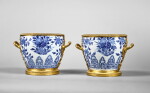
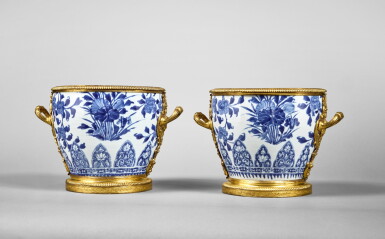
A Pair of Late Louis XIV Gilt-Bronze Mounted Blue and White Porcelain Cache-Pots, the Porcelain Kangxi (1662-1722), the Mounts Circa 1715
Estimate
30,000 - 50,000 USD
Lot Details
Description
A Pair of Late Louis XIV Gilt-Bronze Mounted Blue and White Porcelain Cache-Pots, the Porcelain Kangxi (1662-1722), the Mounts Circa 1715
height 7 5/8 in.; width 11 in.; diameter 8 1/2 in.
19.5 cm; 28 cm; 21.5 cm
Probably acquired by Alfred Sommier (1835-1908) for the château de Vaux-le-Vicomte in the late 19th Century, and thence by descent to the comtes de Vogüé;
Anonymous sale, Beaussant-Lefèvre, Paris Drouot, 23 June 2006, lot 91;
Private Collection, U.S.A;
Taste of the Royal Court: Important French Furniture and Works of Art from a Private Collection, Christie's London, 9 July 2015, lot 1;
Where acquired by the present collector.
The tradition of mounting exotic porcelain imported from China and Japan dates to at least the late Middle Ages with the earliest arrival of Asian porcelain in the West, and initially porcelain was mounted in silver, silver gilt or on rare occasions gold. The development of trade routes with the foundation of the Dutch, English, Danish, Swedish and French East India Companies in the seventeenth century resulted in a significant increase in the quantity of porcelain reaching Europe’s shores and concomitant rise in appeal to wealthy collectors, many of whom had pieces mounted in silver and silver-gilt as a reflection of the status in which Asian works of art were held, described by the contemporary historian André Félibien as l’engouement pour la Chine. Following the various sumptuary laws introduced by Louis XIV to finance his military activities that led to much of the royal silver being melted down in 1688-89, artists looked to alternative materials and gilt bronze became increasingly favoured for mounting porcelain, a trend accentuated in the eighteenth century with the rise of Paris as the leading European centre for the production of luxury gilt bronze objects such as candelabra, clocks cases and chenets.
The mounts on this pair of typical of the late Louis XIV and early Régence period, and the design of pierced strapwork headed by a female mask draws inspiration from gilt bronze objects produced in the workshop of the court cabinetmaker André-Chalres Boulle, for example a set of four wall lights supplied in c. 1715 to the Duchess de Berry at the château de La Muette (Paris, Musée du Louvre [OA 18515]; one illustrated Jean-Nérée Ronfort, André-Charles Boulle, 1642-1732, Ein neuer Stil Für Europa, Frankfurt 2009, p. 80). Almost identical mounts and handles headed by double scrolls rather than a shell are found on a pair of Chinese blue and white porcelain cache-pots formerly in the Paris trade and illustrated in Pierre Kjellberg, Objets montés du Moyen âge à nos jours, Paris 2000, p.35, and rleated mounts also appear on a pair of Chinese famille verte lidded vases in the Getty Museum, Los Angeles (72.DI.50) and a pair of blue and white cache-pots from the Ogden Nash collection sold Christie's London, 13 November 2019, lot 7.
This pair was formerly in the collections of the Comtes de Vogüé at the Château de Vaux-le-Vicomte south of Paris. One of the greatest masterpieces of French architecture, Vaux-le-Vicomte was built between 1658 and 1661 for Louis XIV's Intendant of Finances Nicolas Fouquet by the architect Louis Le Veau, with interiors decorated by the painter Charles Le Brun and gardens designed by André Le Nôtre. Fouquet's residence was of a hitherto unprecedented splendour and used by its owner as a venue for lavish entertaining, to such an extent that the King felt his position threatened and had Fouquet arrested and imprisoned, and confiscated his property. Vaux-le-Vicomte did however serve as an inspiration for the building of Versailles, and Louis XIV employed the same creative team of Le Veau, Le Brun and Le Nôtre. The château passed through multiple owners over the next two centuries and was in a state of neglect when acquired by the sugar magnate Alfred Sommier (1835-1908) in 1875, who undertook a large-scale campaign ofrestoration of the building and refurbishment of the interiors, completed by his son Edme (1873-1945). Alfred Sommier's daughter Lucie (1874-1946) had married Comte Robert de Vogüé in 1897, and after World War II ownership of the château passed to their descendants.
You May Also Like