A Directoire Gilt Bronze, Enamel and White Marble Skeleton Clock, The Enamel Dated 1796
Estimate
30,000 - 50,000 USD
Lot Details
Description
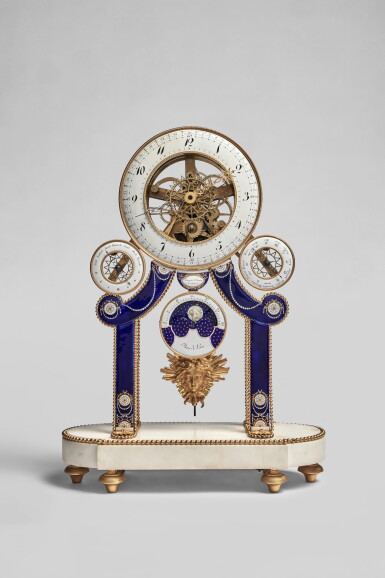
A Directoire Gilt Bronze, Enamel and White Marble Skeleton Clock, The Enamel Dated 1796
the 8.25 inch annular enamel dial with Arabic numerals and well pierced gilt-brass time hands and pierced blued-steel calendar hand, flanked by subsidiary dials for month and day of the week with symbols; a further dial below inscribed Phase de Lune indicating moon phase and lunar date, with an enamel plaque above signed Prosper Simon A PARIS; the movement visible through the centre of the principal dial with skeletonised plates and barrel cover, five-spoke train wheels, back mounted pin wheel escapement with beat adjustment on the crutch; the finely cast and chased sunburst mask pendulum pendant from a knife edge with fine regulation screw mounted above the suspension; the reverse to the annular dial signed Coteau 1796; the whole supported on a gilt-brass frame with beaded border and applied at the front with dark blue enamel panels embellished with gilt, white and silvered decoration, raised on a break-front white marble plinth with bowed sides on bronze toupie feet; previously with a cresting element, feet probably later
height 21 in.; width 16 in.; depth 7 in.
53 cm; 40.5 cm; 18 cm
Sotheby's London, 28 June 2002, lot 91;
Galerie Steinitz, Paris;
Le Goût Steinitz, I, Christie's New York, 19 October 2007, lot 86;
Where acquired by the present collector.
Skeleton clocks became fashionable in the late eighteenth century and were designed to both exhibit the technical prowess of clock mechanisms and exploit their aesthetic potential; they were frequently mounted on white marble and gilt bronze bases applied with richly decorated enamel plaques. The maker of this clock appears to be unrecorded, but the enameller of the dials was one of the most accomplished European artists in this medium during the last quarter of the eighteenth century. Born in Switzerland, Joseph Coteau (1740-1801) appears to have trained in Geneva and became a maître peintre-émailleur in that city's Académie de Saint Luc in 1766. Shortly thereafter he relocated to Paris, where he is recorded in the Rue Poupée in the Saint-André-des-Arts district from 1772 and later was received master in the Parisian guild of enamel specialists. Coteau quickly gained a reputation for his exquisite 'jewel' technique of raised beaded, lozenge or cabochon decoration and produced dials for the leading Parisian clockmakers as well as working on prestigious and royal commissions for the Sèvres porcelain factory.
A similar pendule squelette by the maker Bruel utilising an identical sunburst mask pendulum is in the Musée Carnavalet, Paris (inv. no. MB627), illustrated in Tardy, La Pendule française dans le monde (Paris 1994), plate XLIII p.207, and two further comparable examples also with the same pendulum by the clockmakers Bourret and Bruel respectively are recorded in Tardy, p. 84 and Pierre Kjellberg, La Pendule française (Paris 1997) p.319 fig. C.
You May Also Like