A Louis XIV Carved and Giltwood Frame, Circa 1700
Estimate
150,000 - 250,000 USD
Lot Details
Description
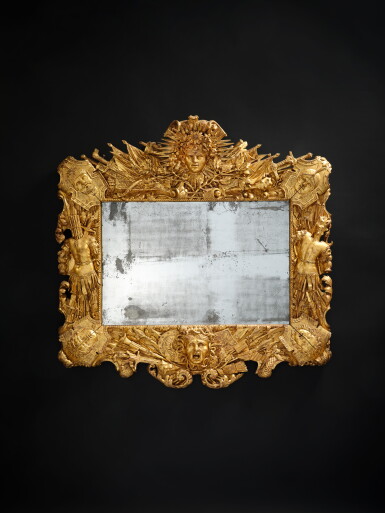
A Louis XIV Carved and Giltwood Frame, Circa 1700
now with an associated bevelled mirror plate; the crest with a central Apollo mask and the apron centered by the head of Medusa with military trophies; the sides centered by trophies of arms and armour and the corners mounted with shields decorated with busts of Roman centurions above and masks of Hercules and a Hirsute figure below; the reverse with a two fragmentary printed paper labels EXPOSITION INTERNATIONALE DU CADRE DU XV E AU XXESIECLE (AVRIL 1931) N. 137 GALERIE GEORGES PETIT, PARIS and Transports Manutention d'Objets d'Art Garde Meuble Déménagements Expéditions Maritimes Assurances PUSEY 23 25 27 Rue des Petites Ecuries PARIS TEL. PRO. 35-21 35-22 35-50
height 46 in.; width 48 in.; depth 6 ½ in.
117 cm; 122 cm; 16.5 cm
Marie-Cécile von Springer (1886-1978), wife of Baron Eugène Fould (1876-1929), 54 avenue d'Iéna, Paris, from at
least 1931;
By descent to Baron Max Fould-Springer (1906-1999);
Christie's Paris, 11 March 2003, lot 234, where acquired by Djahanguir Riahi (1914-2014), Paris;
Djahanguir Riahi Collection, sold Christie's London, 6 December 2012, lot 8;
Where acquired by the present collector.
Paris, Galerie Georges Petit, Exposition Internationale du Cadre du XVe au XXe siecle, April 1931, no. 137
Serge Roche, Cadres Français et Etrangers, du XVe au XVIIle siècle, Paris 1931, pl. 13 (property of Madame la Baronne Fould-Springer)
One of the finest surviving late 17th-century examples of its type, this extraordinary frame is a tour de force of French virtuoso woodcarving. The dynamic classical, antique and mythological elements are typical of the ornamental repertory of the reign of Louis XIV and correspond to motifs found in some of the most important building projects of the era, such as the Galerie d'Apollon and Grande Galerie of the Louvre and the newly built château de Versailles.
The composition is centered above and below by magisterially executed masks backed by military trophies. The mask above represents a deity with sunburst rays and sunflower crown, most likely Apollo, after whom Louis XIV styled himself as the Sun King, though it has also been suggested the mask may represent the Greek hero Perseus based on the presence of the Gorgon head on the lower section. This powerful icon of a Medusa head resonated strongly with French baroque artists and was used frequently by architects and sculptors, appearing for example in the bronze medallion of Medusa that adorned the front doors of the old Paris Hôtel de Ville by Henri Perlan, c.1653 (Paris, Musée Carnavalet, S3039). The frame's corners are decorated with ancient shields bearing busts of warriors above, what appears to be a bust of Hercules at the lower left, and a hirsute mask at the right, possibly the god of wind Boreas. The flanking sides incorporate ancient armour, based on the Greek and Roman tropaion tradition of displaying the armour of a defeated enemy on a pike as a monumental trophy and often used by as a decorative subject by sculptors of Antiquity, depicted for example on Trajan's Column in Rome or on life-size scale such as the magnificent marble torso in the current sale (lot 8). The motif was resurrected during the Italian Renaissance and incorporated by Northern artists on frames for portraits of military leaders, like Ferdinand Bol's 1667 painting of the Dutch naval hero Michiel de Ruyter (The Hague, Mauritshuis). The horizontal format of the offered frame, along with the presence of the mythological masks, suggest it was more likely intended for a history painting rather than a portrait, probably a battle scene from Antiquity.
Ornamental subjects derived from Antiquity were disseminated widely during the Louis XIV period through the engravings of architects and designers like Jean Marot (1619-1679), his son Daniel (1661-1752), Jean Bérain (1640-1711) and especially the prolific Jean Le Pautre (1618-1682). Military trophies, shields and masks of classical deities and Medusa recur frequently in his output, as in his Trophées d'Armes Antiques et modernes and Trophées d'armes à la romaine published by Mariette [fig.1]. These elements were used widely in the wall decoration of the state apartments at Versailles, particularly in the both the Salon de la Paix and the Salon de la Guerre flanking the Hall of Mirrors, where large military trophies of arms and armour were executed in gilt bronze after models by the sculptors François Lespingola (1644-1705) and Jacques Buirette (1631-1699). It is entirely plausible that the present frame was designed and carved by one of the army of sculptors and artisans employed by the Bâtiments du roi, the official Crown agency responsible for building and embellishing the interiors and gardens of the royal residences. An elaborate giltwood frame of slightly later date and similarly carved with military trophies by Jean Le Pautre's nephew, the sculptor Pierre Lepautre (1659-1744), was supplied for a portrait of Louis XIV by Hyacinth Rigaud offered by the monarch to the Duc de Vendôme, now at the Château de Chenonceau.
The early history of this lot is unknown prior to its inclusion in an exhibition of frames organised at the Galerie Georges Petit, Paris in 1931 by the artist, furniture designer and dealer Serge Roche (1898-1988), to accompany his book on frames which identifies the work as from the collection of the Baronne Fould-Springer. Born in Vienna, Marie-Cécile (Mitzi) von Springer was the daughter of the Austrian industrialist Baron Gustav von Springer and married Eugène Charles Joachim Fould (1876 - 1929) of the French Fould banking family, who was ennobled by the Habsburg Emperor Franz-Joseph as a baron in 1908. She maintained residences in the Avenue d'Iéna in Paris and the Palais Abbatial de Royaumont, a former bishop's residence constructed in the late 18th century on the grounds of the 13th-century Cistercian abbey of Royaumont near Chantilly, acquired in 1923 and filled with an important collection of fine and decorative arts. The frame passed by descent to Marie-Cécile's only son Max Fould-Springer and was subsequently acquired by the Franco-Iranian businessman Djahanguir Riahi, who assembled one of the greatest collections of 17th and 18th-century French Furniture of the late 20th Century, including important works by the Louis XV cabinetmaker Bernard II Van Risamburgh in Japanese lacquer made for Madame de Pompadour; royal commodes by Jean-Pierre Latz and Roger Vandercruse supplied to the Dauphine Marie-Josèphe de Saxe at Choisy and the Comtesse de Provence at Fontainebleau, respectively; and a distinguished group of tables and torchères by Louis XIV's Premier ébéniste du Roi André-Charles Boulle.
You May Also Like