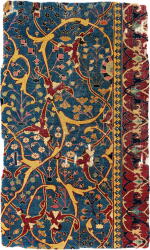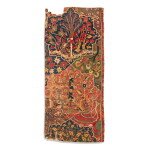
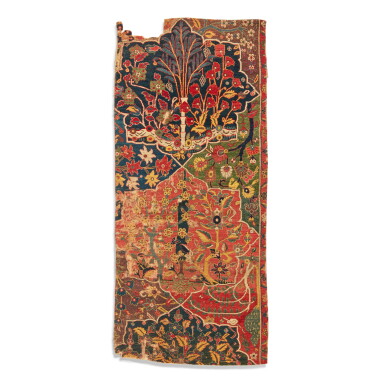
A Fragment from the Von Hirsch Garden Carpet, Northwest Persia, 17th century
Estimate
200,000 - 300,000 USD
Lot Details
Description
A Fragment from the Von Hirsch Garden Carpet, Northwest Persia, 17th century
approximately 7ft. by 3ft. 2in.
213 by 95 cm
Robert von Hirsch (1883-1977), Germany and Switzerland;
The Robert Von Hirsch Collection, Volume Three, Furniture & Porcelain, Sotheby's Parke Bernet, London, 23 and 27 June 1978, lot 501 (part);
With Alan Marcuson, by 1979;
Lefevre & Partners, London, 27 April 1979, lot 16;
Christopher Alexander (1936-2022), Berkeley, before 1993;
The Christopher Alexander Collection, Christie's, London, 15 October 1998, lot 216;
Sir Howard Hodgkin CH CBE (1932-2017), London;
Howard Hodgkin, Portrait of the Artist, Sotheby's, London, 24 October 2017, lot 241;
Where acquired by the present collector.
San Francisco, M. H. de Young Museum, The Christopher Alexander Collection, November 1990 - February 1991.
HALI, vol. II, no. 1, Spring 1979, advertising p. 66;
"With hindsight: 1978 - 1988", HALI, no. 42, November-December 1988, reproduced p. 89;
C. Alexander, A Foreshadowing of 21st Century Art, the Color and Geometry of Very Early Turkish Carpets, New York and Oxford, 1993, pp. 280-282, reproduced p. 281;
"Auction Price Guide", HALI, no. 102, January 1999, pp. 125-126;
D. Shaffer, "Season of mists", HALI, no. 193, 2017, pp. 122-125, reproduced fig. 3;
"Auction Price Guide", HALI, no. 194, 2017, p. 143.
Since its sale at Sotheby’s Parke Bernet & Co, 23 & 27 June 1978, lot 501, the von Hirsch garden carpet fragment has captured the imagination of carpet scholars and long been pursued by leading collectors. Robert von Hirsch (1883-1977) was a German-born Swiss leather manufacturer and patron of the arts. Von Hirsch first began collecting in 1907 when he was just 24 years old; significantly expanding his collection from 1920-1933, under the guidance of the director of Frankfurt’s Städel Museum, Georg Swarzenski. In its nascent stages, the collection focused primarily on impressionism and modern art, yet von Hirsch turned to works by the Old Masters, such as Dürer, Raphael, Rubens and Rembrandt, as well as important furniture, carpets and tapestries, as the collection developed in the 1920s. Von Hirsch’s Frankfurt residence in Bockenheimer Landstrasse was a hub for art admirers until he emigrated to Basel in 1933.
Von Hirsch bequeathed several works to institutions, but he decreed that the vast majority of his collection be sold, apparently having enjoyed the struggle of assembling such a prominent collection, he wanted to see it repeated after his death, stating “I want people to love and fight for my things just the way I did.” ("The Sale of the Century", TIME, 3 July 1978, and R. W. Apple Jr., "Von Hirsch Sale Sets Records", The New York Times, 21 June 1978). Thus, in 1978, a landmark sale of von Hirsch’s collection was held at Sotheby’s Parke Bernet & Co., drawing in visitors that ranged from royalty, the Queen Mother and Princess Margaret, to Hollywood actors, such as Jack Nicholson, alongside dealers, museum directors, and collectors globally ("The Sale of the Century", TIME, 3 July 1978).
This important fragment was part of lot 501 in the 1978 sale. At that time, it comprised 4 fragments joined vertically through the middle. Following this sale, however, it was split into quarters and thereafter dispersed between collectors. Configured correctly, these four fragments would have formed almost the complete length of the right-hand edge of the field of a larger Garden carpet. In this arrangement, ten near-complete star lozenges and the two half lozenges, follow a harmonious design and color pattern which is somewhat lost in the 1978 configuration. Assuming, therefore, that there were approximately twelve cartouches vertically, and a minimum of four cartouches horizontally, coupled with a large border necessary for such a vast field design, we can estimate the original carpet would have measured a majestic 1200 by 800cm or 39ft. 7in., 26ft. 3in.
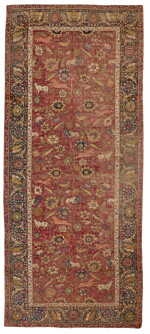
These four fragments remain the only examples thus far recorded of this magnificent and enigmatic carpet. In their discussion on the von Hirsch carpet, Eskenazi and Franses liken it to the Jaipur Garden Carpet in the Albert Hall Museum, Jaipur, (acc. no. add/P/681/2225, J. Eskenazi and M. Franses, Il tappeto orientale dal XV al XVIII secolo, London, 1982, pp.43-4). The Jaipur Garden Carpet is woven in the ‘Vase’ technique and is thus attributed to Kirman, before 1632 when it was acquired by Raja Jai Singh I of Amber. It is considered the earliest and most refined prototype for Persian garden carpets (chahar bagh), woven with a series of garden plots enclosing an assortment of trees, flowers, birds and animals around water panels and small pools. It is distinguished by its exuberant coloring and distinct organic and curvilinear tress and flora, as opposed to the linear architectural design more commonly associated with Persian ‘Garden’ carpets. Although it differs from the Jaipur carpet structurally, the von Hirsch carpet shares the organic, animated drawing of the foliage, here arranged into star and cross cartouches. The carpets would furthermore have been of comparably large scale. Despite lacking its main border, the Jaipur carpet measures approximately 866 by 366cm; 28ft. 4in., 12ft. 4in. Eskenazi and Franses also compare the von Hirsch carpet to the Schwarzenberg medallion and animal carpet, early 16th century, illustrated in M. Eiland, ‘Rethinking Kerman A New Look at Some Safavid Carpets’, HALI, issue 100, 1998, p.99, pl.2. Again, the carpets differ structurally but share similarly drawn trees and foliage.
The von Hirsch fragments have deservedly long been pursued by distinguished collectors and are now divided between renowned public and private collections. The lower left quarter is in the Keir Collection, London, currently on loan to the Dallas Museum of Art (F. Spuhler, Islamic art in the Keir Collection, Rugby, 1988, pp.78-80, ill. T28). The upper left, formerly in the collection of the carpet expert Louise Woodhead Feuerstein, was sold at Sotheby’s New York, 31 January 2014, lot 92, where it entered a prominent museum collection (J. Glass, ‘Marketplace: Positive and Lively’ HALI, issue 179, 2014, p.127). The upper right corner, originally joined with the present fragment, entered the Wher Collection, Switzerland (Tapis Present de L’Orient a L’Occident, Paris, 1989, pp.154 & 155). Around 1980, the present fragment entered the collection of architect and design theorist Christopher Alexander, later to be sold in 1998 where it was acquired by Sir Howard Hodgkin CH CBE.
Each von Hirsch fragment is commanding in scale and abundant in life and color. It is therefore unsurprising that this remarkable survivor captivated and inspired its former owners. In his book A Foreshadowing of 21st Century Art, New York, 1993, pp.280-282, Alexander writes of its powerful structure and geometry, harking back to design elements of the Seljuk and Timurid period. In particular, he mentions the designs found in early tiles, such as 13th century Kashan tiles, that together form interlocking star lozenges (see MET Museum, New York, acc. no. 91.1.106). This was clearly not lost on Hodgkin who displayed this fragment opposite a Kashan star tile in his London home. For Hodgkin, whose own work is now world renowned for vividness of color, it was surely the expressive nature of the piece that caught the attention of the artist for whom the tenacity and wildness of the fragment would no doubt have been appealing. When hung in Hodgkin's dining room, it was the first thing to be seen when entering the room, displayed in prime position as one would a great painting.
Known only by four surviving fragments, the von Hirsch carpet is enigmatic, exuberant and beautiful. Though we may never know the carpet’s full story, this iconic fragment is a rare document of what was undoubtedly one of the most impressive and important carpets woven by the Safavids.
You May Also Like