The Yerkes-Remarque Mughal Hunting Carpet, India, first half 17th century
Estimate
250,000 - 350,000 USD
Lot Details
Description
The Yerkes-Remarque Mughal Hunting Carpet, India, first half 17th century
approximately 15ft. 6in. by 6ft. 7in.
473 by 200 cm
By repute, Stefano Bardini (1836-1922), Florence;
Charles T. Yerkes (1837-1905), New York;
American Art Association, New York, The Charles T. Yerkes Collection: Rare Oriental Rugs and Fine Old Tapestries, 8 April 1910, lot 207;
Duveen Brothers, London and New York;
Erich Maria Remarque (1898-1970), Ascona;
Thence by inheritance to his wife, Paulette Goddard (1910-1990), Ascona;
Sotheby’s, London, 18 November 1976, lot 10;
Wher collection, Switzerland;
The Textile Gallery, London, by 1984;
The Thyssen-Bornemisza Collection, Lugano, by 1986;
Sotheby's, London, 3 July 2013, lot 23;
Where acquired by the present collector.
Zurich, Kunstegewerbe-museum, Ausstellung iranischer Kunst. Elamitischer und persischer Kulturkreis, 10 May 1936 - 19 July 1936;
London, Park Lane, The Grosvenor House Antiques Fair, Stand No. 61, 18-26 June 1984.
J. K. Mumford, The Yerkes Collection of Oriental Carpets, London, 1910, reproduced pl. IX;
HALI, vol. VI, no. 2, 1984, pp. 72-73;
F. Spuhler, The Thyssen-Bornemisza Collection: Carpets and Textiles, trans. by M. Schlatter, P. Wilson, London, 1998, p. 178, reproduced pl 46;
T. J. Farnham, "The Yerkes Collection", HALI, Issue 101, November 1998, pp. 75-87, reproduced fig. 4;
"Auction Price Guide", HALI, issue 177, reproduced p. 130.
When Spuhler published this carpet as part of the Thyssen-Bornemisza Collection, empowered by its long register of illustrious provenance, he supposed that it was once part of the great carpet collection of the Maharaja of Jaipur. Though there is no documentary evidence of this, the source of the design and its execution here clearly indicate court patronage.
During the reign of the Mughal emperor Akbar (r.1556-1605), carpet production was essentially a court undertaking, and the quality, size, design and value of the Mughal carpet was dependent on the tastes and demands of the court. The Indian ‘animal’ compositions are often chasing and fighting animals, without medallions or spandrels, and are woven in wool, with cotton warps and wefts. They were inspired by the Persian, ‘Paradise’ and ‘Hunting’ carpets, as well as woven textiles. Celebrated examples include ‘The Emperor’s Carpets’ (MET Museum, New York, acc. no.4.3.121.1 and Museum of Applied Arts, Vienna, inv. no. T 8334).
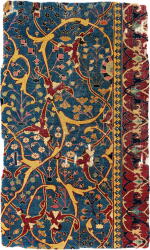
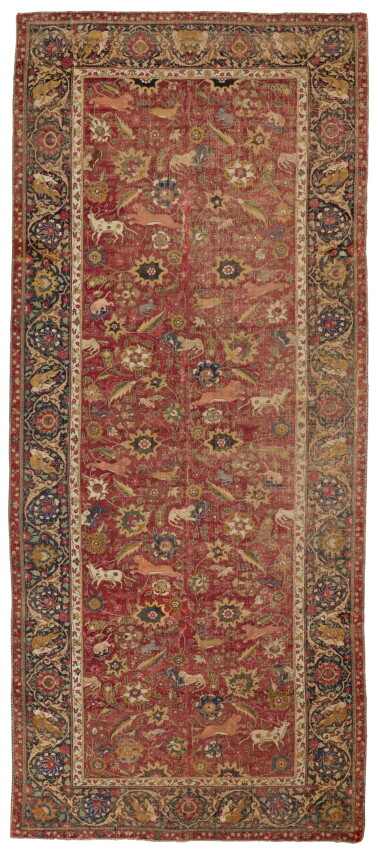
The design of the 'Yerkes-Remarque' Mughal hunting carpet is simple but beautifully executed. The field itself is divided into four, almost identical, blocks of design. The main field, dominated by the wine red ground, is then enclosed by an ivory inner border, which picks up and accents the white of the animals. Defined by the intensity of its dark blue ground the main border serves to echo the deep blue of the central palmettes. As if to complete and unify the overall design the outer border is composed of a thin strip of wine red.
Within the main field we find varied palmette and rosette blossoms linked through elongated lancet leaves together with the distinct Mughal Indian leaf forms, made up of a cornucopia of blossoms. Scattered amongst these large ornate flowers, filled with deep blues and framed by flame outlines, are detailed animal combat scenes. In one instance a powerful tiger, poised mid-air, is ready to pounce upon an unsuspecting white zebu bull. In a scene just above, a pink spotted leopard bites hungrily into the rewards of his chase, an exhausted blue deer. The orientation of each block alternates from left to right such that the animals in chase appear to spiral their way through the field.
The Yerkes-Remarque carpet is set apart by its particularly intricate main border that has been executed with exceptional care. Yellow vines, covered with forked leaves, unfurl in an S-shape creating a distinctive and fluid pattern. In the gaps between the scrolling vines we flip alternately from highly ornate and boldly colored palmettes to lions feasting upon fawns. In this case the lions are detailed with light blue ‘flames’ and clawing outstretched paws. The undulating vines loop beautifully at the corners, propelling and maintaining this sense of fluidity and movement. Spuhler notes that ‘such accomplished corner solutions tend to indicate court design workshops’ (F. Spuhler, The Thyssen-Bornemisza Collection: Carpets and Textiles, trans. M. Schlatter, P. Wilson, London, 1998, p.181, pl.46).
The long, narrow format of this carpet is typical of Mughal and Safavid Persian court carpets of the period; in the west, contemporary collectors of these precious carpets often displayed them on refectory tables. An example is the 'Fremlin' carpet, now in the Victoria and Albert Museum, which was made for William Fremlin, a servant of the East India Company between 1626 and 1644, probably as a table carpet; it was most likely made for him in Lahore after 1637, when he became President of the Council of Surat. The family coat-of-arms appears in both the main field and the border (illustrated in S.B. Sherrill, Carpets and Rugs of Europe and America, Abbeville Press, New York, 1996, pl.159). As in the lot offered here, it displays scenes of the chase on a wine red ground, although the motifs are sparser and it does not have the dynamic energy of the present lot; it does however, allow us to securely date this example to no later than the first half of the 17th century.
The provenance of this carpet is a roster of some of the most prominent collectors and dealers in the field of classical carpets from the 19th century to the present day. According to the provenance listed by Thomas Farnham (T.J. Farnham, The Yerkes Collection, HALI, issue 101, November 1998, pp.75-87 and 112-114, footnote 32), connoisseur and dealer Stefano Bardini (1836-1922), Florence, sold this carpet to Charles T. Yerkes, an American financier who acquired his own banking house at the age of twenty-two, soon accumulating vast wealth. His unscrupulous business practices, which led to a short period of incarceration, and his reputation for womanizing resulted in his exclusion from American polite society. Yerkes therefore opted to spend summers in Europe. Here, he began to collect important paintings and tapestries but was displeased to see that his collection was inferior to those of other American connoisseurs. He quickly identified a gap in the connoisseurship of his counterparts, that of classical carpets, and between 1892 and 1903 Yerkes developed an interest in the field.
Fueled by his competitive streak and empowered by the guidance of prominent dealers such as Stefano Bardini and Vincent Robinson, who were building the great European museum collections at that time, Yerkes would go on to acquire “the finest collection of Persian carpets owned by an individual in modern times” (A. Upham Pope, Catalogue of a Loan Exhibition of Early Oriental Carpets, exhibition catalogue, Chicago, 1926, p.120). Michael Franses even suggests that he was “possibly the first important collector of historical oriental carpets after Cardinal Wolsey, King Henry VIII and the Habsburgs” (Franses quoted in Farnham, op. cit., p.75. Farnham's article provides a full biography of the collector and the highlights of his collection; the present carpet is reproduced on p.76, no.4). The sale of the Yerkes Collection upon his death bought huge publicity and, due to the scandal attached to his name, stirred unprecedented curiosity. It is Yerkes who is credited for whetting the appetite of American collectors and elevating their taste through the finesse of his carpet collection.
The Duveen Brothers acquired this carpet in the 1910 sale and subsequently sold it to Erich Maria Remarque (1898-1970), author of All Quiet on the Western Front. It remained in this collection for many years and was later inherited by his wife Paulette Goddard, leading American actress of the Golden Age of Hollywood. It later entered the Wher Collection, Switzerland, and latterly the Thyssen-Bornemisza collection, Lugano, via the Textile Gallery, London, by 1986.
During his lifetime, Heinrich, Baron Thyssen-Bornemisza de Kászon (1875-1947) amassed hundreds of artworks into one of the finest collections of the 20th century. His dedication to classical carpets ensured that hugely iconic weavings entered the family's collection, including the famous Béhague-Sanguszko carpet. Europe's illustrious rug collectors, such as Wilhelm von Bode and Kurt Erdmann, sold their best pieces to the Baron, allowing him to obtain some of the most important classical carpet weavings known and attainable at the time.
When Heinrich Thyssen-Bornemisza died, the large collection was divided up among his heirs. Eventually, the new head of the family, Hans-Heinrich Thyssen-Bornemisza (1921-2002), bought back works from other heirs and recreated the collection. In his role as head of the family Hans-Heinrich Thyssen-Bornemisza not only inherited a vast business empire in naval construction and oil but also a love and appreciation of oriental carpets. Continuing in his father’s footsteps Hans-Heinrich Thyssen-Bornemisza, together with his wife Baroness Carmen, enriched the family collection with exquisite rugs, carpets and textiles, including classical Chinese carpets from the late 17th and early 18th centuries. Highly prized by both Baron Heinrich and his son, Hans Heinrich, these carpets, rather than being shown in the public gallery in the Villa Favorita in Lugano, were enjoyed in their private homes. By the late 20th century the Thyssen-Bornemisza Collection had become one of the world's most important depositories of classical carpets. The Thyssen-Bornemisza Collection of carpets was first published in 1972 by May Beattie, and updated in 1998 by Friedrich Spuhler, op.cit. The lot offered here appears as Plate 46 in this cited publication.
You May Also Like