A 'Portuguese' Carpet Fragment, Khurasan, Northeast Persia, first half 17th Century
Estimate
80,000 - 120,000 USD
Lot Details
Description
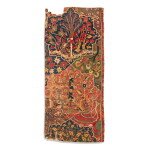
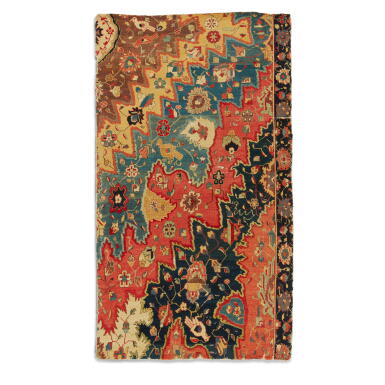
A 'Portuguese' Carpet Fragment, Khurasan, Northeast Persia, first half 17th Century
approximately 6ft. 9in. by 3ft. 10in.
206 by 118 cm
Sir Howard Hodgkin CH CBE (1932-2017), London;
Howard Hodgkin, Portrait of the Artist, Sotheby's, London, 24 October 2017, lot 174;
Where acquired by the present collector.
D. Shaffer, "Season of mists", HALI, no. 193, 2017, pp. 122-125, reproduced fig. 2;
"Auction Price Guide", HALI, no. 194, 2017, reproduced p. 144.
The dynamic layering of color preserved here is a distinct feature of so-called ‘Portuguese’ carpets. This rare group, known by approximately a dozen carpets, are drawn with striking flaming layers with a wonderful range of strongly contrasting colors that surround a central medallion with four mirrored palmettes. A space in each corner of the field is occupied by a pictorial scene comprising small sailing ships with figures clad in European clothing, alongside a figure in the water, often surrounded by fish, whales or dragon heads (see MET Museum, New York, acc. no.44.63.6).
The group’s moniker derives from these figures who are thought to be Portuguese sailors but the iconography of the pictorial scenes has not yet been fully resolved. These scenes have given rise to diverse speculation around the group’s origin, with various centers in India and Persia offered as potential sources (S. Cohen, “Safavid and Mughal Carpets in the Gulbenkian Museum, Lisbon” in HALI, issue 114, pp.75-77). The attribution of these carpets is now generally agreed to be Khurasan, Northeast Persia, primarily based on structural features such as the use of four-ply warps typical of Persian production and the significant presence of jufti knotting, a feature only exceptionally seen in Indian carpets and a distinctive hallmark of Khurasan weaving.
In 1972, Charles Grant Ellis wrote a comprehensive account of this small group of carpets and divides them into three sub-groups. Our fragment would form part of Group I, considered to have the finest weaving and most complete set of iconography (C.G. Ellis, “The Portuguese Carpets of Gujarat", in R. Ettinghausen (ed.), Islamic Art in the Metropolitan Musuem of Art, New York, 1972, pp.267-289, pp.268-270, and Cohen, op.cit., p.75). They are fantastical in composition with birds within the medallions, and large leaf forms that unfurl between the serrated layers. Such carpets were woven with two ships in the marine scenes and are the most elaborate type. Examples of Group I ‘Portuguese’ Khurasan carpets include: Museum für Angewandte Kunst (Museum of Applied Arts), Vienna (inv. no.T 8339/1922 KB); Musée des Tissus de Lyon (acc. MT 25.095); Sotheby’s, Monaco, 25 June 1979, lot 98, now in private Swiss collection; and Schloss Museum, Berlin, (inv. no.KGM 87.974, though lost during the Second World War), (Ellis 1972, pp.268-273, figs. 2, 4, 5, and 7).
Group II is distinguished by their smaller size and regular drawing with more linear medallions enclosing only floral stems without birds. For examples of this group, see Gulbenkian Foundation, Lisbon (acc. no.GML, T.99); MET Museum, New York (acc. no.44.63.6; Francis du Pont Winterthur Museum, Delaware (inv. no.59.914). The final group, Group III, presents a transitional design somewhere between the two, see the Rijksmuseum, Amsterdam (inv. no.17272), and a carpet in the collection of Lord Sackville, Knole Park, Kent (Ellis, op.cit., p.277, fig.11.
The present fragment preserves a quadrant of the field terminating in the upper left corner with a partial palmette that was originally part of the central composition of the larger carpet. The remarkable preservation of the pile documents weavers that celebrated color and used it masterfully. The use of ton-sur-ton is particularly successful here in the red, mid-blue and brown layers which are framed by a narrow strip in a lighter or darker shade that subtly adds depth to the drawing. The yellow layer is animated by a striking flame-like orange, while the midnight-blue is highlighted by gentle light green.
The depth between the serrated layers is emphasized by two ochre and ivory leaves that peek through blue and red layers to gently frame a bird that perches between the two. This furthermore underscores the abundance of the minor blossoms and birds which give life to each layer and are a hallmark of the most complex group of ‘Portuguese’ Khurasan carpets.
You May Also Like