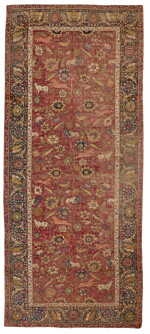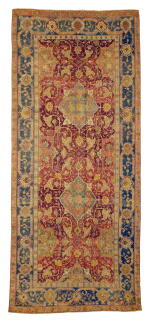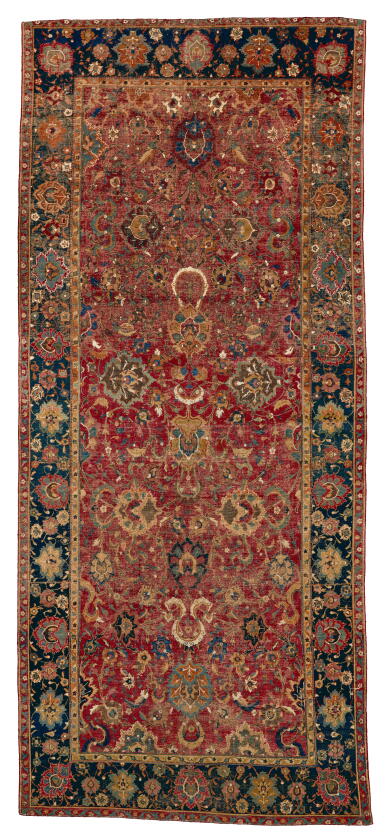
A Safavid Isfahan Carpet, Central Persia, early 17th century
Estimate
300,000 - 500,000 USD
Lot Details
Description
A Safavid Isfahan Carpet, Central Persia, early 17th century
some cotton whites
approximately 13ft. 8in. by 5ft. 10in.
417 by 179 cm
William A. Clark (1839-1925), New York and Montana;
Bequeathed to the Corcoran Gallery of Art, Washington D.C.;
Important Carpets from the William A. Clark Collection, Corcoran Gallery of Art, Sotheby's, New York, 5 June 2013, lot 5;
Where acquired by the present collector.
Washington D.C., Arthur M. Sackler Gallery, The World at our Feet. A Selection of Carpets from the Corcoran Gallery of Art, 4 April 2003 - 6 July 2003;
Washington, D.C., Corcoran Gallery of Art, Masterpieces: European Arts from the Collection, 25 August 2007 - 15 April 2008.
The Corcoran Gallery of Art. Illustrated Handbook of The W. A. Clark Collection, The Corcoran Gallery of Art. Washington, D.C., 1928, p. 73;
"Carpets for the Great Shah: The Near-Eastern Carpets from the W. A. Clark Collection," The Corcoran Gallery of Art Bulletin, Washington, D.C., vol. II, no. 1, October 1948, p. 13, no. P 8, unillustrated;
'Auction Price Guide', HALI, issue 177, 2013, reproduced p. 129.
An Iconic Safavid Design: Three Carpets from the Clark-Corcoran Collection (Lots 54-57)
Margaret Squires, PhD
The carpets offered here from the prestigious Clark-Corcoran Collection are three variations on an iconic Safavid design. Their bold patterns of flowers, both naturalistic and fantastical, cloud bands, and scrolling vines rendered in rich hues of red, green, blue, and orange, proved so effective that this type not only furnished important Safavid spaces but proliferated to elite contexts across Asia, Europe, and eventually North America. The various names for these carpets in scholarship reflect this plurality of associations: they have been called ‘Isfahan’, ‘Herat’, ‘Indo-Persian’, ‘in-and-out palmette’, and ‘vine scroll’ carpets, among others. In all likelihood, the type was produced across multiple weaving centers over a long period, from the late sixteenth century to the end of the seventeenth.
Historical context
The idea for carpets with this color palette and design likely evolved from the magnificent garden and animal carpets woven in court workshops during the earlier part of the sixteenth century. The fantastical inhabited garden of The Emperor’s Carpet, now in the Metropolitan Museum of Art (acc. no.43.121.1), is reimagined here with the animals omitted and the floral, vegetal, and cloud-band motifs magnified and emboldened. The result is a carpet design that is infinitely repeatable and thus adaptable to many shapes and sizes, appropriate for both religious and secular uses, and, with the figural scenes of Persian courtly pursuits and literary vignettes removed, malleable to any cultural context. This final point was probably a deliberate move on the part of carpet weavers and designers around the time of Shah ‘Abbas I, as carpets became increasingly viable as an export good with the facilitation of European trading companies in the seventeenth century.
One vine scroll carpet, likely a royal commission, survives in a Safavid-era Iranian collection: a spectacular example preserved in the Shrine of Imam Reza, Mashhad, Iran.1 This carpet has a red- and blue-dominated color palette, an ‘in-and-out palmette’ border, and a central field design of large lotus-palmettes set against a background of scrolling vines, leaves, and cloud-bands, all features shared with the three carpets presented here. Its main distinction from this trio is the use of silk for its warp and the resulting finer weave, evidence of its production in a court workshop. The Mashhad example is said to have been a gift from Shah ‘Abbas to the shrine around the year 1600.
The majority of vine scroll carpets, however, were produced for a wider commercial market—the three offered here represent the upper echelon of that group. These carpets were eagerly sought across Europe and Asia, bound for palaces, stately homes, and religious and ceremonial spaces. In Europe, there is particularly strong evidence for their high regard in Portugal and the Netherlands, two hubs of maritime trade where Safavid carpets came to represent wealth and cosmopolitan sophistication. Jessica Hallett’s scholarship on the Portuguese contexts of Safavid carpets highlights the primacy of vine scroll carpets amongst Portugal’s elite in the seventeenth century.2 Their prevalence in northern Europe is attested by numerous depictions of vine scroll carpets in Netherlandish paintings from the same period.3 A portrait by Peter Paul Rubens (1577–1640) of Aletheia Talbot, Countess of Arundel, painted in 1620 (fig.1) displays a carpet strikingly similar in color palette and design to lot 54 in the present sale.4
Outside the European context, vine scroll carpets were also exported to the Mughal and Deccani realms. One of the largest assemblages of vine scroll carpets survived in the collection of the Maharaja of Jaipur, acquired in the seventeenth century and now divided among several museums in Jaipur, Ahmadabad, Varanasi, and numerous foreign collections.5 The carpets once furnished the palace complex at Amber Fort, the seat of power of the Rajput maharajas. Though the collection has never been published in full, a draft catalogue with technical data and photographs is in the May Beattie Archive at the Ashmolean Museum, University of Oxford. Several bear close visual and technical relationships to the carpets offered here. Another small collection of vine scroll carpets is in Bijapur, the historical capital of the Adil Shahi dynasty, one of the Shi’a Deccani sultanates in the early modern period.6
Techniques and workshop practices
Vine scroll carpets are typically woven with asymmetrically knotted pile in high-quality wool on a cotton foundation. Lot 54 is a notable exception to this rule in its use of cotton for some of the white areas of the pile. This is a rarity and for some may indicate an Indian, rather than Persian, origin for this carpet. The great carpet scholar and technical analyst May Hamilton Beattie examined all three carpets in Washington in 1963, remarking on the cotton pile but concluding that all three were of Persian manufacture.7
A large scientific study by Raquel Santos, Ana Claro, Blythe McCarthy, and Jessica Hallett examined the dyes used in a group of vine scroll carpets in Portuguese collections, shedding light on workshop practices and the evolution of the type.8 Testing of several hundred samples revealed complex dye recipes utilized for Iranian vine scroll carpets, combining multiple plant and insect sources to produce specific hues. Their research found that diversity and experimentation with dyes became increasingly characteristic of vine scroll carpets over the span of their production, evolving alongside the development of motifs and designs. This range of dye recipes across the wider group also confirms that these carpets came from multiple centers of production rather than one centralized court workshop in Isfahan.
The Clark-Corcoran Provenance
These three carpets come from one of the most storied American collections, that of Senator William A. Clark (1839–1925). A mining magnate, known as one of the ‘Copper Kings’, and later a banker, entrepreneur, and United States Senator for Montana, Clark amassed one of the largest fortunes in US history. Like his Gilded Age contemporaries, Clark sought to evoke the Old-World grandeur of European aristocrats by acquiring art and antiques and building a chateau-inspired mansion on Fifth Avenue. The house, dubbed “Clark’s Folly” by a skeptical press, was completed in 1911 as a setting for his growing collection.9
Clark’s taste in carpets was strongly influenced by the art dealer Vitall Benguiat, one of the key figures in the ‘Oriental carpet boom’ at the turn of the twentieth century.10 His acquisitions included a large number of important Safavid carpets as well as a few Mughal and Ottoman carpets, lesser-known at the time. Some of the larger carpets were laid on the floors of Clark’s Fifth Avenue mansion, in the manner of European aristocratic homes. Others, including several vine scroll carpets, were given the same treatment as Clark’s formidable collection of European and American paintings, hung on the walls to be admired as precious works of art (fig. 2).11
On Clark's death in 1925, his collection was bequeathed to the Corcoran Gallery of Art in Washington, DC. In 1948, the carpets, including the three offered here, went on display in an exhibition entitled 'Carpets for the Great Shah', with an accompanying catalogue.12 From then on, the carpets remained for the most part in storage, save for a small exhibition in 2003 ('The World at Our Feet: A Selection of Carpets from the Corcoran Gallery of Art') to coincide with the tenth International Conference on Oriental Carpets.13 The Corcoran Gallery ultimately deaccessioned the Clark carpets between 2009 and 2013, a move that preceded the Gallery’s closure in 2014. The record-breaking sales, which included the Clark sickle-leaf ‘vase’ carpet now in the Museum of Islamic Art, Doha, signaled a new ‘carpet boom’ one hundred years after the first.
The three carpets offered here attest to the appeal of the iconic Safavid vine scroll design—one carried from the looms of Iran to early modern palaces and shrines, Gilded Age mansions, and modern-day museums.
Margaret Squires, PhD, is the May Beattie Visiting Fellow in Carpet Studies at the Ashmolean Museum, University of Oxford.
1 Hadi Maktabi, “Mashhad Carpet Museum,” Hali 190 (2016), 56.
2 Jessica Hallett, "Carpet, Painting, and Text," in The Oriental Carpet in Portugal: Carpets and Paintings, 15th–18th Centuries, ed. Jessica Hallett and Teresa Pacheco (Lisbon: Museu Nacional de Arte Antiga, 2007).
3 See Onno Ydema, Carpets and Their Datings in Netherlandish Paintings, 1540-1700 (Woodbridge: Antique Collectors’ Club, 1991).
4 Alte Pinakothek, Munich, inv. no. 352.
5 See Daniel Walker, Flowers Underfoot: Indian Carpets of the Mughal Era (New York: The Metropolitan Museum of Art, 1997), 12–14.
6 Franz Sindermann, “Bijapur: Carpets from the Asar Mahal and the Archaeological Museum,” Ghereh 22 (1999-2000), 23–34.
7 May Beattie Archive, Ashmolean Museum, University of Oxford, GB/3673/MBA/1/1/9/28; GB/3673/MBA/1/1/9/30; GB/3673/MBA/1/1/8/39
8 Raquel Santos, Ana Claro, Blythe McCarthy, and Jessica Hallett, “Color Power: Contributions of Science and Technology to the Study of Sixteenth- and Seventeenth-Century ‘Vine-Scroll’ Carpets,” The Textile Museum Journal 47 (2020): 136–59.
9 United Press, “’Clark’s Folly’ Brings Price of $3,000,000 in Sale,” The Pittsburgh Press, 2 February 1927.
10 Daniel Shaffer, “The Copper King’s Carpets,” Hali 162 (2009), 123.
11 See Wurts Bros. (New York, NY), 77th Street and 5th Avenue. Sen Wm. A. Clark residence, faience room, looking west. Museum of the City of New York X2010.7.1.2951.
12 “Carpets for the Great Shah: The Near-Eastern Carpets from the W.A. Clark Collection,” Corcoran Gallery of Art Bulletin 2.1 (1948)
13 Michael Franses, “Classical Context,” Hali 129 (2003), 68–69.
Lot 54
In this carpet, the design is not as symmetrical as it appears at first glance. The bold palmettes along the central axis and the flanking horizontal palmettes do not mirror one other from end to end as is customary on most spiral-vine carpets. This lends a sense of vitality to the field.
The use of cotton for some of the whites here is unusual for 17th century Isfahan carpets, but not unprecedented, with a few examples being a rug sold in these rooms, 16 December 1998, lot 136; and another sold Christie's London, 17 October, 1996, lot 407. While the presence of cotton may suggest an Indian origin for these carpets, every other aspect of their design and structure is consistent with Safavid Persian weavings. As cotton remains white over time, rather than becoming ivory like wool, the cloud band and other motifs in cotton catch the eye and draw us in for a closer look.
You May Also Like