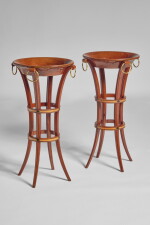
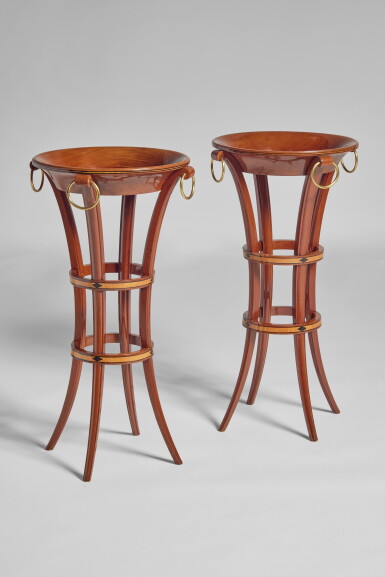
A Pair of Directoire Mahogany, Citronnier and Ebony Inlaid Athéniennes attributed to Papst, Circa 1795
Estimate
25,000 - 35,000 USD
Lot Details
Description
A Pair of Directoire Mahogany, Citronnier and Ebony Inlaid Athéniennes attributed to Papst, Circa 1795
the dished tops with moulded edges raised on four moulded scrolling legs mounted with gilt metal rings joined by two inlaid circular stretchers
height 31 ¾ in.; width 17 in.
80.5 cm; 43 cm
François Ignace Papst, maître in 1785
Osenat, Fontainebleau, Les Collections de l'Hôtel de Masseran, 29 June 2008, lot 43;
Galerie Perrin, Paris;
From whom acquired by the present collector, 4 July 2016.
An almost identical pair of athéniennes stamped by Papst was sold Koller Zurich, 19 September 2013, lot 1224. Like many of his contemporaries in the Parisian furniture trade during the final decades of the Ancien Régime, François Ignace Papst (b.1750) was of German origin. Although it is possible he may have been a supplier to the royal Garde-Meuble as early as the 1770s, he only obtained his maîtrise in 1785, and his earliest securely documented work consists almost entirely of desks, tables and commodes manufactured in the typical late Louis XVI style with highly figured mahogany veneers and elegant gilt bronze mounts. During the Revolution he was employed by the authorities to repair items of furniture seized from émigrés and condemned prisoners, and he continued to receive official commissions from the imperial and royal administrations during the Empire and Restoration, participating in the Expositions des produits de l'industrie française in 1806 and 1819.
Papst's style evolved with the evolution in taste following the Revolution, and the present lot reflects the transition to the more archeological or 'Etruscan' taste of the Directoire and Consulat periods which sought more direct inspiration in models derived from Antiquity. The form of the present lot is based on tripod perfume-burner stands excavated at Pompei and Herculaneum and depicted in ancient Roman wall paintings, and the origin of the name is traditionally held believed to come from a 1762 painting by the neoclassical artist Joseph-Marie Vien (1716-1809), La Vertueuse Athénienne (Strasbourg, Musée des Beaux-Arts) that depicts a Greek maiden making an offering into a brazier supported on a similar tripod stand. Early athéniennes were fashioned out of carved and gilt or painted wood and enjoyed a certain vogue during the first neoclassical revival of the Louis XV/XVI transitional period, but the model attained the height of popularity under the Empire, using either mahogany, the predominant timber for quality furniture at the time, or gilt bronze in direct emulation of antique examples.
Prior to its appearance at auction in 2008, this pair was in the collections of the Hôtel de Masseran, a mansion built near the Invalides in Paris in 1787 by the architect Alexandre-Théodore Brongniart for the Genoese nobleman Carlo Sebastiano Ferrero Fieschi (1760-1826), Prince Masserano, who had married a granddaughter of the celebrated financier and art collector Louis-Antoine Crozat, Baron Thiers. The house passed through numerous owners in both the nineteenth and twentieth centuries, among them the philanthropist and aesthete Comte Étienne de Beaumont (1883-1956), a patron of Picasso, Erik Satie and Jean Cocteau, who used his property to host numerous celebrated balls both prior to and following the Second World War. After de Beaumont's death the hôtel was acquired by the baron Élie de Rothschild (d. 2007) and his wife Liliane, née Fould-Springer (d. 2003), who installed Régence boiseries from the Hôtel de la Comtesse de Parabère at No. 22 Place Vendôme that had belonged to the Baronne's father. In 1978 the property was subsequently acquired by Félix Houphouët-Boigny (1905-1993), president of the Republic of the Ivory Coast, who used it as his Paris residence until his death, and the hôtel is still owned by the Ivory Coast government.
You May Also Like