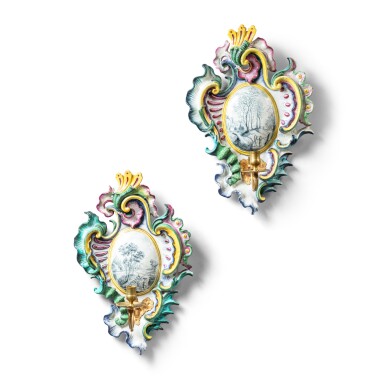
A pair of large Höchst fayence rococo-form wall sconces, circa 1748-50
Live auction begins on:
June 24, 12:30 PM GMT
Estimate
10,000 - 15,000 EUR
Lot Details
Description
modelled, possibly by Gottfried Becker, moulded in high relief in the form of roccaille scrollwork and brightly painted in tones of yellow, greens, blue and dark puce, each reserving a moulded oval domed medallion painted in Schwarzlot, possibly by Joseph Philipp Dannhöfer, with figures in a rustic landscape, each affixed with a gilt-bronze (?) plate and candle sconce, pierced at reverse for hanging, one with wheel mark, and letter H in brown enamel for Georg Friedrich Hess
(2)
Length 19 ⅝ in; 50 cm
Horst Reber, ‘Meisterwerke der kurmainzischen Fayence- und Porzellanmanufaktur Höchst’, in Röbbig München, Ausgewählte Werke. Frühe deutsche Porzellane. Französische Möbel. Kunst und Dekorationen des 18. Jahrhunderts., Munich, 2005, pp. 15-21, illus.
These remarkable fayence wall lights, or Blakers, produced during the formative years of the Höchst factory, rank among the most ambitious and artistically sophisticated survivals of early German fayence production. Of exceptional rarity, they appear to be the only recorded examples of their form in the published literature, underscoring their significance in the development of Rococo interior decoration in mid-18th-century Germany. The dating of the present works to 1748–50 is secured by the painter’s mark H, which identifies Georg Friedrich Hess, who left Höchst and returned to the works at Fulda with his son Ignaz by the spring of 1750.
The closest comparable models to the present works are a very large pair (illustrated in Röbbig, 2005, pp. 16–17, together with a slightly smaller pair now in the collection of the Museum Angewandte Kunst, Frankfurt, Inv. Nr. X122271 a & b). Together the four form a cohesive set, all cast from the same mould, with a dragon to the left and an eagle to the right of the rocaille cartouche, framing monochrome puce landscape scenes at the centre. These spectacular wall lights were almost certainly conceived for Johann Friedrich Karl von Ostein (1689–1763), Elector and Fürst of Mainz from 1743 until his death, and the patron who granted the Höchst factory its electoral privilege in 1746. Their presumed destination was Ostein Hof, the Elector’s palace in Mainz, constructed between 1747 and 1752 and furnished in the height of the Rococo taste. The exuberant asymmetry and sculptural vitality of these wall lights would have harmonised perfectly with the interiors designed by Johann Valentin Thoman and Anselm Franz Freiherr von Ritter zu Groenesteyn, chief architect to the Mainz court. The set of four, decorated with monochrome puce landscapes, has traditionally been attributed to Adam Friedrich von Löwenfinck and dated to 1748–49, shortly before his departure from the factory in 1749. The larger pair from the set later entered the celebrated collection of Otto (1870–1944) and Magdalena (1879–1950) Blohm of Hamburg and Caracas, and was sold in Sotheby’s, London, 25 April 1961, lot 342 (to Chester for £1,900).
Reber in Röbbig, op.cit., 2005, attributes the Schwarzlot painting on the present works to the artist Joseph Philipp Dannhöfer, who came to Höchst in 1747 where he worked as a painter until his departure in 1751. A particularly closely related Schwarzlot scene appears on a Höchst faience jug in the collection of the Victoria and Albert Museum, London, acc. no. C.246-1923. Bearing the painter’s mark CH—given possibly as Cajetan Huber—and decorated with borders by Georg Friedrich Hess, the jug provides a compelling comparison to the present work.
Related Literature
Meisterwerke deutscher Fayencekunst, Exhibition Catalogue, 1925, cat. nos. 553–554, illus. taf. 51 (the smaller pair now in the Historisches Museum, Frankfurt);
Horst Reber, Die Kurmainzische Porzellanmanufaktur Höchst, Fayencen, Band II, Munich, 1986, pp. 108-11, figs. 119, 120a/b (for the pair in the Historisches Museum, Frankfurt and pair formerly in the Blohm collection).
You May Also Like