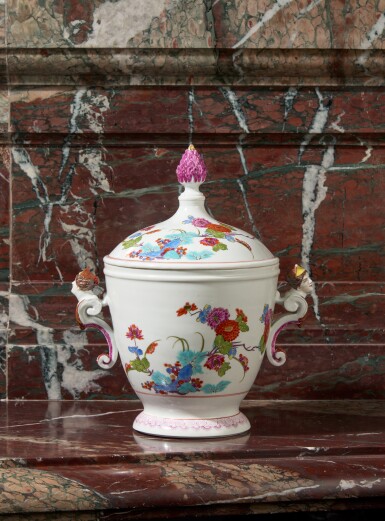
A rare Meissen porcelain Kakiemon two-handled ice cooler and cover, circa 1730-35
Live auction begins on:
June 24, 12:30 PM GMT
Estimate
8,000 - 12,000 EUR
Lot Details
Description
painted, in Kakiemon style with large branches of indianische Blumen embellished with gilding, issuing from rockwork, above two concentric iron-red lines, the cover similarly painted with the addition of a small bird, surmounted with a puce artichoke finial, the cooler with caryatid C-scrolled handles painted in Böttger lustre, puce and iron red, the foot decorated with a puce spiral border, crossed swords mark in underglaze-blue
Height 11 ⅞ in; 30 cm
Offered, A Distinguished Private Collection of 18th Century Meissen Porcelain, Sotheby’s, London, 24 November 1998, lot 39;
The Buckendahl Collection;
Lempertz Cologne, 15 November 2012, lot 37;
Acquired at the above sale.
The earliest documented reference to this form occurs in 1728, in a manufactory commission report recording an order for “two large ice pots … after an Indian model,” supplied to Count von Watzdorf. The handles of this form have been attributed to the Meissen modeller J.C.L. Lücke, and his specification of models for the years 1728-29, includes: 'Einen Henckel in Forma einer Sirena auf einen Eyß Topf', [a handle in the form of a siren, on an ice bucket] (quoted in Rainer Rückert, Meissener Porzellan 1710-1810, exh. cat., Munich, 1966, p. 124, cat. no. 525, where an example of this form from the Schneider collection is illustrated). The Schneider example, decorated in underglaze-blue, and surmounted by a finial in the form of a seated chinoiserie figure, is most recently discussed at length by Julia Weber, Meißener Porzellane mit Dekoren nach ostasiatischen Vorbildern, Stiftung Ernst Schneider in Schloss Lustheim, Band II, Munich, 2013, pp. 14-18, cat. no. 1.
The pattern seen on the present example closely corresponds to a pair formerly in the collection of the Portuguese banker and renowned collector Ricardo Espírito Santo (1900–1955). These pieces were acquired by Espírito Santo as part of the collection of Count Alfred III Potocki (1886–1958), which was evacuated from Łańcut Castle in Poland in 1944 (discussed by Selma Schwartz in Brittle Beauty, Reflections on 18th-century European Porcelain, London, 2023, pp. 140-45, cat. no. 18.)