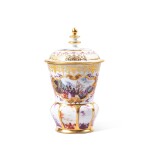

A Meissen porcelain octagonal flared beaker and cover, circa 1735
Live auction begins on:
June 24, 12:30 PM GMT
Estimate
8,000 - 12,000 EUR
Lot Details
Description
with flared cylindrical neck and octagonal lower body, the neck painted with two scenes of figures by harbours within gilt-edged cartouches, linked by puce-scroll and iron-red trelliswork panels enclosing landscapes and surmounted by chinoiserie figures, the panels of the lower body painted alternately in puce and iron-red monochrome with panels of harbour scenes reserved on the gold ground, the stepped domed cover surmounted with a gilt finial above two landscape vignettes, crossed swords mark in underglaze-blue, gilt letter C. to both
Height 7 in; 17,6 cm
The Estate of Dr Willy Abrahamson (1873-1931), Berlin, sold, Auktionshaus des Westens, Berlin, 18 March 1931, lot 25;
Pauls-Eisenbeiss Collection, Basel (by 1972);
Brigitte Britzke Collection, Bad Pyrmont (by 2002).
Museum im Schloss, Bad Pyrmont, Meissener Porzellan des 18. Jahrhunderts aus Bad Pyrmonter Privatbesitz, 28 November 2002 to 26 January 2003;
Fundación Caja Segovia, La Porcelana de Meissen en la Colección Britzke 1709-1765, 16 July to 18 November 2009.
Dr Erika Pauls-Eisenbeiss, German Porcelain of the 18th Century, Vol. I, London, 1972, pp. 454-55;
Meissener Porzellan des 18. Jahrhunderts aus Bad Pyrmonter Privatbesitz, exh. cat., Bad Pyrmont, 2002, p. 42;
La Porcelana de Meissen en la Colección Britzke/Das Meissner Porzellan der Britzke-Sammlung, exh. cat., Segovia, 2009, p. 68.
A particularly close comparable example of this form is preserved in the Rita and Fritz Markus Collection at the Museum of Fine Arts, Boston, acc. no. 1983.611. Formerly in the collection of Dr. Fritz Mannheimer, Amsterdam and Paris, the beaker was subsequently sold at Frederik Muller & Cie, Amsterdam, 14–21 October 1952, lot 325. The piece is illustrated in V. S. Hawes and C. S. Corsiglia, The Rita and Fritz Markus Collection catalogue, Museum of Fine Arts, Boston, 1984, pp. 99–101, cat. no. 23, where the authors also cite the present example together with other recorded examples of the model.
Cranfield University used non-invasive X-ray fluorescence (XRF) for this lot to screen the green enamel for chromium, which was not detected, a result consistent with 18th century manufacture.