
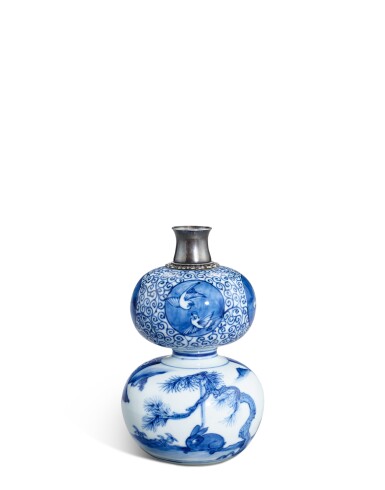
A blue and white inscribed 'Shonsui' double-gourd vase, Ming dynasty, Chongzhen period | 明崇禎 青花祥瑞兔福壽葫蘆瓶
Estimate
100,000 - 300,000 HKD
Lot Details
Description
of compressed double-gourd form with a short constricted waist, one side of the lower bulb painted with a hare beneath a gnarled pine tree, the reverse with the characters fu and shou reserved on a diaper ground, the upper bulb decorated with four roundels of birds among dense scrolls, the mouth-rim fitted with a Japanese metal collar from Ikeda, Nagoya
overall h. 13.8 cm
A Japanese private collection, circa 2010.
Shonsui ware represents a cross-cultural and aesthetic synthesis of Chinese blue and white porcelain and the Japanese tea ceremony. Chinese blue and white influenced the aesthetics of tea utensils in Japan, while also reflecting the specific needs of Japanese tea culture. This fusion created the distinctive style of 'Shonsui ware,' which stands as an important testament to East Asian ceramic exchange in the 17th century.
Shonsui ware used Chinese cobalt pigment, producing a deep and layered blue. Sumptuous designs were created with geometric and auspicious motifs of Chinese blue and white porcelain, defining a distinctive style unique to Shonsui ware. For example, the present vase takes the form of a gourd: the upper section features scroll patterns with groups of cranes, while the lower section is divided—one half with geometric cartouches inscribed with the characters fu (fortune) and shou (longevity), and the other half with a white ground of pine trees, altogether evoking an atmosphere of enduring blessings and longevity.
Shonsui ware represents an extension of Jingdezhen craftsmanship. During the Wanli to Chongzhen reigns of the Ming dynasty, as the imperial kilns gradually declined and private kilns rose to prominence, Chinese blue and white porcelain was exported to Japan, becoming a quintessential example of cross-cultural exchange.
來源
日本私人收藏,約2010年
祥瑞瓷器是中國青花瓷器和日本茶道跨文化、美學的結合。中國青花影響了日本茶道用器的審美,也反映了日本茶道文化的具體需求,造就了獨特的「祥瑞瓷」風格,成為十七世紀東亞陶瓷交流的重要見證。
祥瑞瓷使用中國鈷藍料,色澤濃烈、層次分明;使用中國青花的幾何紋、吉祥紋重新組合,形成繁複華麗的裝飾,成為祥瑞瓷獨特的風格。如本器呈葫蘆形,上部捲草紋地上飾團鶴;下部一般一半幾何形開光上書「福」、「壽」,一半白地繪蒼松,充滿福壽綿長的氣氛。
祥瑞瓷是中國景德鎮工藝的延伸,當明朝萬曆至崇禎年間,景德鎮御窰漸漸衰落,民窰興起,把中國青花瓷器出口至日本,成為跨文化交流的典型代表。
You May Also Like


