
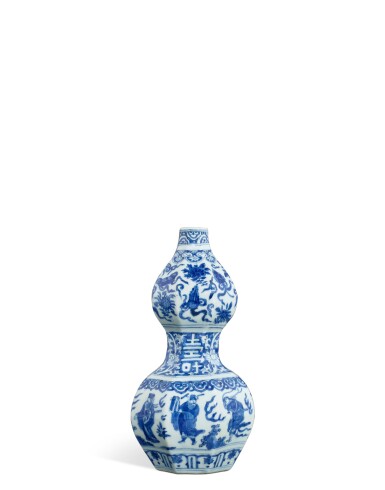
A blue and white 'Eight Immortals' octagonal double-gourd vase, Ming dynasty, Jiajing period, Fugui Jiaqi mark | 明嘉靖 青花八仙祝壽八方葫蘆瓶 《富貴佳器》款
Estimate
200,000 - 800,000 HKD
Lot Details
Description
of octagonal section, the lower bulb painted with the Eight Immortals in a garden setting between borders of ruyi blooms and lotus lappets, sweeping up to a constricted waist with a reserve-decorated frieze of shou characters alternating with lotus sprays, the upper bulb decorated on each facet with one of the anbaxian paired with a floral sprig, the motifs alternating in position from facet to facet, all below a band of pendent ruyi heads and a further ruyi border, the base inscribed with a fugui jiaqi (‘fine vessel for the rich and honourable’) mark, Japanese wood box
19.5 cm
Mayuyama & Co., Ltd, Tokyo, circa 2000.
The Fame of Flame: Imperial Wares of the Jiajing and Wanli Periods, University Museum and Art Gallery, the University of Hong Kong, Hong Kong, 2009, cat. no. 1.
Replete with symbols of longevity—the double-gourd form, the shou character, and the Eight Immortals—this well potted and decorated vase reflects the Jiajing Emperor's ardent devotion to Daoism and his desire to attain immortality.
Fugui jiaqi is an auspicious phrase first appearing on porcelains of the Jiajing period. While wares bearing this mark reached their peak of popularity during the Wanli period, the phrase continued to be used on porcelains in the Tianqi and Chongzhen periods.
來源
繭山龍泉堂,東京,約2000年
展覽
《爐火純青:嘉靖及萬曆官窯瓷器》,香港大學美術博物館,香港,2009年,編號1
You May Also Like


