
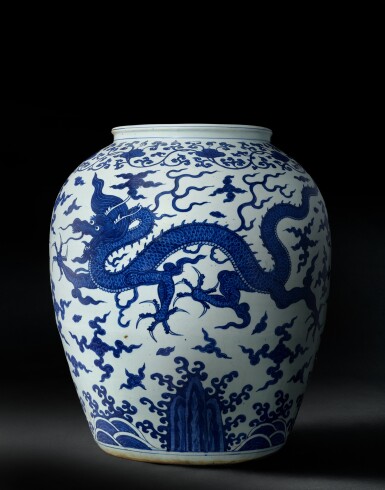
A rare large blue and white 'dragon' jar, Mark and period of Wanli | 明萬曆 青花行龍壽字紋大罐 《大明萬曆年製》款
Estimate
2,000,000 - 4,000,000 HKD
Lot Details
Description
sturdily potted with a broad ovoid body rising to a short waisted neck, the exterior painted in deep cobalt blue with two five-clawed dragons, one striding forward, the other turning its head back, their sinuous scaly bodies writhing amid ruyi-shaped clouds above crested waves, each rendered with bulging eyes and gaping jaws, separated by a stylised shou character fashioned from a twisting wisp of smoke rising from jagged mountain peaks, all below a meandering lingzhi scroll encircling the shoulder, the grainy base centred with a countersunk glazed roundel inscribed with a six-character reign mark within a double circle
h. 53.5 cm
Collection of Paul E. Manheim (1906-1999), New York.
Sotheby's New York, 16th September 2009, lot 120 and back cover.
Acquired from the above.
On loan to the Metropolitan Museum of Art, New York, 1968-2009.
The Fame of Flame: Imperial Wares of the Jiajing and Wanli Periods, University Museum and Art Gallery, the University of Hong Kong, Hong Kong, 2009, cat. no. 52.
Drawing inspiration from Jiajing-period prototypes, the jar is remarkable for both its imposing size and the lively depiction of five-clawed dragons. Firing such a monumental ceramic piece is especially difficult, as the sheer size of the body makes it hard for heat to circulate evenly within the kiln, greatly increasing the risk of warping, cracking, and glaze imperfections. Achieving such a well-composed design on such a large vessel is likewise demanding, as the artisan has to keep a perfectly balanced, continuous design flowing smoothly over an extensive curved surface.
Compare a similar example in the Shanghai Museum, illustrated in Lu Minghua, Mingdai guanyao ciqi [Ming Imperial Porcelain], Shanghai, 2007, pl. 1-76. Jars of this type were also sent to the Ottoman court as diplomatic gifts; for a closely related example, see Regina Krahl, Chinese Ceramics in the Topkapi Saray Museum, vol. 2, Istanbul and London, 1986, no. 1328.
For private collection examples recorded at auction, see a jar sold at Christie’s Hong Kong, 27th November 2013, lot 3303; and a pair of Jiajing-period examples from the collection of the Okada Museum of Art, sold in these rooms, 22nd November 2025, lot 1074.
Paul E. Manheim (1906-1999) was an American financier, collector, and philanthropist based in New York, where he was a partner at Lehman Brothers. Beginning in the 1960s, he assembled a notable collection of Asian art, particularly Chinese, Indian, and Nepalese works. From 1969 to 1982, he served on the Board of Trustees of the Brooklyn Museum, contributing to the institution’s growing engagement with Asian art during a period of increasing American interest in the field.
來源
Paul E. Manheim(1906-1999年)收藏,紐約
紐約蘇富比2009年9月16日,編號120及封底
購於上述來源
展覽
借展於大都會藝術博物館,紐約,1968-2009年
《爐火純青:嘉靖及萬曆官窯瓷器》,香港大學美術博物館,香港,2009年,編號52
此罐承嘉靖時期製式而成,體量宏碩,青花發色濃艷明麗。燒造如此巨制殊為艱難,因罐體龐大,窰火內勻熱不易,稍有不慎,即易致坯體變形、開裂,或釉面生瑕。
罐身飾五爪雙龍翻騰於江崖海水之上,行龍氣勢雄偉,姿態矯健,一龍昂首前視,一龍回首相應,龍鱗規整飽滿,筆觸生動。雙龍間飾萬歲壽藤,其形若縷縷青煙,自山巒間裊裊升起。肩部一圈纏枝靈芝紋起伏有致。能於斯巨器之上繪畫如此繁而不雜、連綿流暢之構圖,殊非易事。
上海博物館藏一類例,載於陸明華,《明代官窰瓷器》,上海,2007年,圖版1-76。此類大罐亦遠播西亞,入藏鄂圖曼宮廷,參見康蕊君,《Chinese Ceramics in the Topkapi Saray Museum》,卷2,伊斯坦堡及倫敦,1986年,編號1328。另可參考一例售於香港佳士得2013年11月27日,編號3303;以及一對嘉靖時期大罐,為岡田美術館收藏,售於香港蘇富比2025年11月22日,編號1074。
Paul E. Manheim(1906至1999年)為美籍金融家、收藏家及慈善家,曾任雷曼兄弟公司合夥人。自1960年代始,廣泛蒐集亞洲藝術品,尤重中國、印度與尼泊爾之板塊。1969年至1982年間,擔任布魯克林博物館董事會成員,對該館亞洲藝術收藏之拓展貢獻良多,當時正值美國學界對此領域興趣漸增之際。
You May Also Like


