
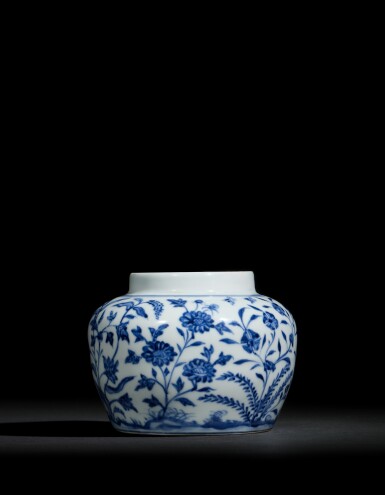
An exceptionally rare and finely painted blue and white 'floral' jar, Mark and period of Chenghua | 明成化 青花九秋圖罐 《大明成化年製》款
Premium Lot
Estimate
9,000,000 - 20,000,000 HKD
Premium Lot
Lot Details
Description
potted with a well-proportioned body rising to a rounded shoulder surmounted by a tall straight neck, the exterior delicately painted in soft tones of cobalt blue with luxuriant autumn blossoms and budding flowers, the blooms borne on curling leafy stems emerging from the ground and accentuated by two grasshoppers hovering above, all between double-line borders encircling the upper shoulder and foot, the base inscribed with a six-character mark within a double circle, veiled overall save for the unglazed footring with an unctuous glaze, wood stand
h. 10.5 cm
The dating of this lot is consistent with the results of the thermoluminescence test conducted by C&C Authentication Laboratory Limited, report no. 4341PK05, dated 2nd December 2002.
此拍品經熱釋光測定,結果與斷代吻合(中科古物鑑証實驗室有限公司,報告編號:4341PK05,報告日期:2002年12月2日)。
An old Hong Kong family collection, acquired in the early 1990s.
The Chenghua reign (1464–1487) occupies a singular and almost paradoxical position in the history of Chinese imperial porcelain. With porcelain produced for less than two decades and with no grand monuments or flamboyant stylistic revolutions, the period nonetheless yielded objects of such refinement and authority that they would come to eclipse the achievements of far longer and more productive reigns and stand as among the rarest and most desirable porcelain pieces ever produced. Chenghua porcelains were not conceived as statements of power or abundance, but as exercises in restraint, intimacy and absolute control – objects made not to impress at a distance, but to reward sustained, close looking. It is within this rarefied aesthetic environment that the present jar must be understood.
Manufactured at Jingdezhen exclusively for court use, Chenghua wares were produced under an unusually strict regime of supervision. Documentary sources attest to the direct involvement of high-ranking court officials, and the archaeological record confirms extraordinarily limited output. Even at the moment of their creation, these porcelains were not commodities but privileges, circulating within a narrow imperial sphere. The fragility of this system ensured that survival rates would be low; subsequent centuries of warfare, dynastic collapse and dispersal only compounded these losses. As a result, the corpus of extant Chenghua porcelain is vanishingly small, numbering only a few hundred pieces worldwide, most now held in institutional collections and primarily still in the Palace collections of Beijing and Taipei. For a near-complete list of attested examples, see Julian Thompson’s summary in The Emperor’s Broken China. Reconstructing Chenghua Porcelain, Sotheby’s, London, 1995, pp 116-128.
The reverence accorded to Chenghua porcelain did not diminish with time. On the contrary, by the late Ming period it had already become a benchmark against which all later blue-and-white wares were measured. Literati writers described these objects not in terms of technical bravura but of taste: a quality understood as innate, ineffable, impossible to replicate and, of course, expensive. As Shen Defu (1578–1642) notes in the Wanli yehuo bian [Unofficial matters from the Wanli reign], Chenghua ware had become so expensive by the Wanli period (1573-1620) that even he, a wealthy palace official, would have no means to acquire even a pair of cups. During the Qing dynasty, this retrospective admiration hardened into active imperial collecting. Chenghua wares were sought out, catalogued, painted and preserved as exemplars of an idealised past, their quiet elegance standing in deliberate contrast to the more assertive aesthetics of later periods. Compare, for example, a jar of this design from the collection of the Yongzheng Emperor (r. 1722-1734) immortalised in the famous Guwan tu [Pictures of Ancient Playthings] handscroll of 1728, preserved in the British Museum, London.
Jars of this type today are exceptionally rare with only four other examples recorded in Julian Thompson’s near-exhaustive catalogue raisonné of Chenghua pieces; see The Emperor’s Broken China. op. cit., Table 1, B2: the first preserved in the Taipei Palace Museum (accession no. gu ci 014387), illustrated in Mingdai taoci daquan [An encyclopedia of Ming porcelain], Taipei, 1993, p. 206; the second sold at Christie’s Hong Kong, 1st October 1991, lot 750; the third, from the Deshantang Collection, sold at Christie’s Hong Kong, 30th May 2006, lot 1387; and the fourth, the closest in comparison to the present piece, from the collection of Hikonobu Ise, exhibited widely in Japan and most recently sold in these rooms 9th September 2025, lot 5044.
However, even within this group of five, a subtle yet enchanting variation exists which leaves each jar to assert itself as a unique work of art – an intimate meditation on a prescribed theme, rather than a mechanical repetition. While on first glance, each jar may appear identical, produced to the same overall schema, on closer treasured inspection, one notes an unpredictable and vibrant rhythm to each design, with subtle variation in colour, design, stroke, and form that speaks to the individual nature of each piece – the hand of the ancient potter and the individual orders of the Chenghua Emperor and his court. Most famously noted of the period’s ‘Palace Bowls’ on which blooms vary in size, washes and pointillism are applied seemingly at will, and leafy scrolls seem to jump from the surface as if tossed by the wind, Chenghua flower jars display similar variation and play, quite unlike any earlier or later imperial designs.
Some scholars attribute this natural variation to a varying adherence to earlier prototypes from which the present design emerged. Like many of the earliest designs produced in the Chenghua reign, the form of the present jar is derived directly from earlier 15th-century prototypes. Decorated with closely related garden scenes of flowers emerging from the ground, these unmarked jars are typically attributed to the Yongle reign (1403-1424) and feature the distinctive ‘heaping and piling’ of early wares produced with imported cobalt pigments from the Middle East. Compare, for example, one such jar from the collection of Mrs Alfred Clark in the British Museum, London (accession no. 1972,0619.1.a), illustrated in Jessica Harrison-Hall, Catalogue of Late Yuan and Ming Ceramics in The British Museum, London, 2001, pl. 3:23; and an unmarked covered jar of related design in the Taipei Palace Museum (accession no. gu ci 014347), included in the Special Exhibition of Ch’eng-hua Porcelain Ware, Palace Museum, Taipei, 2003, cat. no. 84, unspecifically attributed to the Ming dynasty but likely predating the present.
However, while the overall schema of the present jar is undoubtedly inspired by the aforementioned, the genius of Chenghua wares lies in its subtle departure from its austere sources into a world of subtlety and sweetness. Increasing levels of aluminium oxide and reducing iron oxide compared to those of the Xuande reign, the porcelain of the mid-fifteenth century is whiter and finer than its predecessors; its underglaze blue, shiqing (‘mineral blue’), more finely controlled than prior, with a blend of domestic and imported cobalt, to produce smoother warmer tones than the ‘heaped and piled’ surface of its Yongle counterpart. Similarly, the design, while incorporating the overall Yongle schema, shows areas of development and free movement more akin to that of the Interregnum period (1436–1464) of the Zhengtong, Jingtai and Tianshun reigns. This period, still largely unexplored in the scholarship, shares much of the spontaneity of the finest Chenghua wares and may be the origin for the present design’s departure from Yongle rigidity. Compare, for example, similarly free-spirited renderings of chrysanthemum sprays on dish fragments excavated from the Zhengtong or Tianshun strata at the Imperial kilns of Zhushan, Jingdezhen, in 2014 in Refilling the Interregnum. Newly Discovered Imperial Porcelains from the Zhengtong, Jingtai and Tianshun Reigns (1436-1464) of the Ming Dynasty, Hong Kong, 2019, cat. no. 53.
And yet, this sense of ease is deceptive. Beneath the apparent freedom of the present jar lies extraordinary technical precision. It represents the culmination of an approach to porcelain that values balance over brilliance, and intimacy over spectacle. In its proportions, palette and surface, the present jar captures a moment of perfect equilibrium – one that would prove impossible to sustain. Later wares would dazzle, astonish and proliferate, but they would rarely achieve this same quiet authority. As such, the present jar stands not merely as a survival from the Chenghua reign, but as a distilled expression of its philosophy: an object made for the hand, the eye and the cultivated mind, and one that continues, centuries later, to define the upper limits of ceramic refinement.
來源
香港家族舊藏,入藏於1990年代初
明成化年間(1464–1487年)在中國御窰瓷器史上佔據著獨特且近乎矛盾的地位。該時期御窰燒造活動不足二十年,既未產生宏大的器型,也未引發華麗的風格革命,然而其瓷器卻以極致精雅與內在權威,超越了後世更漫長、更高產的朝代所獲成就,成為史上至為稀有、令人夢寐以求的珍品。成化瓷器並非以彰顯權力或豐饒為初衷,而是專注於內斂、私密與絕對掌控的審美實踐。其製作目的非為遠觀之懾人,而在近賞之玩味,須經持久細觀方得真趣。唯有在此般精純的美學語境中,本品九秋圖罐方可得其真解。
成化瓷器的製造遵循一套異常嚴格的監控制度,由景德鎮御窰廠專為宮廷燒造。文獻記載證實當時有高級官員直接參與督造,考古發現亦佐證其產量極為有限。即便在燒制之初,這些瓷器就非流通商品,而是僅限宮廷內部流轉的珍稀特供。這種脆弱的傳承體系註定其存世量稀少,加之此後數百年的戰亂、朝代更迭與流散,更使傳世雪上加霜。如今全球可考的成化瓷器存量極少,僅存數百件,大多收藏于文博機構,主要集中於北京與台北的故宮博物院。欲查閱近乎完整的現存成化瓷器名錄,詳見朱湯生,〈成化窰燒造記錄考〉,《The Emperor's Broken China: Reconstructing Chenghua Porcelain》,倫敦蘇富比,1995年,頁116至128。
成化瓷器所受的尊崇並未隨時間消減。相反,至晚明時期,它已成為衡量後世青花瓷的尺規。文人雅士品評這些器物時,關注的並非技藝之精湛,而是格調 - 一種被理解為與生俱來、難以言傳、無法複刻且必然昂貴的特質。正如沈德符(1578-1642年)在《萬曆野獲編》中所記,萬曆年間成化瓷已昂貴到連他這位富有的宮廷官員也無力購得一對盃盞。及至清代,這種追慕之情更凝結為有系統的皇家收藏活動。成化瓷被搜羅、著錄、摹繪、珍藏,成為理想化往昔的典範,其含蓄雅致的風韻,與後世更具張揚之美的審美取向形成刻意對比。試觀雍正帝舊藏中一件同式樣的罐子,其形制被1728年繪製的著名手卷《古玩圖》(現藏倫敦大英博物館)永久定格,可資比照。
此類罐存世極罕,在朱湯生近乎完備的成化瓷器專著,見前書,書中僅錄得四件同型器。首件現藏於台北故宮博物院(館藏編號:故瓷14387),著錄於《明代陶瓷大全》,台北,1993年,頁206;第二件售於香港佳士得1991年10月1日,編號750;第三件出自德善堂珍藏,售於香港佳士得2006年5月30日,編號1387;第四件原為伊勢彦信舊藏,曾在日本多地展覽,也與本器最為相似,終於香港蘇富比2025年9月9日伊勢專場成交,編號5044。詳見前書前引著作表1之B2條目。
然而,即便在這五件同型器中,仍存在著微妙而迷人的差異,每件罐子都以其獨特的方式宣示著自身作為獨立藝術品的價值。它們更像是對既定主題進行的個性化演繹,而非機械的重複。初看之下,各罐或許形制相同,遵循著統一的整體框架;但若細細品鑒,便會發現每件器物上的紋飾皆蘊含著不可預料的靈動韻律。無論是發色、圖樣、筆觸,或是器形微妙的差異,皆訴說著每件作品的獨有特質,那是古代匠人的手澤,也是成化皇帝與宮廷每一次特諭的印記。正如這一時期最負盛名的「宮碗」,其上的花卉大小錯落,暈染與點染看似隨性而就,卷草紋飾仿佛迎風躍出釉面。成化花罐同樣展現著這般隨性靈動的意趣,與前後任何時代的官窰設計皆迥然不同。
有學者將這種自然差異歸因於對早期原型遵循程度的不同,本罐的器型正是從這些原型演變而來。與成化朝早期許多設計一樣,此罐的形制直接承襲自十五世紀前期的原型。這些無款識的罐子通常被斷代為永樂年間,裝飾著極為相近的庭院花卉破土而出的紋樣,並帶有早期瓷器的典型特徵,使用從中東進口鈷料所產生的「堆垛積料」現象。例如,可對比現藏倫敦大英博物館,克拉克夫人舊藏的一件同型罐(館藏編號:1972,0619.1.a),圖版見霍吉淑,《Catalogue of Late Yuan and Ming Ceramics in the British Museum》,倫敦,2001年,圖版3:23;以及台北故宮博物院藏一件無款蓋罐(館藏編號:故瓷14347),其紋飾與此罐相關,收錄於《成化瓷器特展》,故宮博物院,台北,2003年,圖版84,雖籠統斷為明代,但年代可能早於本罐。
然而,儘管本罐的整體構圖無疑受到前述原型的影響,成化瓷器的卓絕之處,恰恰在於其從簡樸原型的微妙超脫,進入一種精微柔美的境界。與宣德時期相比,十五世紀中期的瓷器因氧化鋁含量提升與氧化鐵含量降低,胎質較前代更為白潤細膩;其釉下青料「石青」,通過對國產與進口鈷料的精妙配比控制,發色較前代更為勻淨溫潤,一改永樂時期典型的「堆垛積料」之貌。同樣,其紋飾設計在沿襲永樂整體框架的同時,展現出更具自由度的演繹與靈動氣息,更貼近正統、景泰、天順三朝空白期的藝術特徵。這段在學術界尚待深入探索的時期,其作品與最精妙的成化瓷器共用著某種即興創作的靈氣,或許正是本罐紋飾得以突破永樂程式化束縛的淵源。試觀2014年景德鎮珠山御窰廠正統至天順地層出土的瓷盤殘片,其上菊紋的寫意奔放表現手法,可資參照。詳見《填空補白II:考古新發現明正統、景泰、天順御窯瓷器》,香港,2019年,編號53。
然而,這種自如感卻是一種錯覺。在本罐看似自由的表像之下,蘊藏著非凡的技術精密。它代表了一種製瓷理念的頂峰,這種理念崇尚平衡勝過奪目,追求親近而非炫示。無論是比例、色調還是釉面質感,本罐都捕捉到了一種完美的平衡狀態,而這種狀態在後世將難以為繼。後來的瓷器或炫目、或奇巧、或繁複,卻鮮少能再達到這般含蓄的權威。因此,本罐不僅是一件成化朝的傳世品,更是該時期哲學精神的凝練表達:一件為觸覺、視覺與涵養之心而造的器物。數百年後,它依然定義著陶瓷精雅之美的至高境界。
You May Also Like


