
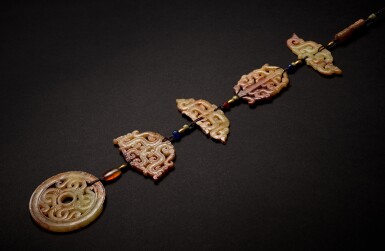
An exceptionally rare group of six jade pendants, Eastern Zhou dynasty, Warring States period | 東周戰國 玉組珮一組六件
Premium Lot
Estimate
9,000,000 - 18,000,000 HKD
Premium Lot
Lot Details
Description
3.3 to 7.6 cm
This elegant assemblage is composed of six principal jade elements, carefully graduated and strung together with spacer beads. The set begins with a cylindrical tube at the top, followed by an arched heng pendant, a vertically oriented openwork plaque, a second arched heng, a semi-circular plaque, and culminates in a circular bi disc. Each piece is masterfully worked with densely intertwined, undulating dragons, showcasing the sophisticated openwork and shallow relief carving techniques that reached their zenith during the Warring States period. The stone exhibits an attractive warm tone with areas of russet and calcification, hinting at its great antiquity.
During the Eastern Zhou dynasty, the wearing of complex jade pendant sets Yuzupei was strictly regulated by sumptuary laws and served as a profound symbol of a nobleman's moral integrity and social rank. According to the Liji or Book of Rites, "a gentleman of virtue does not remove jade from his body without good reason." The rhythmic chiming of the various jade components striking against one another as the wearer walked was intended to regulate their pace, ensuring a dignified and measured gait appropriate for courtly rituals.
The present lot exemplifies the dynamic, fluid style characteristic of the Chu cultural sphere. The specific combination of heng, plaques, and a terminal bi disc closely mirrors the lavish jade sets discovered in elite tombs of the period. For comparable openwork dragon motifs and similar structural components, see the extensive jade assemblages excavated from the Tomb of Marquis Yi of Zeng (c. 433 BC) in Suizhou, Hubei, illustrated in Zeng Hou Yi Mu [Tomb of Marquis Yi of Zeng], Beijing, 1989. Further comparable examples of Chu-style jade plaques and bi discs, exhibiting similar densely coiled dragon patterns, are published in Chuguo Yuqi [Jades of the Chu State], Hong Kong, 1993.
此組珮由六件雕工精湛的玉佩組成,間以串珠相連。自上而下依次為玉管、玉珩、鏤空龍紋佩、第二件玉珩、半圓形龍紋佩,並以一枚玉璧作為底端。每件玉器皆精雕細琢,飾以繁複交纏的蟠龍紋,展現了戰國時期登峰造極的鏤空與淺浮雕技藝。玉質溫潤,局部帶有褐紅色沁與鈣化現象,盡顯古樸之氣。
在東周時期,繁複的玉組珮制度森嚴,不僅是高級貴族身份與等級的象徵,更是君子品德的物化體現。《禮記》有云:「君子無故,玉不去身」。貴族佩戴組珮行走時,玉器相互碰撞發出清脆的「叮噹」之聲,旨在節制步伐,確保其儀態莊重,符合禮制規範。
本拍品充分展現了楚文化圈充滿張力與動感的藝術風格。其以玉珩、牌飾及玉璧組合的形式,與當時高等級貴族墓葬中出土的華麗玉組珮高度一致。關於其構件形制與鏤空交龍紋工藝,可參考湖北隨州曾侯乙墓(約公元前433年)出土之大型玉組珮實例,見《曾侯乙墓》,北京,1989年;另可比較《楚國玉器》(香港,1993年)中收錄的同時代楚系玉牌飾與玉璧,其上亦見類似之繁密蟠龍紋。
You May Also Like


