
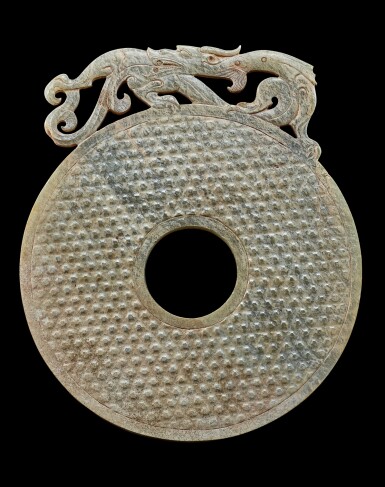
A rare and large jade 'dragon' bi disc, Late Western Han dynasty | 西漢晚期 出廓龍蒲紋玉璧
Estimate
3,000,000 - 6,000,000 HKD
Lot Details
Description
15 cm
Tsai Ching-Liang, Jades of Han Dynasty, Aurora Art Museum, Taipei, 2005, pl. 10.
The bi disc is one of the most enduring and significant forms in archaic Chinese jade carving. Emerging in the Neolithic period as a ritual object associated with Heaven, its significance profoundly evolved during the Eastern Zhou and Han dynasties. In these periods, bi discs became powerful symbols of aristocratic status, cosmic order, and immortality, often utilised in elite burials to protect the soul and guide it to the afterlife. The Han dynasty witnessed the pinnacle of this form with the innovation of elaborate openwork designs extending beyond the outer rim, which perfectly reflected the era's deep fascination with the spiritual realm and mythical beasts.
The present yellowish-celadon jade bi disc is a masterful testament to this innovative Han dynasty style. The disc itself is neatly carved with a classic pu pattern, providing a structured contrast to the dynamic openwork dragon surmounting its upper edge. The artisan ingeniously utilised tubular drills to shape the dragon's fangs and ears, leaving circular traces that emphasise a distinct sense of raw power. Constrained by the original shape of the jade boulder, the carver masterfully employed a multi-perspective composition to maximise the material. The head and neck are depicted in profile; the front legs, though carved in profile, are positioned on either side of the central ridge as if viewed from above, while the hind legs and tail are assembled from an oblique perspective.
To avoid visual confusion from these shifting viewpoints, the artisan skilfully broke the visual continuity. For instance, the front legs and the spine dip and disappear into the upper edge of the disc, interrupting the viewer's gaze and preventing the subsequent sections of the body from blurring with the front, while simultaneously creating the illusion of an elongated body. This overlapping technique, also seen where the sharply turned head crosses the hindquarters, creates a powerful sense of three-dimensional space. As the hind leg firmly steps on the cloud-like tail, the dynamic tension and vital energy of the mythical beast are fully unleashed.
For related examples, compare an earlier Western Han jade disc with addorsed dragons excavated in 1968 from the tomb of the first King of Zhongshan, Liu Sheng, currently in the Hebei Museum, illustrated in Nanjing Museum, ed., Yurun zhonghua: zhongguo yuqi de Wannian shishi tujuan [An Epic of Chinese Jade for 10000 Years], Nanjing, 2023, p. 224. See also an Eastern Han example surmounted by interlocking chi dragons, illustrated ibid., pl. 242, p. 174. For another related example, see a large Eastern Han white jade 'chilong' disc formerly in the Chinhuatang and Yangdetang Collections, included in Teng Shu-p’ing, Collectors’ Exhibition of Archaic Chinese Jades, Taipei, 1999, cat. no. 199, pp. 286-287, and later sold in these rooms, 26th November 2023, lot 3809.
出版
蔡慶良,《漢代玉器》,震旦藝術博物館,台北,2005年,圖版10
玉璧乃中國古代最重要且延續最久的禮器之一。自新石器時代作為祭天瑞器,至東周及漢代,玉璧之意義更趨豐富,成為身份、權力、秩序及得道之重要象徵,常作王侯貴族之重器以佑死後靈魂。漢代玉雕工藝臻於鼎盛,發展出突破圓形輪廓之「出廓」設計,將時人對羽化登仙及神仙世界之嚮往展露無遺。
本品青黃玉出廓龍蒲紋璧即為漢代創新風格之佳作。局部受沁,璧面飾以較簡單的蒲紋。上方出廓神龍生動威猛,龍母題的獠牙和耳部皆利用管具鑽旋出造形輪廓,並以此圓形痕跡彰顯出特有的力道。由於受限於玉料的外形,左前足和身頸鬣鬃的末端設計在同一垂線上;設計者更巧妙運用多視點組合之技巧,頭頸為側視角度;兩前足本身雖為側視,卻組裝在俯視角度的中脊線左右兩側;左後足雖為側視角度,但右後足和尾部卻以斜側的視點組裝。
為避免不同視點所產生的混亂效果,匠人運用技巧阻隔觀者視覺的連續性。例如兩前足和其所夾的背脊向下隱沒在玉璧中,不但可以阻截視覺的慣性,使其後再出現的身軀不會和前段視點相混淆,同時有延長身軀的暗示效果。另外在處理龍首大彎度迴轉並和後身交疊的關係上,也使用了相同的技巧以暗示前後空間關係。如此,當後足踏立在雲氣化的尾部上時,龍紋神靈活現的動態張力自然表現無遺。
參考一西漢早期出廓雙龍紋璧作例,1968年出土於河北滿城中山靖王劉勝墓,現藏河北博物院,載於南京博物院編,《玉潤中華:中國玉器的萬年史詩圖卷》,南京,2023年,頁224;另見一東漢透雕交龍紋璧,見同上註,圖版242,頁174。另可比較一件東漢白玉出廓雙螭龍紋大璧,先後金華堂收藏及養德堂收藏,載於鄧淑蘋,《羣玉別藏續集》,台北,1999年,編號199,頁286-287,後售於香港蘇富比2023年11月26日,編號3809。
You May Also Like


