
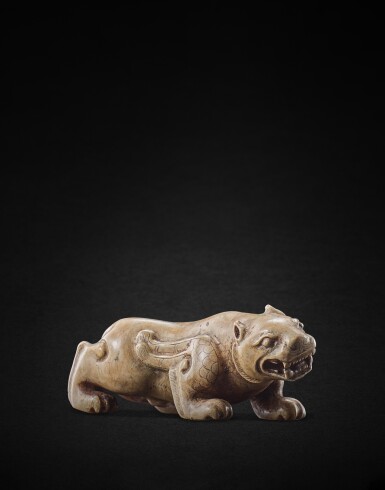
A very rare celadon jade mythical beast, Late Western Han dynasty | 西漢晚期 玉神獸
Estimate
1,000,000 - 3,000,000 HKD
Lot Details
Description
9 cm
Tsai Ching-Liang, Jades of Han Dynasty, Aurora Art Museum, Taipei, 2005, pl. 128.
Masterfully carved in the round, this magnificent mythical beast bixie is a testament to the extraordinary sculptural power and technical refinement achieved by jade artisans during the Late Western Han dynasty. The stone is of a yellow-green tone, suffused with opaque white calcifications and retaining some surface encrustations, adding to its archaic and formidable presence.
The present carving is a masterpiece of design, demonstrating the artisan's ingenuity in maximizing the yield of the precious jade boulder. To minimize the loss of material between the hind legs and the tail, the artisan cleverly designed the beast with its tail tucked tightly beneath its abdomen. To compensate for any potential loss of dynamism resulting from this compact form, the creature is captured in a highly alert, crouching stance. Its head is tilted low and slightly to the right, the neck is stretched forward, and its four powerful limbs are pressed firmly to the ground. Through this brilliant composition, the beast's explosive energy is gathered from the tip of its tucked tail, flowing forward through the muscular curves of its limbs and low-slung body, ultimately erupting in a fierce roar from its formidable jaws.
During the Han dynasty, mythical winged beasts such as the bixie ('warding off evil') and tianlu ('heavenly blessing') were central to the cosmological and funerary beliefs of the elite. They were revered as powerful guardians capable of repelling malevolent spirits and guiding the souls of the deceased to the immortal realms. The combination of feline and draconian features, along with the addition of wings delineated with fine scales and striated feathers, reflects the period's fascination with the supernatural and the pursuit of immortality.
Jade carvings of mythical beasts from the Han dynasty of this size, quality, and sculptural vigour are exceptionally rare. Compare a related jade winged beast of the Western Han dynasty, excavated from the site of the Han dynasty capital Chang'an, now in the Xianyang Museum, Shaanxi province, illustrated in Gu Fang, The Pictorial Handbook of Ancient Chinese Jades, Beijing, 2007, p. 272. See also a celebrated jade bixie in the Palace Museum, Taipei, exhibiting similar posture and wing details, illustrated in Masterworks of Chinese Jade in the Palace Museum, Taipei, 1969, pl. 20. For examples sold at auction, compare a slightly smaller Han dynasty jade mythical beast from the Sze Yuan Tang Collection, sold at Bonhams Hong Kong, 5 April 2016, lot 33.
出版
蔡慶良,《漢代玉器》,震旦藝術博物館,台北,2005年,圖版128
黃綠玉質,局部受沁白化,古樸凝重。圓雕神獸辟邪,體態豐滿,雕工精湛,展現了西漢晚期玉雕匠人卓越的立體造型能力與藝術造詣。此件圓雕辟邪設計極具巧思,設計者為了達到玉料使用的最大邊際效益,巧妙將獸尾內收至腹部下,以減少後足和尾部間因空間關係所造成的玉料消耗。而為回補因此而減弱的動感和張力,匠人將頭部設計為向右前方低斜的姿勢,頸部平伸,四足壓低。如此一來,神獸警覺匍匐之勢恰由回收的尾尖向前凝聚,配合四肢強有力的曲線,穿過低平的身頸,由威猛的口鼻咆哮而出,將神獸蓄勢待發的爆發力展現得淋漓盡致。
在漢代宇宙觀及喪葬文化中,帶翼神獸如「辟邪」、「天祿」等佔有極其重要的地位。它們被視為能夠驅除邪魔、護佑生者,並引導逝者靈魂升仙的神聖守護者。其融合了貓科動物與龍的特徵,雙肩生翼,並以細密的鱗紋與流暢的陰線羽紋刻畫,深刻反映了漢代社會對神仙思想的推崇與對長生不老的渴求。
漢代玉雕神獸凡體量碩大、雕工生動如本品者,極為罕見。比較一相類西漢玉雕神獸,出土於陝西長安城遺址,現藏咸陽市博物館,錄於古方主編,《中國古玉器圖典》,北京,2007年,頁272。台北故宮博物院亦藏有一著名漢代玉辟邪,其姿態與羽翼特徵與本品有異曲同工之妙,見《故宮古玉圖錄》,台北,1969年,圖版20。拍賣市場之例,可參考思源堂舊藏一漢代玉辟邪,體量更小,售於香港邦瀚斯2016年4月5日,編號33。
You May Also Like


