
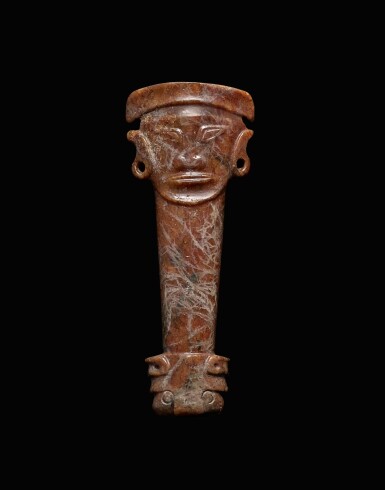
A rare russet jade 'mask' pendant, Neolithic period, Shijiahe culture | 新石器時代 石家河文化 神人獸面玉飾
Estimate
2,000,000 - 4,000,000 HKD
Lot Details
Description
10.4 cm
The present russet jade pendant is a striking example of the spiritual and artistic achievements of the late Shijiahe culture, frequently referred to by archaeologists as the Xiaojia Wuji culture or Post-Shijiahe culture. Flourishing around 2000 BC in the middle reaches of the Yangtze River, with its core in the Handong region of Hubei province, the Xiaojia Wuji culture is celebrated for its highly sophisticated jade-carving traditions and its distinct repertoire of ritual imagery.
This pendant is meticulously worked in the form of a human head with a peaceful, benevolent expression. According to current scholarship, anthropomorphic jades of the Xiaojia Wuji culture generally fall into two distinct categories. The first features fierce expressions with protruding fangs, which are believed to symbolise nature deities and are often referred to as "divine masks" shenmian. The second category, to which the present pendant belongs, features serene, human-like faces without fangs. These are widely considered to represent human ancestors, or "ancestor masks" zumian. Both types served as crucial objects of worship and sacrifice for the ancient peoples of this region, acting as mediums for spiritual communication. The rich russet tones of the jade further enhance the solemn and reverent presence of this ancestral figure.
For closely related examples of this benevolent "ancestor mask" type, compare a jade pendant of similar iconography excavated in 2015 from tomb W8 at the Tanjialing site in Tianmen, Hubei province, attributed to the Xiaojia Wuji culture, illustrated in Nanjing Museum, ed., Yurun zhonghua: zhongguo yuqi de Wannian shishi tujuan [An Epic of Chinese Jade for 10000 Years], Nanjing, 2023, p. 96. Another relevant comparison is a jade human head of the same culture collected in Shimen county, Changde, Hunan province. A third related example from an American museum collection is illustrated by Elizabeth Childs-Johnson and Gu Fang in The Jade Age: Early Chinese Jades in American Museums, Beijing, 2009, pl. 6-10.
本品玉飾呈紅褐色,古樸莊重,為石家河文化晚期精神信仰與玉雕工藝之傑作,考古學界常將此時期稱為「肖家屋脊文化」或「後石家河文化」。肖家屋脊文化,約分佈於公元前2000年前後的長江中游地區,以湖北漢東地區為核心。該文化以其精湛的治玉工藝及獨特的祭祀圖像而聞名於世。
此玉飾精雕人首,面容和善。據學者研究指出,肖家屋脊文化中常見兩類擬人形象的玉器:一類面目猙獰、口露獠牙,普遍認為象徵自然界的神靈,可稱為「神面」;另一類則如本品,面容平和、呈人首形,無獠牙特徵,象徵人類祖先,可稱為「祖面」。兩者皆為史前先民祭祀與崇拜的重要對象。玉質本身的紅褐沁色,更為此祖面平添幾分肅穆與神秘感。
參考相近之「祖面」作例,可比較一件2015年湖北天門譚家嶺遺址W8出土之肖家屋脊文化玉人面像,載於南京博物院編,《玉潤中華:中國玉器的萬年史詩圖卷》,南京,2023年,頁96。另可參考湖南常德石門縣曾採集到的一件肖家屋脊文化玉人頭像。美國博物館亦藏有一件相關作例,著錄於江伊莉與古方合著,《玉器時代:美國博物館藏中國早期玉器》,北京,2009年,圖6-10。
You May Also Like


