
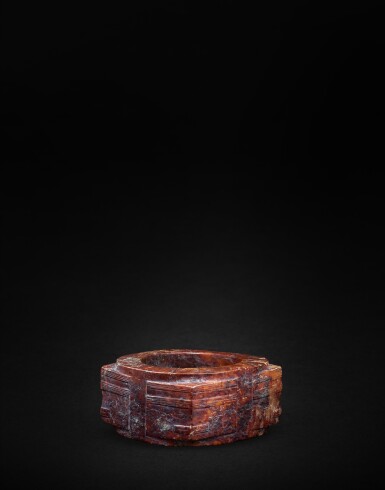
A rare jade 'mask' cong, Neolithic period, Liangzhu culture | 新石器時代 良渚文化 神人紋玉琮
Estimate
1,000,000 - 3,000,000 HKD
Lot Details
Description
7.8 cm
Typical of Liangzhu culture cong, a shape invented and developed from a bracelet by the Neolithic communities in southeast China, this thick-walled square cylinder is decorated with stylised masks neatly arranged on each of the four corners.
The Liangzhu culture in the Yangtze River Delta, which flourished from the late 4th to the end of the 3rd millennium BC, was one of the most prominent Neolithic Chinese civilizations. Among the large variety of Liangzhu artefacts, cong – tubular jades with a central perforation – stand out as iconic of this culture. They were made for the most prestigious ranks in the society. Although the original meanings of cong were lost following the decline of the Liangzhu culture, their form continued to fascinate generations of collectors, connoisseurs, scholars and artisans for centuries. The importance of cong in the history of Chinese art therefore cannot be overstated.
The earliest cong have the form of a circular bangle with a single tier of zoomorphic masks. The rectangular form soon took over and the motif became more complex, often featuring a crowned human figure, perhaps a shaman, on top of an animal mask with protruding goggled eyes. Examples with alternating registers of stylised human faces and animal masks suggest that the motif seen on the present cong represents the face of the shaman and the striated bands probably symbolise the headdress. Towards the dusk of the Liangzhu civilization, these elaborate, fine engravings slowly disappeared and simpler designs appeared, while at the same time taller cong with multiple rows of faces were made.
Compare with two archaic jade vessels, cong, unearthed in Zhejiang, Liangzhu Culture, which are illustrated by Gu Fang in The Complete Collection of Jades Unearthed in China: Zhejiang, Beijing, 2005, pp.105-106; see another similar example excavated in Luzhuang, Zhejiang Province, now in the Nanjing Museum, illustrated in liangzhu wenhua yuqi, Hong Kong, 1989, no.38.
琮內圓中空而外方,柱形,單節,四面,每面頂部兩條平行陰刻線紋,以棱角為中軸對稱淺刻一對圓目,棱線正中部分略微打磨凹陷之,其下亦陷地浮雕方鼻,方鼻之上淺劃鼻孔,由此組成人面。
長江下游環太湖流域的良渚文明,約在公元前三千多年到二千年間達到鼎盛,為後世留下了豐富的文化遺產,是中國新石器時代最重要的文化之一。在良渚出土的古物中,玉琮最具代表性。玉琮呈外方內圓的形狀,僅限貴族使用,其象徵和用途已隨良渚文化的消逝而成謎。然而,數千年來,許多藏家、學者和工匠對玉琮的形式與意義不斷研究與延續製作。雖然良渚文明已消亡,但玉琮作為中國藝術中的重要象徵,歷久不衰,意義深遠。
早期的玉琮形狀圓潤,表面刻有單層獸面紋,巨大的圓眼與尖牙特徵鮮明。隨後,玉琮形狀逐漸呈現方形,紋飾變得更為複雜,出現了羽冠神人與獸面的圖案。神人紋額頭上的橫紋可能象徵羽冠,而獸面則以凸起的圓眼和細緻的卷曲紋為特徵。到了良渚文化晚期,多層玉琮開始盛行,紋飾線條簡化,神人與獸面的刻紋也更為簡約,但依然保留了其獨特的藝術風格。
單節良渚文化的玉琮頗有制式可循,一般以兩條平行陷地陰刻的細密帶飾代表頭髮,陰刻雙眼,鼻樑陷地打磨,鼻孔起地,陰線劃之。可比較兩件出土於浙江的良渚文化玉琮,制式裝飾和本件玉琮幾乎一樣,見古方編,《中國出土玉器全集8·浙江卷》,北京,2005年,頁105及106。另見江蘇省阜寧縣陸莊出土一件褐綠色良渚玉琮,現藏南京博物院,著錄於《良渚文化玉器》,香港,1989年,編號38。
You May Also Like


