
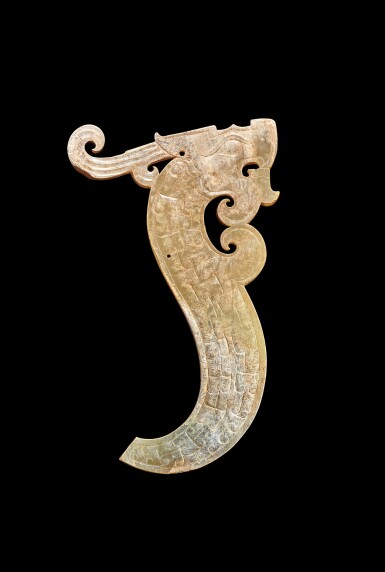
A pale celadon jade 'dragon' pendant, Eastern Zhou dynasty, late Warring States period - early Western Han dynasty | 東周戰國晚期至西漢早期 龍形玉觿
Estimate
200,000 - 400,000 HKD
Lot Details
Description
10.8 cm
Tiffany Chen, Selected Works of Jade, Aurora Art Museum, Taipei, 2003, pl. 126.
Sun Qingwei, Jades of Warring States Period, Aurora Art Museum, Taipei, 2023, pl. 134.
Jade pendants of this elegant, sweeping form are known as xi. Originally functioning in antiquity as practical implements made of bone or horn for untying knots, by the Eastern Zhou dynasty they had evolved into luxurious jade ornaments forming part of the elaborate pectoral sets worn by the elite. The physical act of untying knots became a metaphor for unravelling complex problems; thus, the xi served as a symbol of the wearer's wisdom, decisiveness, and capability.
Xi pendants of this type were usually made as pairs and buried in tombs dating to the Eastern Zhou dynasty. Their form evolved significantly over time: those dating to the Spring and Autumn period closely resemble the shape of an animal's tooth or fang, while examples from the Warring States period are usually slenderer in form. The elaborate dragon-shaped pendants, such as the present lot, developed from the late Warring States period into the early Western Han dynasty.
Compare a similar dragon pendant excavated from a Western Han dynasty tomb at Beishantou in Anhui province, illustrated by Gu Fang, The Pictorial Handbook of Ancient Chinese Jades, Beijing, 2007, p. 240. See also another related example in the Palace Museum, Taipei, illustrated in Art in Quest of Heaven and Truth – Chinese Jades Through the Ages, Taipei, 2012, p. 84, pl. 5-5-17. For a closely related auction example, see a pale green and russet jade 'dragon and phoenix' pendant (xi) of comparable arched form and surface decoration, dated to the Warring States period to Han dynasty, from the Sze Yuan Tang Collection, sold at Bonhams Hong Kong, 5 April 2016, lot 19.
出版
陳臻儀,《古玉選粹》,震旦藝術博物館,台北,2003年,圖版126
孫慶偉,《戰國玉器》,震旦藝術博物館,台北,2023年,圖版134
玉觿本為解結之實用工具,早見於商代,多以骨或角製。至東周時期,玉觿逐漸脫離實用功能,演變為高等級貴族繁複組玉佩中之重要裝飾構件。「解結」於古時亦引申為解決繁雜難題之意,故佩觿象徵佩戴者之聰明才智與果敢決斷。此類玉觿多成對製作,常見於東周墓葬。其形制隨時代演變:春秋時期多呈獸牙狀,戰國時期則漸趨修長。至戰國晚期至西漢早期,開始發展形製不同的龍形玉觿。
安徽省巢湖市北山頭西漢墓出土一件龍形玉觿可資比較,見古方,《中國古玉器圖典》,北京,2007年,頁240。另見台北故宮博物院藏一件戰國晚期至西漢早期的鳳形佩,見《敬天格物:中國歷代玉器》,台北,2012年,頁84,圖5-5-17。拍賣市場亦可參考一件戰國至漢代之青褐玉龍鳳紋觿,其器形弧度及表面紋飾與本品頗為相似,出自思源堂古玉收藏,售於香港邦瀚斯2016年4月5日,編號19。
You May Also Like


