
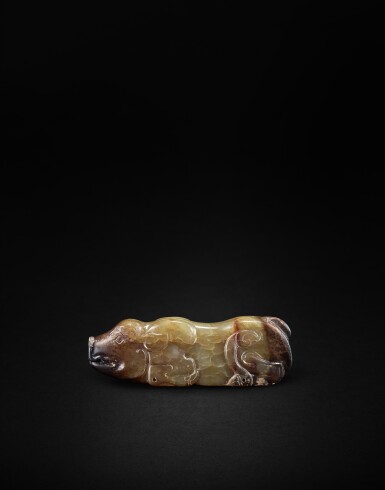
A pale celadon and russet jade pig, Western Han dynasty | 西漢 玉豬
Estimate
300,000 - 600,000 HKD
Lot Details
Description
8.4 cm
Tiffany Chen, Selected Works of Jade, Aurora Art Museum, Taipei, 2003, pl. 174.
Tsai Ching-Liang, Jades of Han Dynasty, Aurora Art Museum, Taipei, 2005, pl. 140.
Skilfully carved in a recumbent posture from a pale celadon stone highlighted by attractive russet inclusions, the present jade pig is a classic example of Han dynasty funerary jades, which were traditionally placed in the hands of the deceased to symbolise wealth and status in the afterlife. The animal is characterised by its stylised, blocky form with minimal yet expressive incised lines delineating its snout, ears, and folded legs. For a closely related Late Western Han dynasty jade pig of similar vivid execution, excavated in 1982 from a Han tomb in Jiancaoping, Taiyuan city, Shanxi province, and now in the Shanxi Provincial Museum, see Zhongguo yuqi quanji 4: Qin, Han, Nanbeichao [Complete Collection of Chinese Jades 4: Qin, Han, Northern and Southern Dynasties], Hebei Meishu Chubanshe, Shijiazhuang, 1993, p. 178, pl. 160.
出版
陳臻儀,《古玉選粹》,震旦藝術博物館,台北,2003年,圖版174
蔡慶良,《漢代玉器》,震旦藝術博物館,台北,2005年,圖版140
本品玉豬圓雕而成,呈伏臥狀,青玉質地溫潤,局部伴有大片褐紅沁色。此類玉豬乃漢代典型之葬玉(握玉),傳統上多置於死者手中,以象徵財富與來世的尊貴地位。匠人以簡練的線條刻劃出豬的口鼻、雙耳及屈曲的四肢,造型古樸,刀法洗練。比較一相近作例,山西省博物館藏一件西漢晚期玉豬,1982年山西省太原市尖草坪漢墓出土,其相更為生動形象,與本品非常相似,著錄於《中國玉器全集4-秦.漢-南北朝》,河北美術出版社,石家莊,1993年,頁178,圖版160。
You May Also Like


