
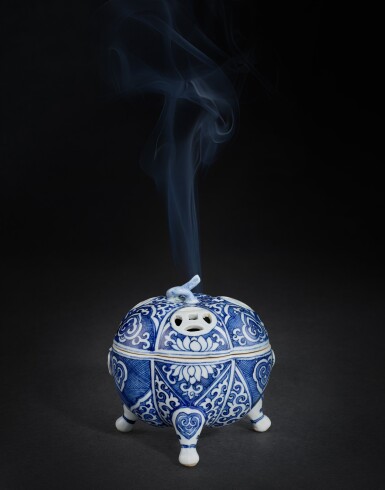
A very rare reticulated blue and white lobed 'gourd' tripod incense burner and cover, Mark and period of Jiajing | 明嘉靖 青花如意蓮紋瓜棱三足蓋爐 《大明嘉靖年製》款
Estimate
600,000 - 800,000 HKD
Lot Details
Description
modelled with a lobed gourd-shaped body resting on three cabriole legs and flanked by two raised ruyi heads, the exterior of the six lobes reserve-decorated with lobed cartouches enclosing alternating motifs of ruyi heads and lotus blooms, all above undulating scrollwork, each of the legs painted with a ruyi head, two circular motifs and a band, the base of the vessel inscribed with a six-character reign mark, the domed cover of corresponding form and decorative motifs, three of the lobes further pierced with coin motifs, all encircling a finial portrayed in the form of a curling stem
h. 12.5 cm
An old Hong Kong family collection, circa 1970.
The Fame of Flame: Imperial Wares of the Jiajing and Wanli Periods, University Museum and Art Gallery, the University of Hong Kong, Hong Kong, 2009, cat. no. 32 and cover.
The present incense burner is extremely rare, and no similar examples appear to be recorded. During the Wanli period, one of the most distinctive decorative features on porcelain was the use of openwork reticulation and sculptural elements, techniques seldom employed in earlier periods. Such pierced designs were most commonly applied to vases and boxes.
Compare a related Jiajing period circular box-shaped incense burner from the Percival David Collection at the British Museum, London, acc. no. PDF,A.653, illustrated in Stacey Pierson, Illustrated Catalogue of Underglaze Blue and Copper Red Decorated Porcelains in the Percival David Foundation of Chinese Art, London, 2004, p.63, no. A653. Although similarly decorated in cobalt blue and reticulated on the cover with coin motifs, the Sir Percival David example is supported on a countersunk base, upon which the phrase fu shou kang ning ('good fortune, longevity, health, and peace'), rather than a reign mark as seen on the present example, is inscribed.
This rare piece was also selected for the cover of the 2009 exhibition catalogue, one of the earliest exhibitions dedicated to Jiajing and Wanli wares.
來源
香港家族舊藏,約1970年
展覽
《爐火純青:嘉靖及萬曆官窯瓷器》,香港大學美術博物館,香港,2009年,編號32及封面
此爐應為孤品,暫未見相類之例錄載。僅見一相關器可資參考,為圓盒形薰爐,署「福壽康寧」款,大維德爵士舊藏,現藏倫敦大英博物館,館藏編號PDF,A.653。其蓋面鏤空金錢紋,蓮紋畫法亦與本品相近,然器形及風格則迥然有別。該器著錄於畢宗陶,《Illustrated Catalogue of Underglaze Blue and Copper Red Decorated Porcelains in the Percival David Foundation of Chinese Art》,倫敦,2004年,頁63,編號A653。
萬曆時期瓷器裝飾工藝中,尤以鏤空與雕塑最為突出,前朝較少施用。其時鏤雕工藝多見於瓶、盒等器。本品作瓜棱形,蓋飾瓜蒂狀鈕,通體均分六棱,下承三足,器形小巧雅馴,頗具書齋清供之致。器身以留白手法繪如意蓮紋,地作網格及卷草紋,蓋面鏤空三組金錢紋。器形與紋飾寓意連年福祿、萬事如意,寓意殊為吉祥。
此爐並獲擢為《爐火純青》展覽圖錄封面,該展為兩岸三地較早以嘉靖、萬曆瓷器為主題的專題展覽之一。
You May Also Like


