
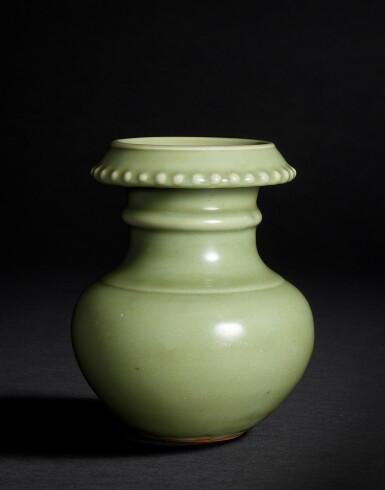
A very rare Longquan celadon pomegranate jar, shiliuzun, Ming dynasty, Hongwu - Yongle period | 明洪武至永樂 龍泉青釉小石榴尊
Estimate
1,000,000 - 3,000,000 HKD
Lot Details
Description
of stoutly potted ovoid form set with a wide cylindrical neck banded with a central rib and surmounted by a down-turned, broad rim edged with studs, the thick olive-green glaze well controlled and ending just short of the countersunk foot, the unglazed footrim fired bright reddish-brown, wood stand
19.3 cm
Collection of the Poon family.
Sotheby's Hong Kong, 17th November 1975, lot 28.
Acquired from the above, thence within the family collection.
This shiliuzun is of delicate form, with meticulously trimmed body, refined workmanship, and luminous glaze, reflecting both the standards of early Ming court porcelain and the high level of production at the Longquan official kilns. According to the Collected Statutes of the Ming Dynasty (Da Ming Hui Dian), in the 26th year of the Hongwu reign, it was stipulated that “all vessels made for imperial use must follow prescribed models,” indicating that the shape, dimensions, and ornamentation of such wares were regulated by official prototypes, making them products of the imperial kilns.
The form of this piece carries features of Tibetan Buddhist metal bum-pa vessels, with its folded rim, slightly drooping edge, and raised boss decoration. In the early Ming, the court adopted a conciliatory policy toward Tibetan Buddhism. The Yongle Emperor in particular valued relations with Tibetan religious leaders and repeatedly dispatched envoys with lavish gifts. Porcelain, as a precious present, was an important part of these tribute lists. The serene glaze colour and sturdy body of Longquan celadon met both the aesthetic preferences and practical needs of the Tibetan region.
The pomegranate holds auspicious meanings in both Han Chinese and Tibetan cultures. In Han Chinese tradition, it symbolises "many sons and abundant happiness." In Tibetan Buddhism, the pomegranate is also regarded as an auspicious fruit, symbolising fertility and completeness. The pomegranate-shaped vessel, through its form and decoration, incorporates this dual cultural symbolism, making it suitable as a religious gift object.
Comparable examples are extremely rare. One from the Qing court collection, identical in size and forming a pair with the present vessel, is now preserved in the Beijing Palace Museum, acc. no. gu-145048, and illustrated in Longquan of the World: Longquan Celadon and Globalization, vol. II: State Vessels, Beijing, 2019, cat. no. 108. It was originally housed in the “Ancient Objects Exhibition Hall” established at the Palace Museum in 1914, which contained 50 Longquan celadon pieces formerly kept at the Chengde Mountain Resort and the Shenyang Imperial Palace. These Longquan wares, legacies from previous dynasties, continued to be used in the Qing court as decorative objects and ritual vessels.
Another example, slightly larger at 20 cm in height, is now in the British Museum, recorded in Jessica Harrison-Hall, Catalogue of Late Yuan and Ming Ceramics in the British Museum, London, 2001, no. 16:33. The author notes that: “ the roll-top mouth raised bosses or studs is a feature of a number of Tibetan brass and copper ewers in the British Museum’s collection. It is likely that a metal-work prototype exists for this jar….”
This vessel represents a precious survival that integrates craftsmanship, artistry, and history. It fills a gap in the study of early Ming imperial kiln porcelain and provides new material evidence for research into Sino-Tibetan cultural exchange and the imperial gift system of the early Ming. With very few extant examples and high artistic value, it stands as an outstanding representative of Ming ceramic art.
來源
潘氏家族收藏
香港蘇富比1975年11月17日,編號28
購於上述來源,後經家族傳承
此器造型嬌小,修胎規整,製作精細,釉色肥厚瑩潤,通體無紋飾,體現了明初宮廷用瓷的標準及龍泉官窰的高水準。根據《大明會典》記載,洪武二十六年規定「凡燒造供用器皿等物,須要定奪製樣」,說明此類器物的造型、尺寸、紋飾均有宮廷頒發的「官樣」規範,屬官窰御製品。
觀此造型,承載了藏傳佛教金屬賁巴壺的特色,器口折沿並略下垂邊沿及上飾之鼓釘紋飾。明初朝廷對藏傳佛教採取懷柔政策,永樂帝尤其重視與藏區宗教領袖的關係,多次遣派使者賞賜。瓷器作為貴重禮品,是賞賜清單中的重要組成部分。龍泉青瓷的釉色溫潤、質地堅實,符合藏地審美與實用需求。
石榴在漢藏文化中均有吉祥寓意。漢地視石榴為「多子多福」的象徵,藏傳佛教中石榴亦被視為吉祥果實,象徵豐饒與圓滿。石榴尊的造型裝飾兼具雙重文化寓意,適合作為宗教賞賜品。
傳世品中類同者屈指可數,清宮舊藏一例與本器尺寸一致可以成對,現藏於北京故宮博物院,館藏編號:故145048,並錄於《天下龍泉:龍泉青瓷與全球化》,卷2:國家公器,北京,2019年,編號108。清宮舊藏此例原屬 1914年成立之故宮古物陳列所收藏,所內藏五十件原藏於承德避暑山莊和瀋陽奉天故宮的龍泉青瓷。這些前朝遺留下來的龍泉窰器至清朝仍被作為宮廷陳設及祭禮用器。
另一例稍大,高20公分,現藏大英博物館,著錄於霍吉淑,《Catalogue of Late Yuan and Ming Ceramics in the British Museum》,倫敦,2001年,編號16:33。書中筆者提到折沿及鼓釘與大英博物館藏的西藏金屬賁巴壺相似,極有可能是此類石榴尊的原型。
本器融合了工藝、藝術與歷史的珍貴遺存,更填補了明代早期官窰瓷器研究的空白,也為明初漢藏文化交流、宮廷賞賜制度研究提供新的物證。此類器物存世量稀少,藝術價值高,為明朝陶瓷藝術的傑出代表。
You May Also Like


