
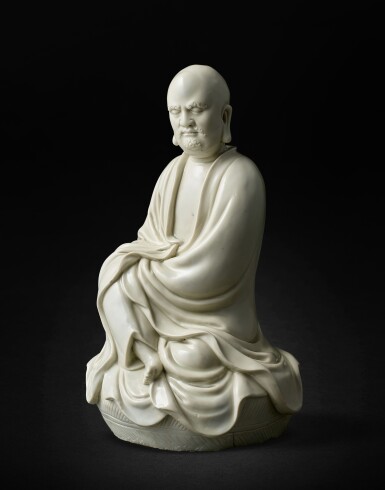
A blanc de Chine seated figure of Bodhidharma, By He Chaozong, Late Ming dynasty | 明末 德化白釉達摩坐像 《何朝宗》款
Estimate
1,200,000 - 2,400,000 HKD
Lot Details
Description
modelled seated on an oval mat-like pedestal with the right knee raised and the left leg tucked beneath, the arms resting on the right knee beneath a voluminous robe opening at the chest and falling in layered folds to reveal the right foot, the face with a contemplative expression, downcast eyes and pendulous earlobes, the brows, moustache and beard picked out in tight curls, the back impressed with a He Chaozong seal mark within a double-gourd cartouche, wood stand
25.2 cm
A & J Speelman Oriental Art, London, circa 1970.
He Chaozong, the Dehua kilns' most famous potter and greatest figure sculptor, lived and worked in the late Ming period, around the late 16th and early 17th centuries. His figures are characterised by remarkable sculptural quality, with the most delicate facial features and bold garment folds. He is mainly known through his extant work, which often bears his seals, but very little is recorded about the man himself. His works defined the characteristic Dehua style, and his images, which have provided models for porcelain sculpture until today, established a standard that has never since been reached again.
Compare a similar blanc de Chine seated figure (h. 22.2 cm) of Bodhidharma, also impressed with a maker's mark within a double-gourd cartouche, though modelled without a deis like the present example, published in P. J. Donelly, Blanc de Chine, London, 1969, pl. 147b. See also another He Chaozong-marked blanc de Chine figure of Bodhidharma, rendered seated on a low deis, sold at Christie's Hong Kong, 1st June 2016, lot 3324.
Two similar, however, unmarked, blanc de Chine figures of Bodhidharma are preserved in the British Museum, London, published in Ming Ceramics in the British Museum, London, 2001, nos 17:13 and 17:14. The first example (h. 16.5 cm), like the present figure, is shown seated with the right knee raised, but its detailing is more simplified, particularly in the treatment of the robe’s folds. The detailing of the second example (h. 30.5 cm) is more comparable to that of the present figure, as evident in the robes and the double-line band on the feather-patterned dais; however, it is depicted seated cross‑legged on the oval dais and covered with a crackled glaze. See also another very similar figure (h. 29.8 cm) in the Metropolitan Museum of Art, New York, published in John Ayers, Blanc de Chine: Divine Images in Porcelain, China Institute Gallery, New York, 2002, cat. no. 30.
來源
史博曼,倫敦,約1970年
何朝宗,活躍於晚明十六世紀末至十七世紀初,乃德化窰最有名的陶匠,擅人物塑像,其工藝超卓,衣紋粗獷飄逸,眉目精緻細膩,毫髮畢現。作品甚豐,多有其印,惟其人生平不詳。何朝宗之技,空前絕後,奠定了德化瓷藝風格,他的作品,時至今日,仍用作瓷質塑像的底本。
可參考一尊相近之德化白瓷達摩坐像(高22.2公分),同樣有雙葫蘆形《何朝宗》印,但未設底座,與此拍品有所區別,載於P. J. Donnelly,《Blanc de Chine》,倫敦,1969年,圖版147b。另參見另一尊有《何朝宗》款之德化白瓷達摩坐像,坐於低座上,售於香港佳士得2016年6月1日,編號3324。
倫敦大英博物館亦藏有兩尊類似但不帶《何朝宗》款的德化白瓷達摩坐像,載於《Ming Ceramics in the British Museum》,倫敦,2001 年,編號 17:13 及 17:14。其一(高16.5公分)與本尊相似,呈右膝屈起之坐姿,唯細節較為簡略,尤以袍褶處為明顯;另一尊(高30.5公分)之造型細膩程度則更接近本品,特別是袍服及羽紋底座上之雙線紋,惟座姿為雙腿交叉而坐,釉見開片。另參見一尊非常相似之坐像(高29.8公分),現藏於紐約大都會藝術博物館,著錄於John Ayers,《Blanc de Chine: Divine Images in Porcelain》,紐約中國協會美術館,2002年,編號30。
You May Also Like


