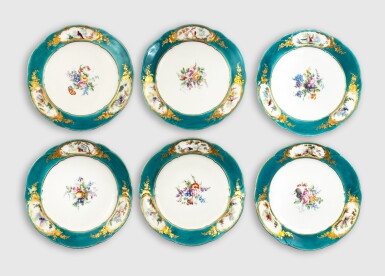
Six Sèvres Porcelain Green-Ground Plates (Assiette à palmes) from the Service for Frederik V of Denmark or Madame de Pompadour, circa 1757
Estimate
12,000 - 18,000 USD
Lot Details
Description
Six Sèvres Porcelain Green-Ground Plates (Assiette à palmes) from the Service for Frederik V of Denmark or Madame de Pompadour, circa 1757
painted with a bouquet of flowers at the center, the border with three oval cartouches painted with birds in landscapes within gilt floral scrollwork cartouches, within moulded scrolls, the shaped rim edged in gilding, four with interlaced LL marks enclosing date letter D for 1757, one with interlaced LL mark in blue, various incised marks
diameter 9 3/4 in.
24.8 cm
Possibly from the service presented by Louis XV to Frederick V (1723-1766), King of Denmark and Norway in 1758, or from the group of twenty-four plates owned by Madame de Pompadour (1721-1764);
Hungerford Crewe (1812-1894), 3rd Baron Crewe, FSA FRS, Crewe Hall, Cheshire;
Thence by descent until sold, Bonhams, London, 7 July, 2022, lot 156;
Where acquired by the present collector.
A service described as “de porcelaine de France, en vert, peint à figures, fleurs & oiseaux” was recorded in the Livre-Journal of the Paris marchand-mercier Lazare Duvaux on 7 March 1758. It was supplied to the abbé-comte de Bernis, Minister of Foreign Affairs, who acted as intermediary in the presentation of the service from Louis XV to Frederick V of Denmark. Decorated in a newly developed green ground and painted with a variety of scenes featuring birds in landscapes, flower bouquets, and garlands, the service represented one of the most lavish diplomatic gifts of the period. Louis XV had commissioned it in return for the gift of stallions that Frederick V had presented in 1757. The importance of this service is recorded in the Mémoires du Duc de Luynes sur la cour de Louis XV (1735-1758), Paris, 1860-1865, vol. 16, pp. 92, 144, and 328, where the Duc de Luynes describes several visits by Louis XV to the factory to oversee its development.
Valued at 34,542 livres and 5 sous, the service was formally presented in Copenhagen on 22 May 1758 by Jean-François Ogier d’Enonville, président honoraire of the Parlement of Paris and French Ambassador Extraordinary to Denmark. Duvaux’s entry 'no. 3068' records ninety-six assiettes priced at 60 livres each. However, twenty-four of these plates were removed from the service before its delivery to de Bernis, leaving only seventy-two to be included in the royal gift. The reason for this reduction remains uncertain. David Peters has suggested the missing 24 plates may have been delivered to Madame de Pompadour instead (see David Peters, Sèvres Plates and Services of the 18th Century, vol II, 2005, revised edition 2026, pp. 301-06, no. 57-2). Indeed, following the Marquise's death in 1764, an inventory was drawn up of her possessions, which included twenty-three assiettes à bord verd, which cannot be identified in the Sèvres sales registers. Savill, op. cit., also suggests that Madame de Pompadour may have acquired them from Lazare Duvaux or that they may have been given to her by Louis XV.
Crewe Hall, Cheshire
Crewe Hall was built in the grand Jacobean style between 1615 and 1636 by Sir Randolph Crewe (1558-1646). It was reputedly remarked that with the house he had "brought London into Cheshire". The house's distinctive character reflected the work of Flemish, Italian and other foreign craftsmen. It was restored and enlarged in 1837 and, following a devastating fire in 1870, substantially rebuilt for Hungerford, Lord Crewe (1812-1894) by Sir Edward Barry, architect of the Royal Opera House and the Palace of Westminster. On Lord Crewe's death in 1894, the baronetcy became extinct and the estate passed to his nephew, Robert Monkton Milnes, Baron Houghton, later Earl and Marquess of Crewe. Before the family left the house in 1922, Crewe Hall reportedly comprised 190 rooms, employed around 100 servants and 20 gardeners, and stood at the centre of an estate that included approximately 50 farms and 200 cottages. In 1931 the Hall and surrounding estate were offered to Cheshire County Council, which declined the gift, and were subsequently sold to the Duchy of Lancaster in 1936.
The Crewe collection, largely assembled by Hungerford Crewe, included one of the most remarkable surviving works of eighteenth-century Sèvres porcelain: the celebrated pot-pourri vase en vaisseau painted by Charles-Nicolas Dodin, now in the Musée du Louvre, inv. no. OA 10965. Exhibited at the South Kensington Museum in 1862, the vase was then described as :No. 1,280 "Vase in form of a ship (vaisseau à mât) of rose Dubarry ground with green border". Subsequently owned by Alphonse and Édouard de Rothschild, it later entered the collection of M. and Mme Grog-Carven, who gifted it to the Louvre in 1984.
Related Literature
R. Shaw, A Thing of Beauty is a Joy For Ever, London, 2017, pp. 28-29.
R. Savill, Everyday Rococo, Madame de Pompadour & Sèvres Porcelain, Vol. 2, Norwich, 2021, pp, 661, 663, fig. 15.5.
You May Also Like