
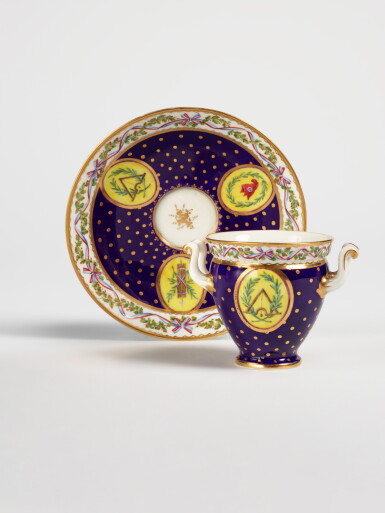
A Sèvres Porcelain Revolutionary Two-handled Cup and Stand (Gobelet à bandeau et soucoupe), circa 1793
Estimate
2,000 - 3,000 USD
Lot Details
Description
A Sèvres Porcelain Revolutionary Two-handled Cup and Stand (Gobelet à bandeau et soucoupe), circa 1793
the cup of oviform with gilt-edged bracket handles, painted with three yellow-ground oval medallions reserving revolutionary attributes including the Phrygian cap, Masonic triangle, and fasces within laurel wreaths, the medallions on a gilt-dotted dark-blue ground, the rims decorated with tricolor ribbons entwined with garlands of leaves, R F Sevres script marks in blue, painter's mark of an X for Jacques-François Micaud père (active at Sèvres between 1757-1810), gilder's mark IN for Jean Chauvaux jeune (active at Sèvres between 1764-1800), indistinct incised mark to stand
diameter of stand 6 3/8 in.
16.3 cm
Michele Beiny, Inc., New York;
From whom acquired by the present collector on 27 July, 2021.
On 6 October 1789, the workers of the Sèvres manufactory witnessed an extraordinary spectacle: Louis XVI, Marie-Antoinette and the french royal family passing through the town of Sèvres under escort as they were compelled to leave Versailles for the last time and head for Paris.
Deprived of much of its aristocratic clientele, the manufactory endured considerable hardship brought on by the revolution. Sèvres nevertheless continued production, although wages were often reduced or went unpaid. The factory remained royal property until the establishment of the Republic in August 1792, when it passed under state control. In 1793, the Minister of the Interior, Dominique-Joseph Garat, ordered the destruction of moulds and models associated with the monarchy. The factory's director, Antoine Régnier, assigned seven workers to carry out the task, systematically dismantling works bearing overt royal associations. At the same time, the celebrated interlaced L mark was replaced by RF (République Française), sometimes accompanied by the name Sèvres. During the Revolutionary period, the manufactory became an important vehicle for the dissemination of civic and republican ideals. Étienne-Maurice Falconet's graceful L'Éducation de l'Amour gave way to subjects such as L'Éducation du Citoyen, La France gardant sa Constitution, and La Liberté et l'Égalité, modelled by Louis-Simon Boizot. Charles-Nicolas Dodin likewise produced painted allegories celebrating the new political order.
As demonstrated by the present gobelet à bandeau, a shape conceived by Boizot for Marie-Antoinette's celebrated dairy at Rambouillet, Revolutionary iconography quickly entered the painters' repertoire, with tricolour ribbons reflecting the new political order. The bonnet phrygien, or Cap of Liberty, appears alongside the Roman fasces, emblematic of civic authority and unity, and the equilateral triangle, a symbol associated with equality, virtue and regeneration. Together, these motifs encapsulate the visual language of Revolutionary France and the transformation of Sèvres from a royal manufactory into an instrument of the Republic.
You May Also Like


