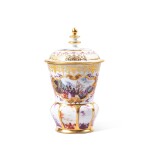
A pair of Vienna (Du Paquier) porcelain vases and covers emblematic of Victory and Peace, circa 1739
Live auction begins on:
June 24, 12:30 PM GMT
Estimate
40,000 - 60,000 EUR
Lot Details
Description
each surmounted by a flattened domed cover with silvered-edge crowned with a standing male or female figure, the gilt gadrooned rim set at either side with seated bound figures flanking a stylized diaper-pattern lappet, Victory represented as a near-nude female figure standing with her foot resting on a sphere, beside a seated lion, raising a striped drapery, Peace as a female figure clad in a flowered skirt and puce cuirass, with a laurel wreath in her hair, standing beside a lamb and lifting a green drapery, the cylindrical vase moulded and applied with two putti at the sides holding blue cornucopias issuing flowers, between an upper band of lappets and a lower band of gadroons, with fantastical birds in flight above, all raised on a short, spreading circular socle, the interior painted with orange and purple flowering branches
(4)
Heights 16 in and 15 ¾ in; 40,5 cm and 40 cm
The Property of a Lady, Sotheby’s, London, 24 February 1959, lot 104 (as Vezzi, for £700);
Acquired at the above sale by Signor Renato Bacchi;
By repute, the Property of a prominent family, Solingen, Germany;
Acquired from the above.
Giuseppe Morazzoni, Le Porcellane Italiane, Vol. I, Milan 1960, tav. 24, one illustrated (as Vezzi);
Claudia Lerner-Jobst, ‘A Monumental Pair of Covered Vases Decorated with Allegorical Depictions of Victory and Peace’, in Hans Ottomeyer and Sarah-Katharina Andres-Acevedo, From Invention to Perfection: Masterpieces of Eighteenth-Century Decorative Art, Munich, 2016, cat. no. 29.
Founded in the early eighteenth century at a moment when Europe was gripped by an almost feverish fascination with “white gold,” the Du Paquier porcelain factory in Vienna emerged as one of the most daring and short-lived triumphs of early ceramic enterprise. Established in 1718 under the patronage of Claudius Innocentius du Paquier, an imperial official with both ambition and vision, the factory broke the closely guarded monopoly of Meissen and became the second European manufactory to master true hard-paste porcelain. Its wares—brilliantly enamelled, technically adventurous, and often boldly imaginative—capture the restless energy of a courtly culture eager to rival the splendor of the East. Though its existence was brief, lasting little more than two decades, before Du Paquier was forced to sell the factory to the state in 1744, these early porcelains stand today as a vivid testament to innovation under pressure, where artistic brilliance and economic risk collided to produce objects of enduring fascination.
The present vases appear to be unique within the known surviving works of early Du Paquier production, with no closely comparable examples recorded to date.
On 18 September 1739 with the signing of the Peace of Belgrade, the Russo-Austrian-Turkish War concluded. It proved deeply damaging for both the Austro-Hungarian Empire and its ally, Russia. Under the terms of the treaty, Austria was compelled to relinquish territories to the Ottoman Empire that it had acquired in 1718. In her discussion of the present vases in the 2016 Munich exhibition From Invention to Perfection: Masterpieces of Eighteenth-Century Decorative Art, Claudia Lerner-Jobst suggests that the finials, which symbolise Victory and Peace, may indicate that the vases were conceived to commemorate the treaty itself—perhaps in an effort to cast a more optimistic light on what was, in many respects, a significant political defeat.
It would not represent the first instance of Du Paquier porcelain serving a diplomatic purpose. Following the war, an armorial service was presented by the Habsburg Emperor Charles VI (1685–1740) to the Russian Tsarina Anna Ivanovna (1693-1740) in gratitude for Russia’s support of Austria against the Ottoman Turks. Echoing the treatment of the figures on the present vases, the finials of the tureens were similarly modelled as seated Turkish figures and nearly all surviving examples from this service are now preserved in museum collections, for example, The Metropolitan Museum of Art, New York, obj. no. 1982.60.330a,b. For a fuller discussion of Du Paquier porcelain as an instrument of imperial diplomacy, and of the service made for Tsarina Anna Ivanovna in particular, see Ghenete Zelleke, ‘Gifts, Diplomacy and Foreign Trade: Du Paquier Porcelain Abroad – Austria and Russia’, in Fired by Passion: Vienna Baroque Porcelain of Claudius Innocentius Du Paquier, Stuttgart, 2009, pp. 948–971.
The attribution of the present vases was the subject of debate in the mid-20th century, with scholars then proposing a Venetian origin. Such uncertainty is perhaps unsurprising given the close relationship between the early Venetian and Viennese hard-paste porcelain manufactories. Francesco Vezzi is known to have visited Vienna in 1719, the year before he founded his factory, where he likely became acquainted with Claudius Innocentius du Paquier’s newly established enterprise. Shortly thereafter, one of Du Paquier’s principal assistants, Christoph Conrad Hunger, left Vienna for Venice and is thought to have provided the technical expertise essential to Vezzi’s ambitious undertaking. The movement of craftsmen and ideas between the two centres is further reflected in notable stylistic parallels, particularly in the use of brilliant enamel colours, chinoiserie decoration, and Baroque silver-inspired forms.