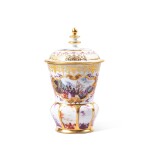
A Meissen porcelain seladon-ground coffee barrel and stand, circa 1738-40
No reserve
Lot closes
June 25, 09:05 AM GMT
Estimate
4,000 - 6,000 EUR
Current Bid
500 EUR
4 Bids
No reserve
We may charge or debit your saved payment method subject to the terms set out in our Conditions of Business for Buyers.
Read more.Lot Details
Description
modelled by J. J. Kändler, the barrel painted with cartouches of figures in European landscapes and purple-camaïeu landscape scenes, surmounted by a mounted cross-legged chinoiserie figure with a teabowl and saucer forming the stopper, supported on an elaborate three-footed scrollwork base supporting two female figures flanking a shield boss painted with a landscape, the sides painted with vignettes of chinoiserie figures, with a bearded male figure support at the reverse, the barrel fitted with a gilt-metal spigot in the form of crowned interlaced LL’s, the stand with crossed swords mark in underglaze-blue
(3)
Height overall 16 ⅛ in; 41 cm
Property from the collection of comte Anne-Jules de Noailles (1900-1979), Thierry de Maigret, Paris, 5-6 December 2023, lot 58;
Acquired at the above sale.
The present porcelain barrel model may possibly derive its inspiration from the celebrated giant wine cask commissioned by Augustus the Strong for the cellars of the fortress of Königstein, the hilltop stronghold overlooking Dresden. Designed by the court architect Matthäus Daniel Pöppelmann, the enormous vessel was constructed in 1723 and filled in 1725 with an extraordinary 238,600 litres of wine. It was the third such cask installed at Königstein, following those commissioned by the Electors Johann Georg II and Johann Georg III.
The barrel quickly became a symbol of Saxon courtly magnificence and appears to have inspired Meissen's porcelain interpretation. An earlier version in porcelain was modelled around 1730 with a separate flat stand supported by four figures, and example today survives in the collection of the Louvre (inv. OA 10861). Like its predecessors, Augustus's giant cask eventually deteriorated and, after some fifty years, was replaced by a smaller barrel. Following further repairs, it was finally dismantled in 1819. Today, only two carved vine-leaf ornaments from the monumental structure survive.
The model features in Kändler’s work reports for August 1738: “Eine starck Verzierte Unterlage Zum coffee Füßgen gefertiget, Selbige ruhet auf 3. Sauber ausgearbeiteten Schnirkeln da auf jeder eine Fügur siezet als 2 Weibers und ein Mannes Bild auf der Vorderseite ist ein zierliches Schild befindl” (Ulrich Pietsch, Die Arbeitsberichte des Meissener Porzellanmodelleurs Johann Joachim Kaendler 1706 - 1775, Leipzig, 2002, p. 56). A further example with a yellow-ground barrel together with its stand painted with the arms of Count Brühl is illustrated in Ulrich Pietsch and Claudia Banz, Triumph der blauen Schwerter, Dresden, 2010, p. 242, cat. no. 172. The inventory of Count Brühl's pantry lists '3 Grosse Fässer mit 1 Bacchus' and '2 kleinere dergl.', [3 large barrels with 1 Bacchus and 2 smaller similar]. A purple-ground barrel with a stand was in the historic collection of Baron von Born, Budapest, sold, Rudolph Lepke's Kunst-Auctions-Haus, Berlin, 4 December 1929, lot 129, and later entered the Marouf collection. Like the present example, both of the above mentioned examples feature the earlier version of a stand with a male bearded figure at the reverse.
Comte Anne-Jules de Noailles (1900-1979)
The only son of the Mathieu Fernand de Noailles (1873–1942) and Anna Bibesco-Bassaraba (1876–1933), princesse de Brancovan, Anne-Jules de Noailles was raised in Parisian high society by a mother who held salons, bringing together the most famous intellectuals, writers and artists of the time. A great collector, Anne-Jules donated important pieces from his collection to the Louvre Museum, including fourteen pieces of 18th-century Meissen porcelain, and to the Musée national de la Céramique de Sèvres, he donated twenty pieces of 18th-century Vincennes and Sèvres porcelain.
Sotheby’s is grateful to Maureen Cassidy-Geiger for kindly sharing these image sources.