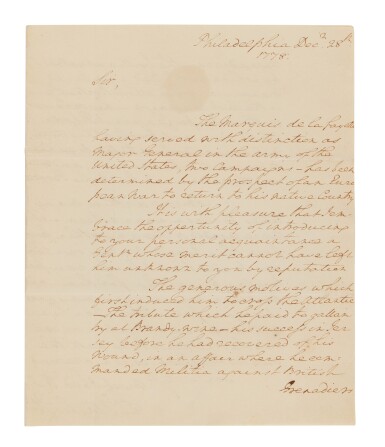
View full screen - View  of Washington, George | An extraordinary letter marking the conjunction of three of the most consequential figures of the American Revolution: George Washington, the Marquis de Lafayette, and Benjamin Franklin.

Property from the Jay T. Snider Collection of Benjamin Franklin

Washington, George | An extraordinary letter marking the conjunction of three of the most consequential figures of the American Revolution: George Washington, the Marquis de Lafayette, and Benjamin Franklin

Estimate

1,000,000 - 1,500,000 USD

Lot Details

Description

Washinton, George

Autograph letter signed (“Go: Washington”) as commander of the Continental Army, 2 pages (241 x 198 mm) on the first leaf of a bifolium of laid paper (watermarked Posthorn | GR), Philadelphia, 28 December 1778; faint seal stain, central vertical crease neatly reinforced. Accompanied by the original full-sheet address wrapper (343 x 255 mm; watermarked Dove and Olive Branch | WMT) directed in a clerical hand to “The Honble. | Benjamin Franklin Esqr | Minister Plenipotentiary of the United States | Versailles,” clerical file docket (“General Washingtons”), fragment of red wax seal; worn with loss and repair at fold creases. Please note: the unusual separate address leaf has preserved the letter in remarkably fresh condition. Morocco folding-case gilt, chemises, by Papuchyan H & H Bindery.


The commander of the Continental Army introduces Lafayette to the fledgling nation’s Minister to France: “It is with pleasure that I embrace the oppertunity of introducing to your personal acquaintance a Gentn whose merit cannot have left him unknown to you by reputation.”


In addition to being Washington’s most explicit expression of his fatherly affection for Lafayette, this letter is also an epitome of the three elements that combined to win American Independence: military capability, diplomatic acumen, and French assistance. 


“The Marquis de la fayette having served with distinction as Major General in the army of the United States, two Campaigns—has been determined by the prospect of an European War to return to his native Country. “It is with pleasure that I embrace the oppertunity of introducing to your personal acquaintance a Gentn whose merit cannot have left him unknown to you by reputation.


“The generous motives which first induced him to cross the Atlantic—The tribute which he paid to gallantry at Brandy-wine—his success in Jersey before he had recovered of his Wound, in an affair where he commanded Militia against British Grenadiers—the brilliant retreat by which he eluded a combined manoeuvre of the whole British force in the last Campaign—his services in the enterprize against Rhode Island—are such proofs of his Zeal, Military ardour & talents as have endeared him to America, and must greatly recommend him to his Prince.


“Coming with so many titles to claim your esteem—it were needless for any other purpose than to endulge my own feelings to add that I have a very particular friendship for him—and that whatever services you may have it in your power to render him will confer an obligation on one who has the honor to be with the greatest respect, esteem & regard Sir—Yr Most Obedt H. Ser.”


George Washington and Lafayette first met in Philadelphia on 31 July 1777, with very different paths bringing them together at the Pennsylvania State House. Washington had served with distinction, though not always with success, as commander in chief of the Virginia Regiment during the French and Indian War. During that conflict, he was plagued by many of the same problems that would occur during the Revolution: insufficient troops, poor supply, erratic pay, challenges to his authority, and a sometimes-interfering civilian government.


During the first eighteen months of his command of the Continental Army, the American general had endured the siege of Boston, the evacuation of New York, and the catastrophic loss of Fort Washington. Only his brilliant leadership in the New Jersey campaign during the winter of 1776–1777, including the daring midnight crossing of the Delaware River, sustained the Americans’ revolution long enough for it to be joined by the young French captain and adventurer.


Marie Joseph Paul Yves Roch Gilbert du Motier, Marquis de Lafayette, was only nineteen years old, an orphan, and one of the wealthiest aristocrats in Europe when his imagination was fired by stories of the nascent American Revolution that he heard related by the Duke of Gloucester, brother of George III. In early 1777, Lafayette resigned his place in the French Army and secretly contracted with the American ministers then in Paris, Silas Deane and Arthur Lee, to assume a commission as a major general serving under Washington. He purchased an outfitted his own ship for the journey, La Victoire, and sailed for the United States in April 1777.


Lafayette was initially received coldly at Philadelphia; unbeknownst to him, Deane had been intemperate with his patronage, and Congress had been overrun with European soldiers of fortune seeking command positions, whose letters of introduction had been larded by Deane with guarantees of rank and promises of the most generous compensation. Shortly, however, Congress recognized the diplomatic benefit of keeping the youthful but influential Marquis contented, and he was commissioned a major general on 31 July, just four days after his arrival in Philadelphia.


Henry Laurens, a congressional delegate from South Carolina, explained to his business manager, John Lewis Gervais, the reasons that Congress granted a commission to Lafayette: “He required no pension, no Special Command; the honour of fighting near General Washington & having rank in the army was he coveted except opportunities to shew his Zeal for the glorious cause of American Freedom. …”


The day that he was commissioned, Lafayette met Washington and the next, while conducting a joint review of troops, “The general invited him to establish himself in his household, and from that moment he looked upon it as his own; it was with such simplicity that two friends were united whose attachment and confidence were cemented by the greatest of causes” (from Lafayette’s Memoir of 1779, written, as was the contemporary manner, in the third person).


Still, the Congress viewed Lafayette’s appointment as strictly honorary, a position that Washington seemed at first to agree with. Both Washington’s own attitude and the prevailing congressional perspective towards Lafayette’s fitness for a field command seemed to shift after the Battle of Brandywine, 11 September 1777. The Continentals had chosen Brandywine Creek as the point to make their first defensive stand against the British advance on Philadelphia. Poor reconnaissance and unfamiliarity with the battle terrain forced Washington to withdraw in an engagement that left both sides with significant casualties. But when Washington earlier had tried to rally his troops, Lafayette was by his side, dismounting at one point to assist the scattering infantry in fixing their bayonets. In what his one-time mentor Jonathan Kalb cynically termed “an excellent bit of good fortune,” Lafayette sustained a bloody but uncomplicated wound in the leg.


The Marquis was one of just two wounded that Washington mentioned by name in the account of the battle that he sent a midnight to the Continental Congress. Word of his valor spread through the colonies and especially broadcast by the President of Congress, Henry Laurens, who now counted Lafayette “as a friend, a Countryman, & a Member of So Carolina.”


While recuperating at a Moravian community near Bethlehem, Lafayette renewed his petition for a field command in a letter, 14 October 1777, so candid that when it was returned to him after Washington’s death, he attempted to redact some of his more critical comments about the Continental Congress. The letter avers that he was addressing Washington “with all the confidence of a son, of a friend, as you favoured me with those two so precious titles. …” Writing not “to my general, but to my father and friend,” the orphaned Lafayette put his future in America entirely in the childless Washington’s hands.


And when Washington next broached the topic of Lafayette’s commission with the Congress, 1 November 1777, he was no longer seeking direction from the legislature, but instead delicately and cunningly providing it: “it appears to me, from a consideration of his illustrious and important connections—the attachment which he has manifested to our cause, and the consequences, which his return in disgust might produce, that it will be advisable to gratify him in his wishes. … Besides, he is sensible—discreet in his manners—had made great proficiency in our Language, and from the disposition he discovered at the Battle of Brandy Wine, possesses a large share of bravery and Military ardor.”


Shortly after Lafayette rejoined General Washington at his headquarters, he led a skirmish expedition against a corps of Hessians attached to Cornwallis’s troops and put the larger force to flight. Lafayette could no longer be denied: on 1 December 1777 Congress resolved “That General Washington be informed, it is highly agreeable to Congress that the Marquis de la Fayette be appointed to command a division of the continental army.” Washington confirmed the appointment in his General Orders of 4 December, placing the Frenchman in command of a division of Virginia light troops with full authority as a major general.


Lafayette’s transition to a formal officer of the line could not have come at a more helpful moment for Washington. The Continental Army was just entering the brutal winter encampment at Valley Forge, while Washington was personally facing one of the most sinister challenges to his military authority, the Conway Cabal. Lafayette’s support during these two crises never wavered, but soon the circumstances of the two men were reversed. Lafayette was forced to abandon an ill-conceived invasion of Canada to rally its French citizens against the British, and it was Washington’s turn to offer comfort and support.


On 1 May 1778, word reached Valley Forge that the historic Franco-American treaty of amity and commerce had been negotiated and signed in Paris some three months earlier. That day Lafayette wrote to Laurens and President of Congress, noting—accurately, if immodestly—“I am myself fit to receive as well as to offer congratulations in this happy circumstance.” He expanded on this theme in his Memoir of 1779: “By leaving France with such éclat, M. De Lafayette had served the revolution. One part of French society became interested in it, and the other was at least more aware of it. If a spirit of emulation made the people of the court wish for war, the rest of the country supported the young rebel, shared his interests, and followed his progress.”


Washington’s trust in Lafayette continued to increase during the 1778 campaign. He was given charge of the only substantial force deployed from Valley Forge encampment, when he led a reconnaissance force of 2,200 towards the British positions in Philadelphia in mid-May. His position was discovered, and on 20 May he cleverly avoided capture by a much larger force at Barren Hill, Pennsylvania (now known as Lafayette Hill). Late in June, when the British withdrew from Philadelphia to New York City, Lafayette was again Washington’s choice to lead the Americans against the Redcoats as they retreated through New Jersey.


After seeing action at Barren Hill and the Battle on Monmouth, Lafayette was deputed to Newport to serve as a liaison between the French naval squadron under the command of the Comte d’Estaing and the American troops directed by General Sullivan. Poor weather rendered the French ships of little use, but Lafayette was instrumental in keeping both sides of the new alliance on good terms. It was about this time that Washington wrote to Gouverneur Morris, then representing New York in the Continental Congress, “I do most devoutly wish that we had not a single Foreigner among us, except the Marquis de la Fayette, who acts upon very different principles than those which govern the rest.”


As the armies prepared to take up winter camps, Lafayette wrote to the President of Congress, requesting leave to return to France in order to “present myself before the king, and know in what manner he judges proper to employ my services”—the Franco-American alliance having made war between France and Great Britain inevitable.


In late October, Congress granted Lafayette leave to go to France and return “at such time as shall be most convenient to him”; the delegates also resolved that Benjamin Franklin, recently appointed minister plenipotentiary to the Court of France, should “be directed to cause an elegant sword, with proper devices, to be made and presented, in the name of the United States, to the Marquis de la Fayette.” Lafayette immediately left for Boston but developed a severe illness that forced him rest at Fishkill for nearly a month before resuming his journey.


When Lafayette departed Boston on the frigate Alliance on 11 January 1779 (arriving in Brest on February 6), he carried this letter of introduction to Franklin. It was accompanied by a second letter to Lafayette himself, in which Washington explained “I cannot forbear indulging my friendship by adding to the many honorable testimonies you have received from Congress, the inclosed letter from myself to our minister at your court—I have there endeavoured to give him an idea of the value this country sets upon you; and the interest I take in your happiness cannot but make me desire you may be equally dear to your own.”


In his letter to Franklin, Washington provided the diplomat not only a very thorough summary of Lafayette’s military career, but a clear articulation of his own “very particular friendship” with the Marquis. Franklin became Lafayette’s closest American friend in Paris. When on Christmas Eve later that year Lafayette’s wife, Adrienne de Noailles (who had corresponded with Franklin while her husband was in America), gave birth to their first child, Lafayette sent Franklin a hurried note at 2:00 in the morning: “The Boy shall be call’d George, and you will easely gess that he bears that Name as a tribute of Respect and love for my dear friend Gal. Washington.” Washington consented to be the boy’s godfather.


Lafayette would return to America three times, in 1781 (when he played a pivotal role at the decisive siege of Yorktown), 1784 (when he saw Washington for the final time), and in 1824 (when he made a triumphant tour of the United States). But the present letter embodies the spirit of his first visit, when he captured the heart of a nation—and the heart of that nation’s leader.


The bond between Washington and Lafayette and the nations they helped to make was perhaps best expressed by President John Quincy Adams in a farewell address for Lafayette delivered at Washington, 7 September 1825: “We shall look upon you as always belonging to us, during the whole of your life, and as belonging to our childreThe Papers of George Washington, Revolutionary War Series, ed. Edward G. Lengel, 18: 521–22. University of Virginia Press, 2008 Lafayette in the Age of the American Revolution: Selected Letters and Papers, 1776–1790, ed. Stanley J. Idzerda, et al. 5 vols. Cornell University Press, 1977–83 A Son and His Adoptive Father: The Marquis de Lafayette and George Washington (exhibition catalogue). The Mount Vernon Ladies’ Association, 2006 David A. Clary. Adopted Son: Washington, Lafayette, and the Friendship that Saved the Revolution. New York: Bantam Books, 2007 James R. Gaines. For Liberty and Glory: Washington, Lafayette, and Their Revolutions. New York: Norton, 2007 Harlow Giles Ungar. Lafayette. Hoboken: Wiley, 2002n after us. You are ours by that more than patriotic self-devotion with which you flew to the aid of our fathers at the crisis of our Fate; ours in that unshaken gratitude for your services which is a precious portion of our inheritance; ours by that tie of love, stronger than death, which has linked your name for the endless ages of time with the name of Washington.”


REFERENCES

The Papers of George Washington, Revolutionary War Series, ed. Edward G. Lengel, 18: 521–22. University of Virginia Press, 2008


Lafayette in the Age of the American Revolution: Selected Letters and Papers, 1776–1790, ed. Stanley J. Idzerda, et al. 5 vols. Cornell University Press, 1977–1983


A Son and His Adoptive Father: The Marquis de Lafayette and George Washington (exhibition catalogue). The Mount Vernon Ladies’ Association, 2006


David A. Clary. Adopted Son: Washington, Lafayette, and the Friendship that Saved the Revolution. New York: Bantam Books, 2007


James R. Gaines. For Liberty and Glory: Washington, Lafayette, and Their Revolutions. New York: Norton, 2007


Harlow Giles Ungar. Lafayette. Hoboken: Wiley, 2002


PROVENANCE

Benjamin Franklin (original recipient, February 1779) — William Temple Franklin (bequest of his grandfather, Benjamin Franklin) — George Fox (Philadelphia physician and intimate friend of William Temple Franklin, who left the balance of his grandfather’s papers at Fox’s estate, Champlost) — Mary Dickinson Fox (bequest of her father) — Alfred Hunt (penciled note signed on address leaf, “Presented to me by Miss Mary D. Fox Sep 8, 1867”) — Thomas F. Madigan (autograph dealer, presumably acquired from Hunt’s estate and described in the October 1933 issue of Madigan’s catalogue The Autograph Album) — Helen Fahnestock Hubbard (presumably acquired from Madigan; her sale, Parke-Bernet Galleries, 27 March 1956, lot 149) — The Elsie O. and Philip D. Sang Foundation (Sotheby Parke Bernet, 26 April 1978, lot 291, sold to) — Robert L. McNeil Jr., of Philadelphia — Jay T. Snider (acquired from the McNeil estate through the offices of Joe Rubinfine American Historical Autographs)