
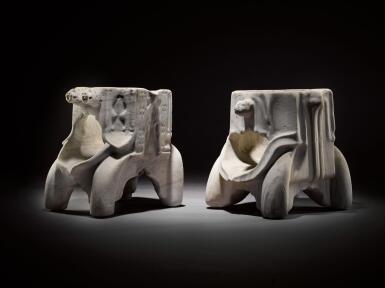
Two Mamluk carved marble jar stands (kilgas), Egypt, 13th/14th century
Estimate
20,000 - 30,000 GBP
Lot Details
Description
each on 4 rounded feet, the sloped trough tapering to a point; one with two lion head terminals above, carved with faceted sides with architectural motifs, a geometric lattice to the reverse; the other with one zoomorphic terminal, carved with faceted sides and a cup blazon to the reverse
39 by 31.5 by 38cm.
38 by 34.5 by 39cm.
Ex-collection Philippus van Ommeren III (1861-1945), Wassenaar, the Netherlands, acquired circa 1920s
Philippus van Ommeren III was born in Rotterdam in 1861. In 1885, he succeeded as director to his family business, Van Ommeren Ltd., founded by his grandfather in 1839, which acted as a shipbroker and agent for the Rotterdam-London line. An entrepreneur himself, van Ommeren took on other ventures, founding Maatshappij Stoomschip Dordrecht in 1891, and later a storage company Matex, in 1910. He served as a member of the Chamber of Commerce and Industry in Rotterdam from 1894, and was one of the founders of the Commercial Law Association in 1919.
Philippus and his wife Alida travelled to Egypt frequently. They admired the architecture of Cairo and in 1923 commissioned their Rust en Vreugd country house in Wassenaar. The villa was designed by Dutch architect Samuel de Clecq, who incorporated various decorative elements inspired by their travels to Cairo. The present kilgas were situated on the balustrades of the stairs leading to the front terrace and are depicted in a tile tableau of the house from the 1920s. The house was demolished in 1987 and a modern apartment complex was erected on the site.
Kilgas such as these were intended as supports for large unglazed terracotta water jars. The porous clay allowed water to seep slowly through the ovoid bottom of the jar, cooling and filtering the water which collected in the basin beneath. They were unique to medieval Egypt responding to a demand for small-scale water storage brought about by the vagaries of its main water source, the river Nile (Knauer 1979, pp. 67-71 and Graves 2016, p.305). Only one dated example is recorded, housed in the Museum of Islamic Art, Cairo, which bears a partial date corresponding to a period between 1106 and 1203. Thus the majority of surviving examples are attributed to Fatimid Egypt between the eleventh to thirteenth centuries (Graves op.cit., p.310).
Our kilgas are almost a pair, each supported on four rounded feet, the body of octagonal form with faceted sides and protruding zoomorphic terminals. The close similarities in their profile indicate that they are contemporaneous. One of the kilgas displays the frequently recurring scaled-down architectural muqarnas motifs on its faceted sides, a form of decoration that proliferated in Fatimid monuments (ibid., p.311, see, for example, a kilga in the Aga Khan Museum, inv. no.AKM817). The other bears a blazon comprised of a roundel divided into three segments, with a cup to the centre. This blazon is associated with the Mamluks of the thirteenth and fourteenth centuries, see for example the blazon carved on the fourteenth-century funerary madrasa of Mamluk Amir Uljay al-Yusufi (photograph in the V&A, inv. no.773-1929). The presence of this blazon on one of the kilgas is important since it allows a chronology to be established and identifies the pair as rare Mamluk examples.
Furthermore, their form is generally typical of kilgas attributed to the Fatimid period, aside from the form of the trough which is shallower with a downwards slope tapering to a point. This form is in contrast to the protruding, horizontal basin of almost all other extant examples. The downwards slope of the troughs in the present kilgas suggests that the water was channelled towards a further vessel. The fact that a dilapidated kilga in the courtyard of the mosque of Sultan al-Mansur Qala’un, Cairo, (Knauer, op.cit., p.73, fig.8) appears to share the same profile with a shallow, downwards sloping trough, might support that the form was a later development in Mamluk Egypt.
You May Also Like


