
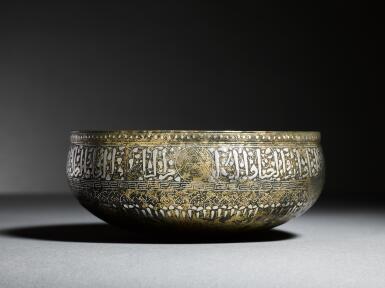
A gold and silver-inlaid brass bowl, Mosul, Jazira, 13th century
Estimate
40,000 - 60,000 GBP
Lot Details
Description
the rounded body with short, slightly everted, rim, inlaid with a calligraphic register in naskh divided by roundels with interlocking fretwork, the interior with a fish roundel
17.2cm. diam.
Formerly in the collection of a distinguished diplomat.
inscription
al-‘izz wa’l-baqa wa’l-birr(?) wał-ghana wa’l- … / … wa'l-uluw wa’l-‘ala al-da … / … al-thana wa’l-iqbal wa’l-thana(?) wa’l-ifdal / al-‘uluw al-baqa … abadan
'Glory and long life and piety(?) and wealth and …/ … and eminence and superiority … / … praise and prosperity and praise(?) and favour, / eminence, long life … forever.’
The profile of this bowl, with its rounded body, and short, slightly everted rim situates it within a group of Syrian and Jaziran metalwork produced in the thirteenth century. Examples include: a basin of similar shape but larger size bearing the titulature of the Atabeg Mu'izz al-Din Mahmud ibn Sinjar Shah who ruled Jazira from 1208 until an ill-determined date (Court and Cosmos, 2016, no.13a, p.64, Museum fur Islamische Kunst, Staatliche Museen zu Berlin (I.3570)); a basin made for Sultan Najm al-Din Ayyub, ruler of Diyarbakir (1232-39) and Syria (1239-49 with interruptions) in the Kelsey Museum of Archaeology, University of Michigan (inv. no.28801, see Grabar 2006, pp.4-14); and a basin made for Sultan Qara Arslan ibn Il Ghazi, Artuqid ruler of Mardin, a city in the northern Jazira, sold at Sotheby’s, London, 25 April 2012, lot 538, now in the Museum of Islamic Art, Doha (inv. no.2013.65, Court and Cosmos, 2016, no.8, p.58). A further related bowl was sold at Christie’s, London, 2 May 2019, lot 22.
Each of these bowls is decorated with engraved and silver-inlaid calligraphic registers but they show variety in the scale and form of the script. The Berlin and Doha basins are solely decorated with calligraphy, whereas the Michigan bowl and Christie’s bowl each include figural roundels. The calligraphic frieze on this bowl is similarly interspersed with roundels but here they are filled with geometric fretwork of a form found elsewhere on Mosul metalwork (see roundels on the renowned Blacas ewer in the British Museum, inv. no.1866.1229.61).
You May Also Like


