
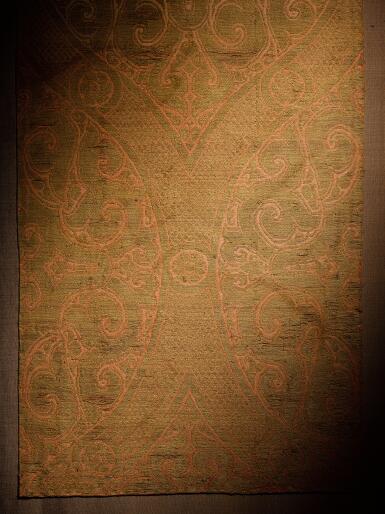
An important Mongol 'Cloth of Gold' silk and metal thread lampas panel, Central Asia or eastern Persia, mid-13th century
Estimate
50,000 - 70,000 GBP
Lot Details
Description
a bold and elegant ogival medallion woven in gold on a salmon-pink ground, the border of the medallion decorated with a minute diamond pattern interspersed with rosettes in roundels, amidst scrolling motifs, mounted on a wooden stretcher
86.5 by 30cm.
This luxurious lampas panel is woven with silk and gold wrapped thread. The metallic threads were fashioned from fine gold leaf which was fixed onto a base which could be paper or made of animal parts. The method of adding gold leaf to a paper substrate is thought to have Chinese origins while adding gold leaf on animal substrate had origins in the eastern Islamic world. The metallic threads of the present lot belong to the latter category.
Silks from the Mongol period dating from the thirteenth to the mid fourteenth century can be attributed primarily to Central Asia and the eastern Iranian world. They are renowned for their opulent use of gold as well as the superlative design and quality of weaving. Craftsmen captured by the Mongols from China and eastern Persia were resettled in Mongolia and Central Asia bringing with them a distinctive decorative vocabulary from their homelands. These craftsmen from conquered territories worked together with local craftsmen for the Mongol court. It is significant that most of the luxury silks produced under the Mongols were woven with silk of one colour and gold. They were given by Mongol emperors to members of the court to be worn on special occasions (J. Watt and A. Wardwell, ‘When Silk was Gold – Central Asian and Chinese Textiles’, 1997, pp.127-8).
There are two lampas fragments from the same textile in the David Collection in Copenhagen (inv. no.4/1993 and 15/1989). Another fragment is in the Bruschettini collection (F.C. Phillip (ed.), ‘Arts of the East – Highlights of Islamic Art from the Bruschettini Collection’, Toronto, 2017, no.22, pp.122-5). A further fragment sold recently at Christie’s London, 26 October 2023, lot 68. It has been suggested that these fragments may have been part of a ceremonial coat. One of the fragments in the David Collection was woven with a pseudo inscription along a border above a narrow frieze comprising running animals – this would have formed the shoulder and the upper section of the back of the coat. It has also been suggested that the Bruschettini fragment was once part of a Mongol tent. The Persian historian Rashid al-din (1247-1318) recorded two tents of ‘gold on gold’ cloth that were given in 1255 and 1256 to Khan Hulegu (1218-65), the grandson of Genghis Khan and founder of the Ilkhanate (ibid., pp.122-3). Five large panels made of ‘cloth of gold’ dated to the late thirteenth or earl fourteenth centuries forming the interior of a Mongol tent are now in the collection of the Museum of Islamic Art in Doha.
For a further related example, see a tiraz fragment with an inscription, produced for Sultan Abu Bakr ibn Sad, a Salghurid prince who ruled Fars in western Persia from 1226-60, in the David Collection (inv. no.20/1994). Two Mongol robes made of ‘Cloth of Gold’, dated to the late thirteenth or fourteenth century, were sold at Christie’s London, 6 October 2011, lots 105 and 106.
You May Also Like


