
PROPERTY FROM THE COLLECTION OF DR. MARK ZEBROWSKI (1944-99)
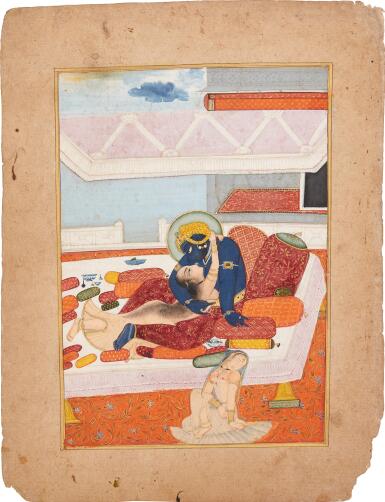
Krishna and Radha lost in admiration, attributed to Chokha, India, Rajasthan, Devgarh, circa 1811-20
Estimate
60,000 - 80,000 GBP
Lot Details
Description
gouache heightened with gold on paper, narrow yellow border, black rules, buff margin
painting: 29.5 by 23cm.
leaf: 22 by 15.5cm.
Dr. Mark Zebrowski, London (1944-99)
Private Collection, London
In the Image of Man, Hayward Gallery, London, 1982
Princes, Palaces and Passion: The Art of India's Mewar Kingdom, Asian Art Museum, San Francisco, 2 February-29 April 2007, no.44
In the Image of Man, Hayward Gallery, London, 1982, illus. colour plate 160, p.88.
J. Williams (ed.), Kingdom of the Sun, Asian Art Museum, San Francisco, 2007, no.44, p.176.
A. Topsfield, Court Painting at Udaipur, Zurich, 2001, p.228, 241 (footnote 80).
The dark, heavy form of Krishna leans forward as he gazes into Radha’s eyes and embraces her pale and sinuous body. Radha epitomises an ideal of female beauty with her hair pulled back and flowing over her diaphanous clothing. Krishna appears to have his hands in ‘apana mudra’, possibly a reference to the erotic mood of the painting. Known as the purification mudra in yoga, the gesture is thought to cleanse and detoxify the body and regulate prana or the flow of life force downwards. An attendant seated in the foreground has her eyes closed and her head modestly turned away. The vivid red and orange colours of the multiple bolsters surrounding the couple, the rolled-up curtain above and the carpet below provide a strong contrast to the figures of the lovers and the attendant. Krishna’s blue is echoed in the blue and white porcelain cups on the floor and the rain clouds above him.
This sensual painting is attributed to the master artist Chokha and is most likely to have been produced under the patronage of Rawat Gokul Das of Devgarh. Chokha was the son of the artist Bagta and was born at Devgarh after his father’s move to the court atelier there. Chokha initially studied under his father at Devgarh but subsequently moved to Udaipur, the capital of Mewar and the main artistic centre of the state. His earliest dated painting is from 1799, which is the date he is assumed to have begun an independent career at Udaipur. He moved back to Devgarh to join his father around 1811 and remained the principal artist there until 1826. By the time he arrived back at Devgarh he was in complete command of his own eclectic style, of which the present painting, with its sensuous corporeality and erotic tone is an important example.
It has been suggested that the figure of Krishna is likely to be the patron of the painting, Rawat Gokul Das himself. Upon close inspection, there is unmistakably a strong resemblance in the heavy limbs, the rounded face with its distinct almond-shaped, slightly hooded eyes, the arched brows and sloping forehead. Gokul Das represented as the Hindu deity would be perhaps with the intention of fostering the concept of ‘divine king’, or a reference to his bhakti (devotion) to Radha and Krishna, the divine couple. For a depiction of Rawat Gokul Das, attributed to Bagta and dated 1806 AD, see the preceding lot in the present sale.
The figure of Radha with her long, flowing hair is closely comparable to that of a seated princess at her toilet, also attributable to Chokha, dated to circa 1811-20, formerly in the Sven Gahlin collection and sold in these rooms, 6 October 2015, lot 74. A further painting by Chokha, in the Jagdish Mittal Museum of Indian Art, Hyderabad, depicts another comparable figure of ‘Radha being prepared for Krishna’ (76.181; illus. In the Image of Man, Hayward Gallery, exhibition catalogue, London, 1982, fig.155, p.139). For other comparable figures of female protagonists by Chokha, see ‘Mother and Child’ dated to c.1815 in the Victoria and Albert Museum, London (IS.4-2007); and ‘Madhavanala swoons before Kamakandala’ dated to circa 1810-20 from the collection of Gursharan and Elvira Sidhu (J. Williams (ed.), Kingdom of the Sun, Asian Art Museum, San Francisco, 2007, no.42, pp.172-3).
For a list of inscribed works and other paintings attributed to Chokha, see M.C. Beach, ‘Bagta and Chokha’ in Beach, Fischer, Goswamy, Masters of Indian Painting 1650-1900, Zurich, 2011, pp.736-738. For further discussion on Chokha, see ‘Chokha returns to Devgarh’ in M.C. Beach & Rawat Nahar Singh II, Bagta and Chokha – Master Artists at Devgarh, Zurich, 2005, pp.80-93; and A. Topsfield, ‘Court Painting at Udaipur’, Zurich, 2001, pp.227-230.
For works by Chokha at Devgarh which have sold at auction, see Sotheby’s London, 26 April 2017, lot 109; Christie’s London, 31 March 2022, lot 103; Sotheby’s London, 25 October 2023, lot 47 (from the Edith & Cary Welch collection); and more recently, Sotheby’s New York, 24 March 2026, lot 861.
You May Also Like


