
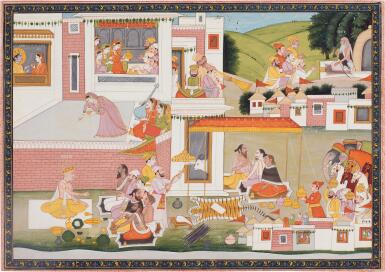
An illustration from a Ramayana series: A feast organised by King Dasharatha for the rishis, attributable to Purkhu and his family workshop, North India, Kangra, circa 1800-20
Estimate
20,000 - 30,000 GBP
Lot Details
Description
gouache heightened with gold on paper, with minute identifying inscriptions in white devanagari script, narrow blue border with gold and silver floral scroll, red rule, trimmed pink speckled margin, the reverse inscribed with '3 Ayodhya' in black devanagari to upper centre, later inventory numbers in pencil and black ink, later typed label adhered to lower centre
painting 23.8 by 34.8cm.; with border 26.3 by 37.3cm.
This illustration from a Ramayana series belongs to the second book of the epic, the Ayodhya Kanda. Dasharatha, the king of Kosala and Ayodhya, is depicted seated at lower left with a group of rishis (sages). A feast has been organised for the holy men. Some attendants are seen bringing in gold vessels balanced on their heads and shoulders. The sage Vashishtha, who was guru and advisor to Dasharatha, is seated at upper right as he converses with a group of devotees who stand before him with folded hands. There is a celebration underway at upper left with a dancer and female musicians on a terrace, further musicians above a doorway. Rama and Sita are depicted having a private conversation near a window at upper left.
This painting, along with the following lots 191, 193, and 194 appear to be from the same Ramayana series. Narrative scenes, often with several figures, the use of diagonals, dominant architecture, and simultaneous events taking place in different sections of the painting, are associated with the style of the master artist Purkhu. Purkhu was master of a large workshop who are known to have been active in the district of Kangra between 1780 and 1820. A number of extensive, large-sized series are thought to be the work of Purkhu and his workshop. For a list of attributed individual works and series attributed to Purkhu, see M.C. Beach, E. Fischer, B.N. Goswamy, Masters of Indian Painting 1650-1900, Zurich, 2011, pp.720-1.
These Ramayana folios are closely comparable to two other known paintings from a Ramayana series which have been attributed to Purkhu and are dated to circa 1800-15. The paintings are now in the Museum Rietberg in Zurich (AO9, RVI 986; illus. B.N. Goswamy and Eberhard Fischer, Pahari Masters: Court Painters of Northern India, Zurich, 1992, nos.168, 169, pp.384-5).
You May Also Like


