
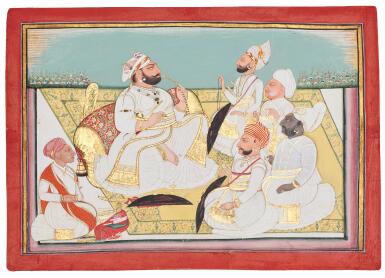
Rawat Gokul Das seated with noblemen, attributed to Bagta, India, Rajasthan, Devgarh, dated VS 1863/1806 AD
Estimate
60,000 - 80,000 GBP
Lot Details
Description
gouache heightened with gold on paper, narrow gold borders, black and white rules, red margins
painting: 19.5 by 29cm.
leaf: 24 by 33cm.
Ex-collection Comte Vitold de Marie-Golish (1921-2003)
Arts D'Orient, Drouot Paris, 13 November 2001, lot 74
Private collection, UK
Vitold de Golish, Splendeur et Crepuscule des Maharajas, Paris, 1963, p.136.
This resplendent painting depicts Shri Gokul Das II (1786-1821), the ninth Rawat of Devgarh, smoking a huqqa leaning against a large floral bolster, as he converses with four other noblemen from Devgarh and neighbouring princely states in Rajasthan. The figures are seated on an elegant floral summer carpet. Their flowing white muslin jamas serve to accentuate the sumptuous use of gold on the jewellery worn by the figures, the resplendent textiles, the katars tucked into their cummerbunds and various accoutrements about them. An idiosyncratic, tiny gold figure of a shrew makes an appearance by Gokul Das’s waist.
The devanagari inscriptions on the reverse identify the figures as:
Maharawat ji Shri 5 Shri Gokul Dasji (wearing an Amarshahi turban – a style invented by Amar Singh II of Mewar)
Kaka Ajit Singh, son of Rawat Durjan Singh
Kishan Singh Jodhpur
Rawat Gyan Singh (uncle of Gokul Das)
Pancholi (minister) Zalim Singh, sitting at far left
The painting was presented by the artist as nazar in the month of Chaitra (the first month of the lunar calendar), in the year Vikram Samvat 1863 (or 1806 AD).
The painting is attributed to the master artist Bagta, who was the principal artist at the court of Devgarh between 1769 and 1814. The figure of the main subject is closely comparable to four other known depictions of Rawat Gokul Das by Bagta which were painted between 1806 and 1808. His distinctive facial features including the slightly hooded eyes underneath arched brows, the sloping forehead bearing the U-shaped Vaishnava mark, the ends of his moustache curling above a full beard, are almost identical to ‘Rawat Gokul Das seated with a rifle’, formerly in the collection of Edwin Binney 3rd and now in the San Diego Museum of Art (1990:661).
The inscription on the reverse of the San Diego painting confirms that the work is ‘by the hand of the painter Bagta’ and was presented in 1807. A further painting of ‘Rawat Gokul Das at Singh Sagar’, formerly in the collection of Howard Hodgkin, is now in the Ashmolean Museum in Oxford. Painted in 1806, the same year as the present lot, the large-scale work depicts a court expedition to a lake in a wooded landscape with Gokul Das shooting waterfowl in the foreground. Along with other attendants, he is accompanied by his uncle Rawat Gyan Singh who is also depicted seated before him in the present work. ‘Rawat Gokul Das at a hunting party’ painted in 1808, in the Chhatrapati Shivaji Maharaj Vastu Sangrahalaya (formerly Prince of Wales Museum) in Mumbai (52.25) shows the ruler dressed in traditional green hunting clothes resting in a clearing while his attendants catch fish and prepare the game caught at the hunt. Another painting by Bagta dated 1808 depicting Rawat Gokul Das seated against a bolster in the zenana quarters of his palace playing Holi sold at Bonhams New York, 19 March 2012, lot 1211.
For a list of inscribed works and other paintings attributed to Bagta, see M.C. Beach, ‘Bagta and Chokha’ in Beach, Fischer, Goswamy, Masters of Indian Painting 1650-1900, Zurich, 2011, pp.734-6. For further discussion on Bagta at Devgarh, see ‘Bagta and His Greatest Patron, Rawat Gokul Das’ in M.C. Beach & Rawat Nahar Singh II, Bagta and Chokha – Master Artists at Devgarh, Zurich, 2005, pp.48-70; and A. Topsfield, ‘Court Painting at Udaipur’, Zurich, 2001, pp.217-220.
The artist Bagta was active at the large court atelier of Udaipur in Mewar from 1761-68. In 1769, he moved to Devgarh, a smaller thikana (principality) owing allegiance to the Maharana of Udaipur. With a change in patrons his style evolved significantly as, with greater freedom, his work exhibited a bolder, more recognisable individuality. At Devgarh, between 1769 and 1814, Bagta primarily worked for Rawat Ragho Das, his son Kunwar Anup Singh, and his grandson Rawat Gokul Das. An equestrian portrait of Kunwar Anup Singh of Devgarh, the father of Gokul Das, attributed to Bagta and dated to circa 1775, from the collection of Paul F. Walter sold at Sotheby’s New York, 14 November 2002, lot 34.
See the following lot, no.181, for another painting from Devgarh depicting Krishna and Radha dated to circa 1811-20, attributed to the artist Chokha, the son of Bagta.
You May Also Like


