
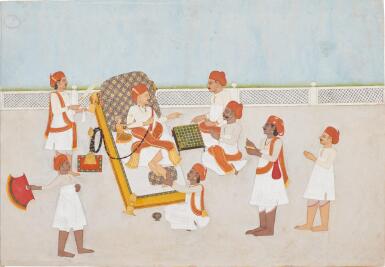
A nobleman playing chess on a terrace, circle of Sahib Ram, India, Rajasthan, Jaipur, circa 1780
Estimate
25,000 - 35,000 GBP
Lot Details
Description
gouache heightened with gold and silver on paper, margins trimmed
24.5 by 35.9cm.
The estate of J.D. McClatchy (1945-2018), American poet, librettist, literary critic, and former president of The American Academy of Arts and Letters, New York
This finely executed and richly detailed painting depicts a nobleman at leisure, reclining on a daybed and resting against an opulent brocade covered bolster. Before him, a chessboard with gold and red pieces is carefully arranged on a bajot (low table). He is attended by a small retinue - one figure waves a flywhisk, another operates a punkha, while others massage his feet and offer him paan. To his right, a diminutive figure, perhaps a child, sits close, gently holding his arm, adding an intimate note to the otherwise formal setting. The cool expanse of the white marble terrace and the delicate muslin angarkhas worn by the figures creates a restrained visual field that heightens the brilliance of the composition's accents drawing the viewer’s eye to the vivid reds of turbans and sashes, the gleam of gold on the jewellery and textiles, and the brightly coloured huqqa mat. The result is a carefully balanced interplay between subtlety and splendour.
The composition of the present work is closely comparable to a painting depicting Maharaja Madho Singh of Jaipur playing chess dated to circa 1760, formerly in the Stuart Cary Welch collection, which sold in these rooms, 31 May 2011, lot 45. Andrew Topsfield’s observations of the latter work equally apply to our painting, "The soothing cool whites and pale greys of the interior, deriving from Mughal painting under Muhammad Shah, are disposed in a pattern of formal rectangles, offset by the diagonals of the bed and chessboard and the thin line of the punkah rope. Within this sparely delineated, neutral interior there is a subtle observation of the relationship between the dominant figure of the Raja and his subservient ring of opponents and attendants." (Topsfield, Court Painting in Rajasthan, Mumbai, 2000, p.10)
The decorative idiom and linear style of painting in the present lot are reminiscent of the work of Jaipur artists working in the late eighteenth century such as Sahib Ram who was active between 1750 and 1820 during the reigns of the Maharajas Madho Singh I, Sawai Prithvi Singh II, and Sawai Pratap Singh. Sahib Ram is believed to have become an established artist by the late 1750s eventually rising to head the Jaipur court atelier. Very few works, primarily portraits of the rulers of Jaipur, now in the Maharaja Sawai Man Singh II Museum in Jaipur, can be firmly attributed to Sahib Ram. Artists working within his circle included Ramji, Sitaram, Radhakrishna, Ramakrishna, among others. For a discussion on Sahib Ram and the Jaipur atelier, and for a list of paintings inscribed or attributed to Sahib Ram, see Molly Emma Aitken, ‘Sahib Ram’, in Beach, Fischer and Goswamy, Masters of Indian Painting 1650-1900, Zurich, 2011, pp. 623 – 640.
Several stylistic features in the present work such as the faces depicted in profile, details of jewelled earrings and necklaces, the slightly upturned ends of the moustaches, the distinctive curls of hair at the nape and in front of the ear, often accompanied by a subtle shadow, find close parallels in works which have been attributed to Sahib Ram or Ramji. For comparison, see a portrait of Maharaja Pratap Singh resting against a pillow, attributed to Sahib Ram, and dated to c.1780-1800; and an equestrian portrait of Maharaja Sawai Pratap Singh by Ramji, dated to c.1782-85, in the Ashmolean Museum (EA 1992.115), both illustrated ibid., p.637, figs. 9,10. A further comparable portrait of Maharaja Pratap Singh attributed to Sahib Ram and dating to the late eighteenth century, formerly in the Paul F. Walter collection, sold at Sotheby’s New York, 14 November 2002, lot 36.
You May Also Like


