
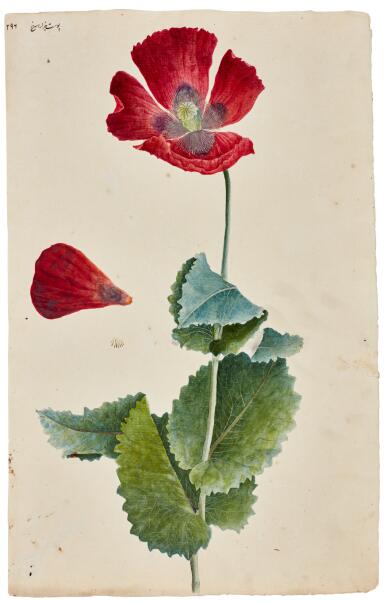
Fourteen botanical studies, India, Company School, late 18th century
Estimate
40,000 - 60,000 GBP
Lot Details
Description
pencil, pen and ink, watercolour on watermarked paper, each numbered and identified in nasta'liq in black ink along upper edge, a few with faint inscriptions in pencil
each sheet 43.5 by 28.5cm. approx.
inscriptions
59 cholul – black eyed beans (vigna unguiculata)
83 surkh bed – a kind of willow or name; the name of a medicinal plant
107 ti-dhara – with three edges (euphorbia antiguorum)
217 sinhur vilayati – Persian cactus
235 ghikuwar vilayati – Persian aloe perfoliate
277 kohila ba gol – lasia spinosa with flower
278 mitha limon shirin – sweet lime
296 post-i hazara surkh – red poppy (?)
297 ‘aqiq albar (al-bahr) zard – yellow Indian shot (canna indica)
315 gul-I zanbaq – lily flower
331 taj-I khorus surkh – red cock’s-comb (red celocia cristata)
351 gul-i farang – bright eyes (catharanthus roseus)
355 gulyachin (gul achin?) – frangipani (?)
439 badinjan ya’ni baigan – egg plant (solanum melongena)
Depicting medicinal plants, flowers and vegetables, the illustrations are inscribed with their common name in Urdu. The numbering follows a system of classification, likely to be based on the work of Carl Linnaeus, a Swedish naturalist and explorer who, in 1735, devised a uniform structure for the naming and classification of plants and animals. Such academic rigour was a reflection of the period which saw strong interest from both professionals and private amateurs in the field, notably from those living in India. The sheets all bear watermarks including J Whatman, Portal & Bridges, a crown over a fleur-de-lys.
The production of natural history paintings for British patrons by Indian artists began in the 1770s. The earliest paintings of botanical specimens were commissioned by Dr James Kerr, a Scottish surgeon stationed in Bengal who arrived in India in 1772 and sent a group of drawings and some specimens of plants back to Scotland as early as 1773. In the late 1770s and early 1780s Sir Elijah Impey, the Chief Justice of Bengal, and his wife Lady Impey employed several artists to produce an extensive series of detailed studies of plants, mammals, birds, reptiles and fish. The production of natural history studies continued in the early 19th century and Indian artists could often find work with East India Company officials as well as through private patronage.
For comparable studies of flowers and plants dated to the late eighteenth century which sold in these Rooms, see Sotheby’s London, In an Indian Garden, 27 October 2021, lot 25; and 24 April 2024, lot 135.
You May Also Like


