
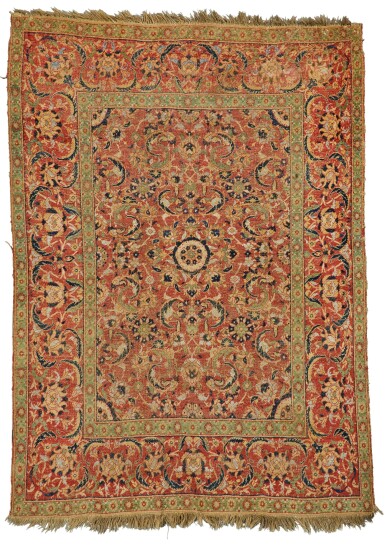
An Ottoman Cairene rug, Egypt, second half 16th century
Estimate
25,000 - 35,000 GBP
Lot Details
Description
187 by 136cm. approx.
Ex-collection Hagop Kevorkian (1872-1962), Paris
Sotheby's, London, 5 December 1969, lot 9
Ex-collection Lewis and Susan Manilow, Chicago
Sotheby's, New York, 7 April 1992, lot 86
The Kevorkian Foundation Collection of Rare and Magnificent Oriental Carpets, travelling exhibition, 1966, exhibited at:
The University of Pennsylvania Museum, Philadelphia, Pennsylvania
The Brooklyn Museum of Art, Brooklyn, New York
The Cleveland Musem of Art, Cleveland, Ohio
The de Young Memorial Museum, San Francisco, California
The Kansas City Museum, Kansas
Dallas Museum, Dallas, Texas
M.S. Dimand, The Kevorkian Foundation Collection of Rare and Magnificent Oriental Carpets, Special Loan Exhibition catalogue, New York, 1966, no.32 (unillustrated).
HALI, no.63, 1992, p.131.
After Sultan Selim I’s conquest of Cairo in 1517, Ottoman design principles came to take over Mamluk carpet production. Although the carpets produced in Cairo by these two dynasties remained technically related, each using an asymmetrical knot open to the left, the kaleidoscopic geometry of the Mamluks was replaced by curvilinear flowers, saz leaves, and arabesques. Carpet production at this time, like almost all other media, became firmly embedded within a cohesive and distinctly Ottoman aesthetic. For further reading see King, Pinner and Franses 1981, pp.36-52, and Denny 1979.
The layout of this rug, with its central roundel and corner cartouches, was common in Cairene rugs (King and Sylvester 1983, p.82, no.53), and in many iterations the roundel encloses further floral motifs. Here, it is much smaller, formed only of a flowerhead, bordered by eight palmettes, with quarter repeats at each corner. This central flower is barely larger than the four further flowerheads that punctuate each quadrant of the field.
The less dominant placement of the centralising motif opens up the space in the field in which feathery saz leaves embrace each other amidst flowering vines. The space is further expanded by the use of the same red as the ground colour of both the border and the field. The carpet is nonetheless colourful, incorporating tones of red, midnight blue, golden yellow, pistachio green, and silvery-grey. The deep shade of blue creates an elegant contrast against the softer shades and guides the viewer through the beautifully drafted stems. A comparably drawn Cairene carpet fragment is in the V&A (inv. no.163-1908).
For a Mamluk carpet, also formerly in the collection of Lewis and Susan Manilow, see lot 131 in the present sale.
You May Also Like


