
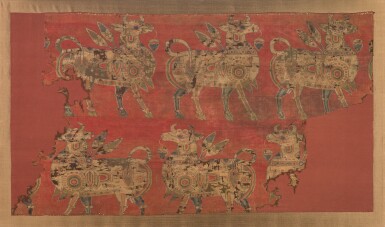
A silk samite fragment with winged bulls, Central Asia, Sogdiana, 7th/8th century
Estimate
60,000 - 80,000 GBP
Lot Details
Description
woven with rows of large-scale winged bulls holding lotus blossoms in their mouths, on a crimson ground, mounted on a stretcher
65 by 118cm.
74.5 by 126.5cm. including stretcher
The distinct palette of this silk samite fragment is associated with a group of post-Sasanian ‘Sogdian’ silks. Here it is woven in six colours: cherry red, ivory, dark blue, golden yellow, light blue and light green. They are most commonly woven with confronting animals enclosed in roundels (for example, a child’s coat in the Cleveland Museum of Art (inv. no.1996.2.1, featuring paired ducks in pearl roundels woven in five colours). The arrangement seen here of alternating rows of animals in march is part of a rarer sub-group.
This composition is found on a silk woven with alternate rows of tigers on a plain ground in the Abegg Stiftung (Inv. Nr.4865/5066, Otavsky 1998, pp.63 & 68-69, pls.31 & 32, see also HALI, no.94, p.94), as well as a winged horse silk (inv. no.T.117) in the Sancta Sanctorum in Rome, now in the Museum Sacro of the Vatican (Fritz Volbach 1942, pl.XXXIX). A fragment showing the rear of a bull in the same collection (inv. no.T.117) must have had a closely comparable design to the present textile (ibid., pl.XXXVI).
The design of the present silk is sophisticated. The bulls stand proudly, holding a lotus blossom in their mouth, their curled tails placed in a manner typical of the way cows use their tails to swot flies. They are richly decorated, adorned with pearled roundels and an elaborate collar with three pairs of attachments at the back of the neck, one of which streams out behind the neck having the appearance of fishes, while two other pairs hang down on each side of the bull's body. Comparably drawn bulls are found on a textile in the Yale University Art Gallery (acc. no.2017.54.18), though they are not enclosed in roundels, they are arranged as confronting pairs, in rows alternating with confronting lions. The weaver has succeeded here in layering more colour within the decorative pendants and roundels in the present fragment.
You May Also Like


