
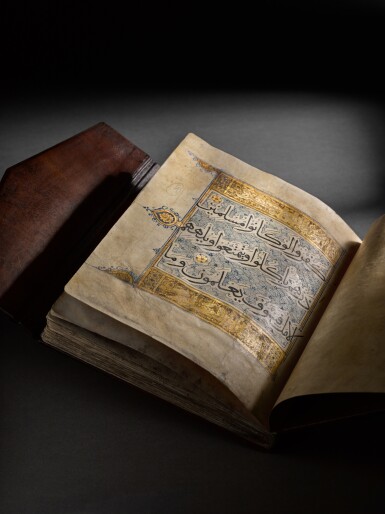
An impressive illuminated Qur'an volume, attributable to Ya'qut al-Musta'simi, probably Baghdad, Iraq, late 13th century
Estimate
100,000 - 150,000 GBP
Lot Details
Description
Comprising juz' XIV and juz' XV, Arabic manuscript on paper, 87 leaves, plus 2 fly leaves, 5 lines to the page written in muhaqqaq in black ink, verses separated by gold rosettes, khams and 'ashr marked by illuminated marginal medallions, surah headings in white on gold and polychrome illuminated panels, f.1a with illuminated frontispiece framing text, final bifolio with text in clouds reserved against a spiral ground, in brown leather binding, with flap
29.5 by 22.5cm.
The layout of the closing bifolio of this manuscript is strikingly similar to juz’ 15 of a Qur’an in the Khalili Collection (inv. no.QUR 29). Its sister manuscript, juz’ 8, is in the Chester Beatty Library (inv. no.MS 1452) and bears a colophon forming part of the original text with the name of Ya’qut al-Musta’simi (James 1992, p.60, no.11).
The hand here is of particularly high quality, exuberant and energetic. The calligrapher almost appears to delight in a close succession of similar letters terminals together (ra’, waw, za’, see f.55a), while allowing a spacious wa kabbirihi kabir to occupy a whole line on f.66b. Many letter forms show close similarities to the calligraphy in the Chester Beatty and Khalili volumes. Similar, for example, are the backwards leaning and curvilinear kaf letters, and the placement of the dot of the ba’ almost overtaking the right edge of the letter. The execution of the word kitab, for example, is very close between this volume and the Chester Beatty manuscript.
Ya’qut was widely considered the foremost practitioner of Arabic calligraphy, a revered figure most famed for his naskh, though specimens in his muhaqqaq are less widely known. James notes that “Qur’ans in muhaqqaq alleged by Ya’qut are exceedingly rare compared to those in naskh and rayhani” (ibid).
The illumination in this volume appears unaltered from its original conception. The palette of gold, burnt orange, and blue is typical of Baghdad Qur’ans of this early period, and is comparable to the palette of the Khalili volume. The frame of the illuminated frontispiece is also related, though here with further pendants at the upper and lower end, which would continue into the fourteenth century. The finispiece of the Khalili volume furthermore shows panels with similar knotted strapwork to those of the frontispiece here.
James suggests that the Khalili volume is possibly the only extant example by Yaq’ut in which the calligraphic, decorative and codicological features remain consistent with Baghdad in the late thirteenth century (James, op.cit., p.63). If this is indeed another work by the renowned scribe, it would be a rare survival adding to this exclusive corpus of material showing the contemporaneous illumination of Yaqut, which is so often lost or covered by later embellishments, as is the case on the Chester Beatty volume.
For a Qur’an copied in naskh by Yaq’ut al-Musta’simi see Sotheby’s, London, 23 October 2024, lot142.
You May Also Like


