
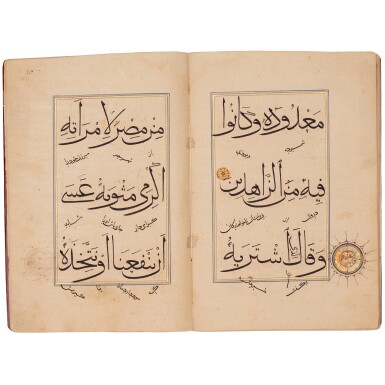
An illuminated Qur'an section in muhaqqaq script on paper, Central Asia or Anatolia, circa 1300-35
Estimate
60,000 - 80,000 GBP
Lot Details
Description
text: Qur'an, surah Hud (XI), middle of verse 117 to surah Yusuf (XII), middle of verse 24
Arabic manuscript on paper, 24 leaves, plus 2 fly leaves, 3 lines to the page written in large muhaqqaq in black ink, with Persian interlinear translation in small black naskh, within later gold and blue rules, verses separated by gold rosettes with green and red dots, 'ashr marked by gold and polychrome marginal medallions, a surah heading in red thuluth, in Mamluk gilt and tooled brown leather binding
text panel: 18.8 by 11.2cm.
leaf: 26.9 by 17.8cm.
This Qur’an section is related to a thirty-volume manuscript once thought to have originated in Sultanate India (James 1988, no.60). This attribution derived from the later added decorative border and hadith extracts written in Kufic found on leaves from juz’ 6, see, for example, Sotheby’s, 5 October 2010, lot 19. Further loose leaves of this juz’ are widely dispersed in museum collections such as the Cincinnati Museum of Art (inv. no.1982.118a-b); Chester Beatty Library, Dublin, (inv. no.MS 1609); Museum of Fine Arts, Boston (inv. no.24.416), to name but a few. Leaves from other sections of the Qur’an, without later illumination, are similarly dispersed, see for example, Chester Beatty Library (inv. no.1458, Arberry 1967, cat. no.83, pl.38).
David James later reattributed the manuscript to fourteenth century Central Asia or Anatolia, relating it to a Qur’an in the John Rylands University Library (inv. no.760-773). Both share a format of three lines to the page copied in a generous muhaqqaq script with interlinear translation written on the diagonal. A further related manuscript is in Astan-i Quds, Mashhad (inv. no.293), copied with five lines to the page, see James 1988, pp.173-4, cat. nos.58-60.
The format of this section is almost identical in calligraphy and layout to James’ cat. no.60. Both are copied on leaves of comparable size, in a distinct and large muhaqqaq widely spaced with sometimes only two words per line, with interlinear translations on the diagonal, and flowerhead verse markers. There are some differences, however, such as the surah headings. It is copied in red here, unlike the illuminated surah heading illustrated by James (ibid., p.171). The bismillah is also different, the present lot showing a tightly compacted thuluth that lies in contrast with the freely drawn muhaqqaq throughout the section, whereas in James’ illustration, the bismillah remains in the same muhaqqaq. A bifolium from the manuscript published by James was sold at Christie's, 25 April 2013, lot 1. That bifolium displayed an illuminated surah heading above a bismillah in thuluth. These differences might indicate variations in production within one manuscript across each volume, or perhaps that this substantial section derives from a closely related manuscript produced in the same workshop as that well-published example.
You May Also Like


