
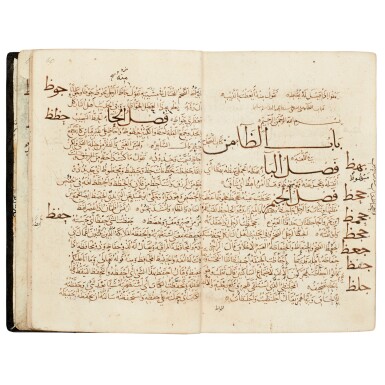
Abu Nasr Isma'il ibn Hammad al-Jawhari (d.1008 AD), Kitab al-sihah fi'l-lugha ('The Book of Correct Language'), probably Iraq, 12th century
Estimate
30,000 - 50,000 GBP
Lot Details
Description
Arabic manuscript on paper, comprising one volume from the letter dad to dha', 65 leaves, 17 lines to the page written in naskh in sepia ink, in Mamluk gilt and tooled brown leather binding
24.9 by 16.5cm.
Abu Nasr Isma'il ibn Hammad al-Jawhari was a celebrated Arabic lexicographer of Turkish origin. His studies took him to Baghdad where he attended lectures of Abu Sa’id al-Sirafi and Abu ‘Ali al-Farisi. For many years he travelled extensively and maintained an earlier tradition among lexicographers by conducting lexical investigations with the Bedouin tribes of Mudar and Rabi’a, and in the Hijaz and Nejd. After years of travel, he settled in Nishapur and devoted himself to literary activity. His beautiful calligraphy was admired to the point that he was considered to be on the same level as Ibn Muqla.
The fame of our author rested on the text of the present manuscript, Taj al-lugha wa sihah al-arabiyya, ('The Crown of Language and the Correct Arabic'), also known as Al-Sihah. It was a milestone in the development of Arabic lexicography and for centuries remained the most widely used Arabic dictionary. Its importance is proven by the mass of lexicographical literature than derived from the present work. The text itself was innovative, arranging the roots under the last radical, which was been interpreted as an effort to help poets to find rhymes.
Some have suggested that Al-Jawhari died before the work was completed, rumoured to have fallen from a great height while trying to fly with wooden wings, and his student Ibrahim ibn Sahl al-Warrak is thought to have completed it from drafts left by his teacher. However, there are records of autograph copies which has led others to suggest this was a rumour intended to reaffirm al-Jawhari’s position as an unwavering authority in the face of small errors that remain within the text. Indeed, a note on f.4a of the present manuscript indicates that the copyist and access to an autograph copy of the work, indicated by the statement 'ra'aytuhu bi-khatt al-jawhari'. Further marginal notes feature the names of important scholars such as Abu Ousam Junadah ibn Muhammad al-Azddi al-Harawi, Abu Sahal al-Harawi, and Al-Jawhari's uncle, Abu Ibrahim Ishaq al-Farabi. For more information on the author and this text, see Kopf 1983, pp.495-7.
For further manuscripts of the Sihah, see Brockelmann, GAL, I, p.133, and GAL, S.I, p.196. Another twelfth century volume of the text dealing with the letter ya' was sold in these rooms, 30 April 2025, lot 502. The present volume stands out for its calligraphic concern, copied in an elegant early naskh punctuated by large headings.
You May Also Like


