
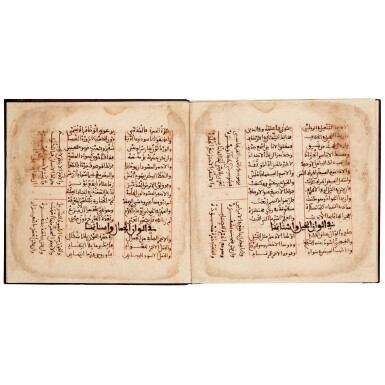
Yahya ibn Muhammad ibn Ayyub al-Ta'i al-Andalusi ibn Muda, a poem on the characteristics of human beings, horses and camels, Andalusia or North Africa, dated Muharram 677 AH/June 1278 AD
Estimate
40,000 - 60,000 GBP
Lot Details
Description
Arabic manuscript on paper, 4 leaves, plus 2 fly leaves, 19 lines to the page written in Andalusi script in dark brown ink arranged horizontally and vertically, within red rules, in brown leather binding
16.5 by 16.5cm.
This work is part of a long-established Arabic literary tradition concerning the precise nomenclature of human and animal attributes. Following a brief introduction, this poetic text is divided into sections in a structured progression through the attributes of humans, horses and camels. It first deals with the physical attributes and identifying marks of humans, then horses, followed by a section on the colours and dentition of horses, and finally a section on the colours and dentition of camels. A later manuscript of this text is in the Hassaniyya Library (inv. no.13958) and another is in the National Library of Morocco (inv. no.D1588).
References to horses and camels abound in medieval Arabic literature, the animals being revered as hayawan anis (‘living beings with souls’) (Kutasi 2024, p.34). Horses were central to status and integral in warfare, whilst camels exemplified tolerance and survival in arid environments, trade, and long travel. Knowledge on horses and camels was treated as its own branch of learned discourse by scholars, poets and linguists. As a result, the Arabic language is rich with extremely precise terminology for their colouration, markings, gait, and dentition, all of which were important in assessing age, quality and lineage. Texts such as the present work unite literary compositions with technical knowledge, and reflect a culture in which poetry, linguistic precision and practical expertise were fundamentally entwined.
You May Also Like


