
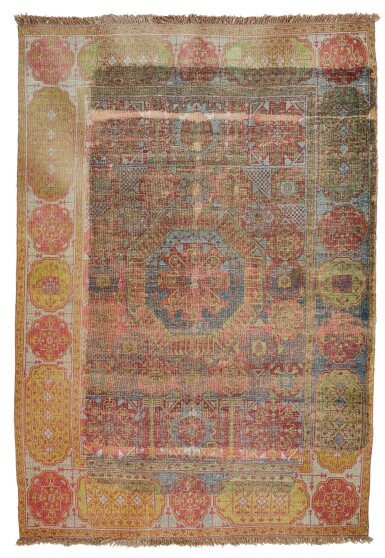
A Mamluk rug, Egypt, early 16th century
Estimate
15,000 - 25,000 GBP
Lot Details
Description
three borders rewoven
180 by 120cm. approx.
Sotheby's, London, 14 April 1976, lot 37
Ex-collection Lewis and Susan Manilow, Chicago, before 1978
Sotheby's, New York, 7 April 1992, lot 54
HALI, vol.1, no.4, 1978, p.390
HALI, no.63, 1992, p.131
The Mamluk dynasty ruled from 1250 to 1517; at its height their empire reached from Egypt to south east Anatolia and the Hijaz in modern day Saudi Arabia, incorporating Syria, Palestine and parts of Libya and Sudan. During the reign of Qaitbay (r.1468-96) - the period to which the earliest Mamluk style carpets are presumed to date - the arts and architecture were revived and flourished, and an ambitious programme of building was instituted throughout the empire. Demonstrating a sophisticated and cohesive aesthetic, the carpets of Mamluk Egypt, with their mastery of complex geometric patterns and disciplined use of colour include some of the most magnificent early carpets to have survived to the present day.
The present rug is woven in the typically narrow palette that can vary between three to seven colours, here comprising three: red, blue and green (which has in areas abrashed to a lighter shade). The design of the smaller Mamluk rugs and carpets is made up of several primary elements with four principal medallion types, each inhabiting a square: an Eight-Pointed Star, an Octagon Medallion, a cusped or Lobed Medallion (some with secondary internal octagon, see the ‘Hirth’ Mamluk carpet, sold in these rooms 27 October 2020, lot 448, and the rare ’Medici’ medallion, with spokes. This example is woven with an octagonal medallion between cogwheel and star elements. Close in arrangement is a rug in the Arkas collection, sold at Dörling, Hamburg, 14 May 1985, lot 409 (HALI, no.216, p.70, fig.5) and its pair in the Louvre (HALI, no.216, p.70, fig.6), as well as one formerly in the Aita collection and sold at Christie’s, London, 18 October 2001, lot 205.
For a Cairene rug also formerly in the collection of Lewis and Susan Manilow, see lot 200 in the present sale.


