
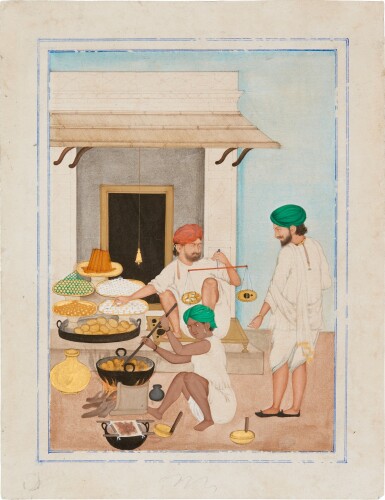
The sweet sellers, attributed to Bishan Singh, North India, Amritsar or Lahore, circa 1860-70
Estimate
60,000 - 80,000 GBP
Lot Details
Description
gouache heightened with gold on paper, with blue rules, buff margins
painting: 20.5 by 14.7cm.
leaf: 25.6 by 19.8cm.
Often known as Baba Bishan Singh, he came from a family of artists working in Punjab in the second half of the nineteenth century. Although mainly working in Lahore and Amritsar, the family is also known to have worked in the neighbouring princely states of Kapurthala, Patiala and Nabha. Bishan Singh and his brother, Kishan Singh, worked as muralists at important Sikh shrines in Amritsar such as the Akal Takht and the Golden Temple. The Exhibition of Arts and Crafts held at Lahore in 1864 displayed ten pictures by Bishan Singh including durbars of Ranjit Singh, Sher Singh and the Municipal Committee of Amritsar (W.G. Archer, Paintings of the Sikhs, London, 1966, p.61).
The colour palette of the present watercolour comprising vibrant reds and oranges and acidic greens on the turbans of the three men, and on the sweets arranged in high piles in platters on the left, in contrast to the pale background, is reminiscent of Bishan Singh’s known works. Alongside large compositions depicting royal processions, durbar scenes with Sikh rulers and noblemen, municipal committee gatherings, shawl traders and weavers at work; there are several smaller format watercolours with single or a few figures depicting Sikh or Kashmiri traders and craftsmen, and holy men, which have also been attributed to Bishan Singh. A painting of comparable format, attributable to Bishan Singh and dated to circa 1860-70, depicting a Sikh artist at work (possibly a self-portrait of Bishan Singh) sold in these rooms, 23 October 2024, lot 181. A detailed portrait of a Sikh shawl trader by Bishan Singh, bearing an inscription in gold Gurmukhi script, dated to circa 1867, sold more recently in these rooms, 30 April 2025, lot 623.
Additional works by Bishan Singh include an illustration of a Kashmir shawl weaving workshop, inscribed in Gurmukhi in the lower left corner with the name of Bishan Singh and dated vikram samvat 1931 (circa 1874 AD), in the Musée Guimet, Paris (acc. no.MA 12702). A durbar scene attributed to the artist depicting Maharaja Sher Singh watching a dance performance, formerly in the Edwin Binney 3rd Collection, is now in the San Diego Museum of Art, (acc. no.1990.1348; B.N. Goswamy and C. Smith, Domains of Wonder, San Diego, 2005, fig. no.112, pp.262-3). Another painting attributable to Bishan Singh, depicting ‘Dost Muhammad being received by Sher Singh in Lahore on his way to regain the throne of Kabul’, is in the Kapany Collection (Susan Stronge (ed.), The Arts of the Sikh Kingdoms, London 1999, no.189, pp.166-7). A further example, depicting a nautch being performed for Maharaja Sher Singh, attributable to Bishan Singh, was in the private collection of Prince and Princess Sadruddin Aga Khan (inv. no.M.301; S. Canby, Princes, Poets and Paladins, London, 1998, no.145, p.186). This painting, alongside a further processional painting of Maharaja Sher Singh, signed by Bishan Singh, is now in the Aga Khan Museum, Toronto (AKM202-3).
For additional paintings by or attributed to Bishan Singh, see D. Toor, In Pursuit of Empire – Treasures from the Toor Collection of Sikh Art, London 2018, pp.280-5; and D. Toor, Ranjit Singh – Sikh, Warrior, King, exhibition catalogue, The Wallace Collection, London, 2024, no.81, pp.122-3.
Furthermore, an incredibly detailed processional scene depicting Maharaja Ranjit Singh riding his elephant through a bazaar in Lahore sold recently in these rooms, 29 October 2025, lot 220.
You May Also Like


