
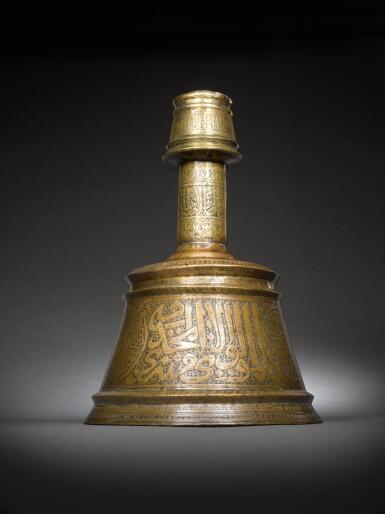
A large Mamluk brass candlestick, made for Sayf al-Din Hatim Dawadar, Egypt, circa 1500
Estimate
50,000 - 80,000 GBP
Lot Details
Description
of truncated conical form, with straight cylindrical neck and truncated conical socket, incised with a large inscription in thuluth on a foliate ground, punctuated by calligraphic roundels enclosing cup blazons, the neck and socket with inscriptions in thuluth
49.5cm. height
Ex-private collection, France, 1990-2010
inscriptions
Around the body: mimma ‘umila bi-rasm al-janab al-‘ali / al-maqarr al-karim al-‘ali al-maw / al-mawlawi al-amiri al-makhd[u]mi , ‘One of what was made for the high excellency, the honourable authority, the high, the lordly, the commander, the well-served.’
In the roundels around the body: al-janab al-‘ali al-maliki al-maliki al-zayni al-maqami a‘azza [nasrahu](?), ‘The high excellence, the possessor, the royal, al-Zayni (Zayn al-Din), the office holder, may (God) glorify his [victory?]’
Around the shoulder: al-maqarr al-‘ali al-‘ad[ili] / … / al-kabiri … / al-maqami …, ‘The high authority, the just … the great … the office holder …’
Around the neck: al-maqarr al-karim al-‘ali al-mawlawi al-amiri al-kabiri al-makhdumi al-‘alimi al-‘a … ‘The honourable authority, the high, the lordly, the great commander, the well-served, the learned, the …’
Around the top: al-maqarr al-karim al-‘ali al-mawlawi al-amiri al-kabiri al-makhdumi al-‘alimi al-‘amili al-‘adili, ‘The honourable authority, the high, the lordly, the great commander, the well-served, the learned, the diligent, the just’
On the inside: mimma ‘umila bi-rasm al-maqarr al-ashraf al-sayfi hatim dawadar al-dawadar, ‘One of what was made for the most noble authority al-Sayfi (Sayf al-Din) Hatim Dawadar, the Dawadar.’
The inscription to the interior of the body of the candlestick records that it was made for the most noble authority al-Sayfi (Sayf al-Din) Hatim Dawadar, the Dawadar. This almost certainly refers to a relative of the penultimate Mamluk ruler al-Ashraf Qansuh al-Ghuri (r.1501-16), named Hatim, who was appointed second Dawadar in 1500 before his death in 1505 (Muhammad b. Ahmad ibn Ayas al-Hanafi, Bada’i ‘ al-Zuhur fi Waqa’i‘ al-Duhur, vol.4, Istanbul, 1931, pp.20, 77).
Mamluk art and architecture was revived under the patronage of Sultan al-Ashraf Sayf al-Din Qaytbay and metalwork re-emerged from a profound crisis with a great variety of styles differing from the typical inlaid Mamluk objects of the fourteenth century. This focus on art and architecture continued under the patronage of the penultimate Sultan Qansuh al-Ghuri who commissioned numerous buildings. However, metalwork surviving from the reign of al-Ashraf Qansuh al-Ghuri is scarce and the present candlestick is therefore an important addition to the corpus of Mamluk metalwork of the early sixteenth century.
Many vessels produced in the fifteenth and early sixteenth century were never intended to be inlaid with precious metals. Instead, craftsmen incised the metal body with intricate designs and applied a black bituminous substance to add a sense of depth. Objects produced for the Sultan himself and those in his immediate circle were decorated in this technique and used very little precious metal, if any at all (see a candlestick and bowl commissioned for Sultan al-Ashraf Sayf al-Din Qaytbay in the Museum of Islamic Art, Cairo, inv. no.4297, see Atil 1981, nos.34 and 35, pp.100-3, and a basin commissioned for Sultan Qansuh al-Ghuri, sold Christie’s 26 April 2012, lot 131).
The form of this candlestick follows the profile typical of the Mamluks in the fourteenth century, comprising a wide flared base with a band of the calligraphy, but applies the simpler technique that had gained popularity under Qaytbay. The thuluth inscription employed on this example is particularly bold, executed with a broad lines that are reminiscent of the calligraphic inscriptions seen on the candlestick of Qaytbay mentioned above.
You May Also Like


