
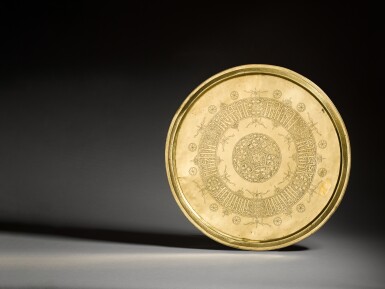
A very large Mamluk brass tray, Egypt or Syria, 14th century
Estimate
30,000 - 50,000 GBP
Lot Details
Description
of circular form with short raised sides and narrow rim, engraved with a central lattice roundel enclosing stylised paired birds and foliate motifs, surrounded by a calligraphic band in thuluth divided by roundels alternating with split palmettes and stylised birds, the rim with an ownership inscription
73cm. diam.
Ex-private collection, France, 1960s, by repute:
Thence by descent until 2025.
inscriptions
al-maqarr al-'ali al-mawlaw/i (?) amir (sic) a a al-kabiri mali (?)/ al-'alimi al-'amili a/ al-'ali al-ghazi al-mujahidi / al-murati (sic) [al-murabiti] al-mathaghiri al-huma/ mi al-niza (sic) [al-nizami] al-maliki al
the rim: sahibuhu [sic] fatima bint al-nasir bin ‘abd al-rabb (?),
'The owner is Fatima daughter of al-Nasir ibn 'Abd al-Rabb (?)'
In the Mamluk period, luxurious objects such as the present tray were produced in specialised workshops. Such production was fuelled by the strong tradition of patronage, especially relating to architectural projects, across the Mamluk domains of Egypt, Syria, and the Hijaz. With the construction of new religious buildings such as mosques and madrasas, and also with secular urban expansion, there was an increased demand for the manufacture of both practical and ornamental objects. The program of urban and cultural expansion stimulated production of glass and metalwork.
The layout of the decoration here is related to a tray sold at Christie’s, London, 28 October 2020, lot 19, with a large calligraphic register interspersed with roundels with are flanked above and below by arabesque palmettes. The present tray bears an ownership inscription of great historical and social significance since it includes the name of a female owner, Fatima bint al-Nasir ibn 'Abd al-Rabb. Although the woman who owned this impressive tray is as yet unknown to us, the inscription situates it within a corpus of luxury metalware that together help us to better understand the position of women in Mamluk Egypt, their wealth, and status.
A large brass tray offered in these rooms, 27 October 2021, lot 197, also bore the ownership inscriptions of two women, Amina bint Ahmad and Zahra bint Akh Qasri. Noha Sadek has traced similar inscriptions incorporating the feminine honourific title gihat in contemporaneous Rasulid metalware (2023, see pp.111-3, in particular). One such example is a Rasulid tray in the Louvre made for Sultan al-Muzaffar Yusuf (inv. no.OA 7081), which bears an inscription al-aizana gihat Iqbal al-Guzari, 'the treasury [of] Gihat Iqbal al-Guzari' (Sadek, op.cit., p.99).
You May Also Like


