
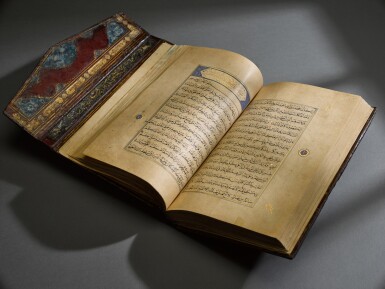
A large illuminated Qur'an, Persia, Safavid, early 16th century
Estimate
50,000 - 70,000 GBP
Lot Details
Description
Arabic manuscript on paper, 239 leaves, 15 lines to the page, written in naskh script in black ink, verses separated by pointed-blue gold roundels, surah headings in gold and white cursive script amidst foliate scrolls on gold and polychrome illuminated panels, margins ruled in gold and blue, illuminated marginal devices throughout, opening double-page illuminated in colours and gold with surah al-Fatihah and surah al-Baqarah in white script within central cusped medallions, the final three leaves with prayers, in floral lacquer binding with stamped central medallion and cornerpieces, with flap, leather doublures with remnants of filigree decoration at centre and corners, gilt-stamped borders
text panel: 22.6 by 12.5cm.
leaf: 32 by 21cm.
Ex-collection Georges de Bouteiller, French Ambassador to Saudi Arabia (1967-75);
Ex-private collection, France
The illumination of this manuscript shows the enduring influence of the Timurid tradition. In the second half of the fifteenth century, the blue-and-gold style of illumination was the most prolific in Timurid book production which paired an elegant, restricted palette with minute floral sprays. By 1467, the Timurids had lost most of Persia to the Aqqoyunlu confederation. As a result, the style became less popular in Timurid Shiraz but it persisted in the late fifteenth century in other centres as shown by a magnificent Qur’an in thirty parts produced for Ya’qub Beg (Wright 2012, p.80, see Sotheby’s, 23 October 2019, lot 121, 10 June 2020, lot 20, and Christie’s, London, 28 October 2020, lot 27).
The fine scrolling ground of the surah headings, framed by blue and gold spandrels with minute highlights of red are closely comparable to a Qur’an, attributed to Tabriz or Shiraz, circa 1480-90, in the Khalili Collection (inv. no.QUR4, see James 1992, pp.42-45, no.9). This manuscript also displays related khams and ‘ashr roundels to the Khalili manuscript. Similar surah headings further feature on a Qur’an of the same period sold in these rooms, 26 April 2023, lot 24. The double page illuminated frontispiece might also be related to a frontispiece dedicated to Sultan Khalil thus datable to 1478 in the Khalili collection (inv. no.MSS 1040) with both share a relatively spacious application of the arabesque spirals. The elongated ogival cartouche anticipates the form which would become prolific in Shiraz illumination later in the Safavid period, at which time the secondary floral motifs, arabesques and cloud bands would also go on to become more densely applied.
The use of lapis in the illumination of the present manuscript is notable. Instead of creating a contrast, the illuminator uses lapis as the ground colour for both the central panel and the inner border and therefore reduces the distinction between the two. As a result, the gilt ogival centre and corner cartouches appear to float delicately within a sea of arabesques and clouds.
On the final folio is a note in Ottoman Turkish recording the birth of Abbas Pasha (the future Khedive), son of Tusun Pasha the governor of Jeddah, on Saturday 16 Safar 1229 AH/7 February 1814 at four o’clock, however, this date is in fact a Monday and does not tally with the recorded date of Abbas Hilmi on 1 July 1812.
You May Also Like


