
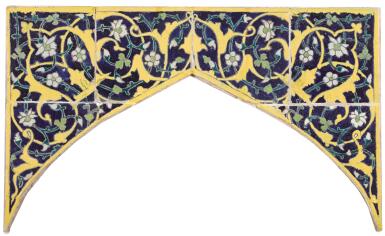
A monumental Safavid arched cuerda seca tile panel, Persia, first-quarter 16th century
Estimate
50,000 - 80,000 GBP
Lot Details
Description
forming the upper part of an archway, comprising six tiles decorated in the cuerda seca technique painted underglaze in yellow, cobalt blue and turquoise with scrolling split palmettes entwined with floral vines, set within a perspex block
93.7 by 56.5cm.
107.6 by 80 by 80cm. with mount
Bonhams, 2 September 1962, 'Property from an English Country Gentleman'
It is extremely rare to find monumental examples of early Safavid tile panels, and the present arched tile panel presents an outstanding model of the visual impact of the cuerda seca technique when used on a grand scale. Particularly beautiful is the way in which the split-palmettes curl and re-curl over each other forming a unified and symmetric design, enhanced by the addition of floral vines in between.
Cuerda seca, or 'dry cord', is used to describe a glazing technique by which various sections of decoration on a ceramic are isolated by a line of oily manganese dioxide powder. After firing, these dividing lines appear as dark and lustreless, but allow for the different colours to be pure and bright (Hattstein and Delius 2000, p.622). This technique dates back to Ancient Egypt and appears on the tiles in the palace of Ramses II in Qantir, before being disseminated with the dawn of Islam throughout the Middle East and Spain, where it became particularly popular (Soustiel 1985, p.384).
This lot is accompanied by a thermoluminescence analysis report confirming the given period of manufacture.
You May Also Like


